Cacatua galerita
Sulphur-crested Cockatoo (Cacatua galerita)
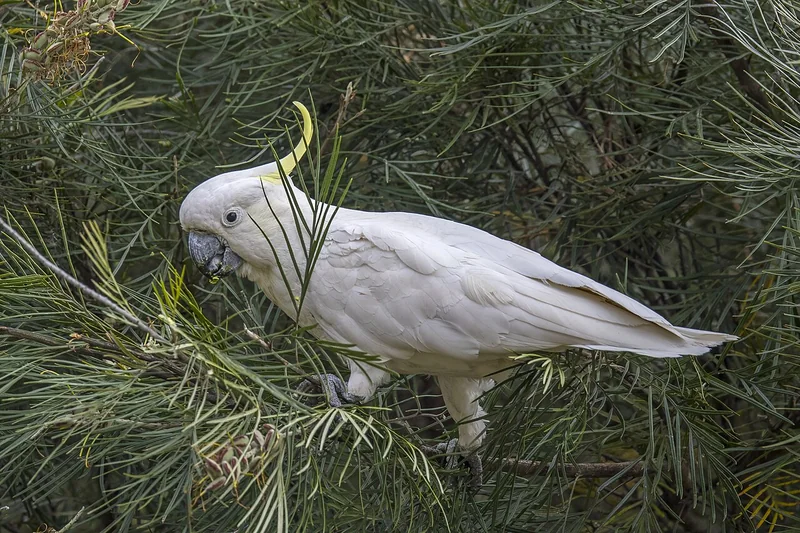 Featured photosulphur-crested-cockatoo.jpg
Cacatua galerita, the sulphur-crested cockatoo, is a large parrot of the family Cacatuidae, native to Australia and New Guinea. Adults are 44 to 55 cm long with a wingspan of 70 to 90 cm and weigh 0.7 to 0.95 kg. The plumage is mostly pure white with a bright sulphur-yellow erectile crest, yellow underwings, and a black bill. The IUCN lists the species as Least Concern. Sulphur-crested cockatoos have adapted readily to human-modified environments and are now common in suburban Australian cities.
Quick facts
- Habitat
- Eucalypt-dominated open woodland, savanna, agricultural land, and urban and suburban habitats with mature trees. The species is unusually tolerant of human-modified environments for a large parrot.
- Range
- Native to most of northern and eastern Australia, plus New Guinea and several adjacent islands. Introduced and established in New Zealand, Indonesia, and parts of Papua. Several Australian subspecies span the native range.
- Size
- 44–55 cm body · 70–90 cm wingspan · 0.7–0.95 kg
- Plumage
- Adults are uniformly white throughout the body, wings, and tail, with a brilliant erectile sulphur-yellow crest above the head, a fine wash of yellow on the underwings and undertail, and pale-blue bare skin around the eyes. The bill is heavy and entirely black. Both sexes look alike; female eyes are reddish, male eyes are darker brown — the only reliable sex difference in the field.
- Song
- An extremely loud, raucous screech delivered both in flight and from a perch. Communal flocks at evening roosts produce a deafening collective chorus. The species is also an accomplished vocal mimic and reproduces ambient sounds of its environment.
- Migration
- Sedentary across the native range. Local seasonal movements between food sources occur but no regular migration. Some Australian populations make short-distance autumn movements within their range.
- Conservation
- Least Concern (LC)
Overview
Cacatua galerita is one of about twenty-one Cacatua cockatoo species. The species' Latin epithet 'galerita' means 'crested' or 'helmeted' — a reference to the bright yellow erectile crest that gives the species its English name. Several Australian subspecies are recognized, differing slightly in body size and crest detail; the introduced New Zealand population descends from twentieth-century releases.
Distribution and urban populations
The native range covers most of northern and eastern Australia, New Guinea, and several adjacent islands. Sulphur-crested cockatoos have adapted readily to human-modified environments — Australian suburban cities including Sydney, Melbourne, and Canberra now host year-round resident populations that feed on lawn grass, ornamental fruit trees, and bird-feeder offerings. The urban populations have learned local foraging techniques (such as opening household rubbish bins) that spread through social transmission within local flocks.
Cognition and social behaviour
Sulphur-crested cockatoos are highly social and form long-term pair bonds within larger flocks. The species is among the more cognitively studied cockatoos, with evidence of tool use, social learning, and complex play behaviour in both wild and captive populations. Sydney suburban flocks have learned coordinated rubbish-bin-opening techniques that vary by neighbourhood — different local 'cultures' of bin manipulation that spread by social observation between birds.
Sources & further reading (2)
- iucn-red-list — accessed 2026-04-30
- encyclopedia — accessed 2026-04-30
Frequently asked questions
Why does the cockatoo have an erectile crest?
The bright yellow crest is raised in display, alarm, and excitement, and lowered against the head when the bird is at rest. The contrast against the white body plumage maximizes visual signalling — both intra-flock communication and warning to predators. The crest is composed of long modified head feathers; the colour is structural in part (white from feather microstructure) and pigmentary in part (yellow from carotenoids). The same display function is found across cockatoo species.
How have urban cockatoos learned to open rubbish bins?
Suburban Sydney populations have learned coordinated techniques for opening household rubbish bins — flipping the lid, moving the lid aside, manipulating the bin's locking mechanism. Field studies have shown the techniques vary by neighbourhood and spread through social learning between birds. Different local 'cultures' of bin-opening exist within metropolitan Sydney, separated by only a few kilometres. The phenomenon is one of the textbook examples of social learning of foraging techniques in birds.
Are sulphur-crested cockatoos pests in Australia?
Wild flocks feed heavily on cereal-grain crops in some Australian agricultural regions, occasionally causing measurable crop damage. The species is locally regarded as an agricultural pest in wheat-growing areas, particularly when large flocks settle on a single crop. The species is also notable for chewing on wooden fittings, electrical cable insulation, and outdoor furniture in suburban settings — a behaviour driven by the parrot's continuously growing bill that needs hard substrates to wear down.