Pulsatrix perspicillata
Spectacled Owl (Pulsatrix perspicillata)
 Featured photospectacled-owl.jpg
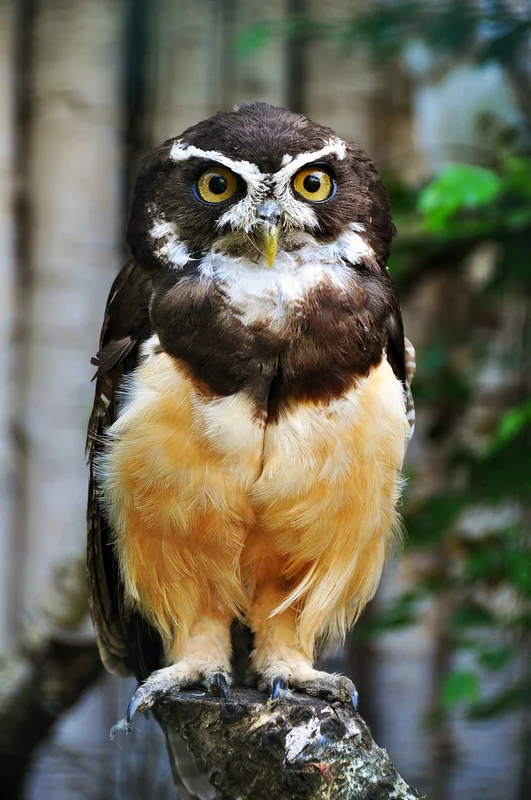
Pulsatrix perspicillata, the spectacled owl, is a large owl of the family Strigidae and the most widespread large owl of the Neotropical rainforest. Adults are 43 to 52 cm long with a wingspan of 76 to 91 cm and weigh 453 to 900 g. The species is immediately recognised by its dark brown head and upper breast, contrasting white facial disc outlined by a dark rim — the 'spectacles' — and yellow-orange eyes. The IUCN lists the species as Least Concern.
Quick facts
- Habitat
- Humid tropical and subtropical lowland and foothill rainforest, gallery forest, and forest edges from sea level to about 1,500 m. Prefers mature forest with tall trees for roosting and nesting. Occasionally forages in adjacent open areas at night.
- Range
- Neotropical: from southern Mexico through Central America south through South America to Bolivia, Brazil, Paraguay, and northern Argentina. The most widespread large Neotropical owl.
- Size
- 43–52 cm body · 76–91 cm wingspan · 453–900 g
- Plumage
- Adults show a broad, dark chocolate-brown hood covering the head and upper breast, a cream-to-white lower breast and belly, and a distinctive white facial disc bordered by a dark brown rim — the 'spectacles'. The eyes are bright yellow-orange. Juveniles show a strikingly different reverse pattern — white head and breast with a dark facial disc — that is maintained for up to a year. The tarsi are feathered.
- Song
- A deep, resonant 'poo-poo-poo-poo-poo' series, gradually becoming louder and more rapid — one of the most powerful and far-carrying owl vocalisations of the Neotropical forest. Also produces a variety of barks, shrieks, and soft hoots.
- Migration
- Sedentary. The species maintains year-round territories in mature forest and does not migrate.
- Conservation
- Least Concern (LC)
Overview
Pulsatrix perspicillata is the largest and most widespread species in the small genus Pulsatrix, which contains two other Latin American owls — the tawny-browed owl (P. koeniswaldiana) and the band-bellied owl (P. melanota). The three Pulsatrix owls are distinguished from other large tropical owls by their distinctive 'spectacled' facial pattern. The genus name Pulsatrix derives from the Latin 'pulsare', meaning 'to beat or strike' — a reference to the powerful, resonant call. The species name perspicillata means 'spectacled' in Latin.
Striking juvenile plumage
Juvenile spectacled owls are among the most distinctive young birds of any raptor, showing a nearly complete reversal of the adult colour pattern — a white head and breast contrasting with a dark facial disc, rather than the adult's dark hood and white facial disc. This reversed juvenile pattern persists for up to 18 months before the bird gradually moults into adult plumage. The adaptive significance of the reversed pattern is not fully understood but may serve to reduce aggression from territorial adults or may function as a distinct cryptic pattern for juveniles in the forest understorey.
Nocturnal ecology and territory
Spectacled owls are strictly nocturnal, roosting communally (usually in pairs) in dense forest canopy during the day and hunting from low-to-mid-canopy perches at night. Territories are large — several hundred hectares in intact rainforest — and pairs vocalise to maintain them, particularly at dusk and dawn. The species is sensitive to forest fragmentation: it rarely crosses open areas and struggles to persist in small isolated forest patches. It is thus a useful indicator of intact lowland rainforest in the Neotropics.
Sources & further reading (2)
- iucn-red-list — accessed 2026-05-07
- encyclopedia — accessed 2026-05-07
Frequently asked questions
Why do juvenile spectacled owls look so different from adults?
Juvenile spectacled owls show a nearly complete reversal of the adult pattern — a white head and breast with a dark facial disc, compared to the adult's dark hood and white facial disc. This reversed plumage is maintained for up to 18 months. The adaptive reason is not fully understood but may reduce aggression from territorial adults encountering young birds, or may provide cryptic patterning suited to the forest understorey where juveniles spend their first year.
How does the spectacled owl hunt?
The spectacled owl is a perch-and-pounce hunter — it sits motionless on a forest perch, listening and watching for the movement and sounds of small mammals, large insects, frogs, and lizards below. When prey is detected, the owl swoops silently to the forest floor or understorey to seize it with powerful talons. The species can take surprisingly large prey — small opossums, large frogs, and small porcupines have been documented.
Is the spectacled owl the largest owl in Central America?
Yes — the spectacled owl is the largest owl occurring regularly in Central America and is also the most widespread large Neotropical owl, ranging from southern Mexico to northern Argentina. It is exceeded in size only by the harpy eagle among Neotropical raptors, and in the owl world is surpassed in size only by the great horned owl in parts of its range. The spectacled owl's mass (up to 900 g) puts it in the upper range of Neotropical owl size.