Bucorvus leadbeateri
Southern Ground Hornbill (Bucorvus leadbeateri)
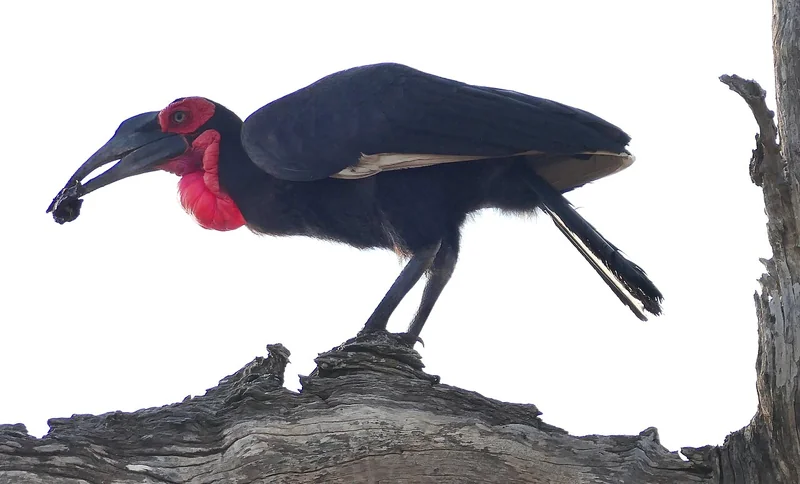 Featured photosouthern-ground-hornbill.jpg
Bucorvus leadbeateri, the southern ground hornbill, is the largest hornbill species in the world, standing up to 129 cm tall with a wingspan of 120 to 140 cm and weighing 3.5 to 6.2 kg. Restricted to sub-Saharan Africa, it is a terrestrial predator of grasslands and open savanna, hunting cooperatively in family groups. The IUCN lists the species as Vulnerable due to its extremely slow breeding rate and declining populations outside protected areas.
Quick facts
- Habitat
- Open savanna, grassland, and open woodland in sub-Saharan Africa — associated with areas containing large trees for nesting and roosting combined with open ground for foraging. Requires large territories of intact savanna. Found in national parks and game reserves more commonly than in agricultural landscapes.
- Range
- Sub-Saharan Africa from Kenya and Uganda south to South Africa (primarily northern KwaZulu-Natal and Limpopo) and west to Angola and Namibia. South Africa holds a significant portion of the global population, mostly within the Kruger National Park and surrounding private reserves.
- Size
- 90–129 cm body · 120–140 cm wingspan · 3500–6200 g
- Plumage
- Adults are entirely black except for vivid red facial and throat skin in males (the female has a patch of violet-blue within the red throat skin) and white primary feathers visible in flight. The bill is large and curved, black, without a prominent casque. Immature birds have yellowish-grey facial skin that gradually reddens with age, reaching adult coloration at around 4–6 years.
- Song
- A deep, booming 'oom-pom-pom' or 'woum-woum' given by groups in a coordinated chorus — one of the most resonant and far-carrying calls on the African savanna, audible from several kilometres away. Groups typically call before dawn from roosting sites.
- Migration
- Sedentary. Groups maintain large permanent territories of 25–100 km² and do not migrate. Territory boundaries are defended year-round.
- Conservation
- Vulnerable (VU)
Overview
Bucorvus leadbeateri is one of two ground hornbill species (the other is the Abyssinian ground hornbill, B. abyssinicus, of northern and East Africa) and a member of the subfamily Bucorvinae — a lineage that diverged early from other hornbills and is now classified in a separate family by some authorities. Southern ground hornbills are unusual among hornbills in being predominantly terrestrial, spending most of their time walking across open ground rather than in trees. They are the largest flying birds in Africa by height and one of the largest flying birds globally.
Cooperative breeding and slow reproduction
Southern ground hornbills have one of the slowest reproductive rates of any African bird — a successful breeding pair typically raises only one chick every nine years on average under natural conditions. Groups of two to nine individuals occupy territories; typically one dominant breeding pair and several subordinate helpers (offspring from previous years). The single egg is incubated by the female in a large tree cavity lined with leaves, and the chick takes approximately three months to fledge. Even after fledging, the juvenile remains dependent on the group for up to two years. This prolonged juvenile dependence and the very slow rate of successful breeding makes the species highly sensitive to any additional mortality or habitat disruption.
Conservation and cultural significance
The southern ground hornbill is classified as Vulnerable by the IUCN and is listed as Endangered in South Africa. The primary threats are habitat loss (agricultural conversion of savanna), persecution (shooting and poisoning), secondary poisoning from pesticide-laced carcasses, and the slow natural breeding rate that means populations recover very slowly from any losses. Conservation efforts in South Africa include the Southern Ground Hornbill Conservation Project, which operates chick fostering programs — removing and hand-rearing the second-hatched chick (which normally dies within a fortnight as the first-hatched pushes it out) and returning it to the wild as a helper bird. The species is venerated in many southern African cultures and is associated with rain-calling ceremonies in some communities.
Sources & further reading (2)
- iucn-red-list — accessed 2026-05-07
- encyclopedia — accessed 2026-05-07
Frequently asked questions
Why does the southern ground hornbill breed so slowly?
Southern ground hornbills have an extremely slow reproductive rate — typically producing only one successfully fledged chick every nine years per group. This is partly because the second egg or chick almost always dies (the firstborn sibling kills the second), and partly because the juvenile remains dependent on the group for up to two years after fledging. The breeding pair also typically waits until previous offspring leave the group before breeding again successfully. This life-history strategy is associated with long lifespan (up to 40–50 years in the wild) but makes the species highly sensitive to increased mortality or habitat loss.
Will a southern ground hornbill attack venomous snakes?
Yes — southern ground hornbills regularly hunt and kill venomous snakes, including puff adders, cobras, and other species. The bird uses a combination of quick strikes with the powerful bill, retreating after each strike, and stamping on the snake's body to immobilise it. The bill and feet can deliver forceful blows. The species does not have any specific resistance to venom, so accuracy and avoidance of bites is important. Tortoises are also taken — the bird hammers the shell until it can extract the animal.
What is the deep booming call of the ground hornbill used for?
The deep booming 'oom-pom-pom' chorus given by southern ground hornbill groups before dawn is a territorial proclamation — advertising the group's presence to neighbouring groups and reinforcing territorial boundaries. The call carries for several kilometres across open savanna. Groups calling simultaneously produce a powerful coordinated chorus. The deep resonance is amplified by the bird's large body and extensive air sac system. The species has long been associated in southern African tradition with thunderstorms and rain — its booming call was interpreted as a rain omen by some communities.