Buceros bicornis
Great Hornbill (Buceros bicornis)
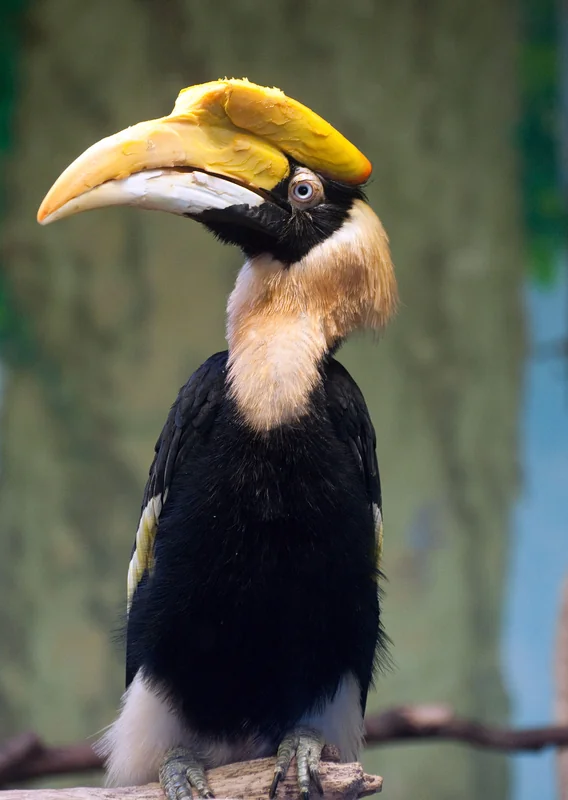 Featured photogreat-hornbill.jpg
Buceros bicornis, the great hornbill, is one of the largest hornbills in the world. Adults are 95 to 130 cm long with a wingspan of 1.52 m and weigh 2.15 to 4 kg. The plumage is black with a white belly and white wing-band, plus a brilliant yellow neck and a striking yellow casque atop the bill. The IUCN lists the species as Vulnerable, reflecting major habitat loss across much of the range. The species is the state bird of Kerala (India) and Arunachal Pradesh.
Quick facts
- Habitat
- Mature wet tropical and subtropical forest at elevations from sea level to 2,000 metres. The species depends on intact mature forest with large fruiting fig trees and tall hollow trees for nesting cavities.
- Range
- South Asia (Indian Western Ghats, the Himalayan foothills, Bhutan, Nepal, Bangladesh) and Southeast Asia (Myanmar, Thailand, Indochina, the Malay Peninsula, Sumatra). The species' range has been substantially reduced by deforestation; many populations are now restricted to protected areas.
- Size
- 95–130 cm body · 152 cm wingspan · 2.15–4 kg
- Plumage
- Adults show black body, head, and tail with a clean white belly and undertail, a bright yellow neck and chest (the colour transferred from preening with yellow oil from a uropygial gland), and a striking yellow casque atop the bill. The casque has the appearance of a second bill stacked above the actual bill — the source of the species' Latin epithet 'bicornis' ('two-horned'). Females have shorter casques and reddish eyes; males have larger casques and white eyes.
- Song
- Loud, deep barking 'kok-kok-kok' calls delivered from high perches in the canopy. The wingbeat in flight produces a loud whoosh that carries hundreds of metres through forest — the species is often heard before being seen.
- Migration
- Sedentary across the breeding range. Local seasonal movements between fruiting trees occur but no regular migration.
- Conservation
- Vulnerable (VU)
Overview
Buceros bicornis is the largest of three Buceros hornbill species (with the rhinoceros hornbill B. rhinoceros and the helmeted hornbill B. vigil). The species' enormous size, dramatic casque, and loud call have made it a culturally significant bird across much of South and Southeast Asia. The species is the state bird of the Indian states of Kerala and Arunachal Pradesh.
Conservation status
The IUCN lists great hornbill as Vulnerable, reflecting major habitat loss across much of the range. The species depends on mature tropical forest with large fig trees and tall hollow trees for nesting cavities — both have been substantially reduced by logging, agricultural conversion, and infrastructure expansion across South and Southeast Asia. Local populations are also affected by hunting for meat, the casque (carved into ornaments), and the live-bird trade.
Nesting biology
Great hornbills (like all Bucerotidae hornbills) have an extraordinary nesting biology. The female enters a tree-cavity nest and the pair seals the entrance with mud, dung, and food scraps until only a small slit remains — wide enough for the male to pass food through but too narrow for predators to enter. The female remains sealed inside for months while incubating and brood-rearing, dependent entirely on the male's food deliveries. After the chicks fledge, the family breaks out the seal and the female and chicks emerge. The behaviour is one of the most distinctive nesting strategies in any bird family.
Sources & further reading (2)
- iucn-red-list — accessed 2026-04-30
- encyclopedia — accessed 2026-04-30
Frequently asked questions
What is the casque on top of the bill for?
The yellow casque atop the great hornbill's bill is hollow and structurally light despite its impressive size. Functions are debated and likely multiple: visual display in mate choice and territorial signalling (males with larger casques have higher dominance), amplification of vocalizations as a resonance chamber, and possibly aiding dominance in head-pushing aggressive interactions. The casque is one of the most distinctive bill ornaments in any bird family.
Why do hornbills seal their nests?
All Bucerotidae hornbills have an extraordinary nesting strategy. The female enters a tree cavity and the pair seals the entrance with mud, dung, and food scraps until only a small slit remains — wide enough for the male to pass food through but too narrow for predators (snakes, monitor lizards, raptors) to enter. The female remains sealed inside for months while incubating and brood-rearing, dependent entirely on the male's deliveries. The seal is broken out only after the chicks are ready to fledge.
Why is the great hornbill important for forest ecosystems?
The species is one of the most important seed dispersers in the Asian tropical forests it inhabits. Great hornbills feed heavily on figs and other large fruits and disperse the seeds widely through the forest as they range between fruiting trees. The loss of hornbill populations from logged or fragmented forests substantially reduces the dispersal of large-seeded canopy trees, with cascading effects on forest regeneration. The species is therefore a 'keystone' frugivore for Asian tropical forest ecology.