Fratercula arctica
Atlantic Puffin (Fratercula arctica)
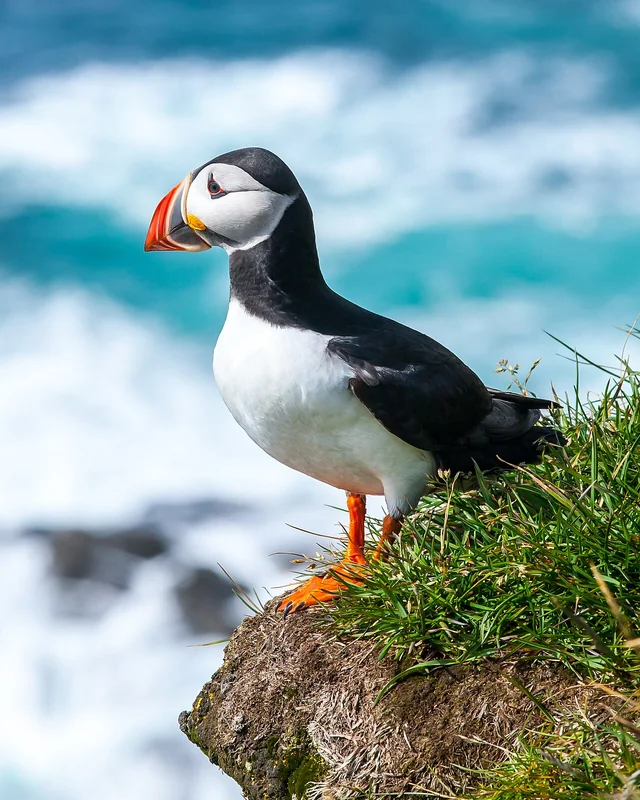 Featured photoatlantic-puffin.jpg
Fratercula arctica, the Atlantic puffin, is a medium-small seabird of the family Alcidae. Adults are 28 to 30 cm long with a wingspan of 47 to 63 cm and weigh 320 to 480 g. The summer plumage is sharply pied — black back and head, white face and underparts — with a brilliantly coloured triangular bill. The IUCN lists the species as Vulnerable, reflecting recent declines linked to changes in North Atlantic prey fish populations. Atlantic puffins 'fly' underwater using their wings, the typical alcid foraging style.
Quick facts
- Habitat
- Coastal cliffs and grassy island slopes for breeding; the open North Atlantic Ocean for the rest of the year. The species spends most of the year far from land and is rarely seen ashore outside the breeding season.
- Range
- North Atlantic — breeds on cliffs and islands of Iceland, the British Isles, Norway, Faroe Islands, Greenland, eastern Canada, and the northeastern United States. Winters across the open North Atlantic, sometimes reaching the Mediterranean.
- Size
- 28–30 cm body · 47–63 cm wingspan · 320–480 g
- Plumage
- Summer adults show black back, head crown, and nape; a clean white face surrounded by a fine grey-black eye-patch; pure white underparts; and the diagnostic triangular bill in vivid red, orange, and yellow stripes. The bill plates moult off in late summer; winter adults have a smaller dull-grey bill and a darker grey face. The contrast between summer and winter plumages is dramatic.
- Song
- Mostly silent at sea. At breeding colonies, gives soft growling and grunting calls from inside the burrow — a sound likened to a chainsaw at a distance. The species is famously quiet for a colonial seabird.
- Migration
- Strongly pelagic outside the breeding season. Most populations winter across the open North Atlantic, far from any coast; some birds reach the Mediterranean. Birds return to breeding colonies in late spring.
- Conservation
- Vulnerable (VU)
Overview
Fratercula arctica is one of three Fratercula puffin species worldwide (with the larger horned puffin F. corniculata and the tufted puffin F. cirrhata of the North Pacific). The family Alcidae — auks, murres, puffins, and guillemots — is the Northern Hemisphere's ecological analogue of the Southern Hemisphere's penguins; both groups 'fly' underwater using their wings. The species' dramatic seasonal bill colour change is one of the most distinctive plumage features of any North Atlantic seabird.
Conservation status
The Atlantic puffin was uplisted to Vulnerable on the IUCN Red List in 2015 reflecting evidence of significant population decline across much of the species' range. Drivers include shifts in North Atlantic prey-fish populations (sand eels, herring, capelin), particularly linked to warming sea-surface temperatures, plus continued mortality from oil spills, fisheries bycatch, and historical overharvest. Several major colonies have shown breeding failure in recent years.
Behaviour
Atlantic puffins breed in dense colonies on coastal cliffs and grassy island slopes. Pairs nest in burrows excavated into peaty soil or rock crevices, laying a single egg per year. Adults can carry up to a dozen small fish back to the burrow at once, held crosswise in the bill — the famous 'beakful of fish' image used in nature documentaries. The species' triangular bill has fine spines along the upper palate that hold each fish in place while the next is added.
Sources & further reading (2)
- iucn-red-list — accessed 2026-04-29
- encyclopedia — accessed 2026-04-29
Frequently asked questions
How do puffins carry so many fish in their bills?
An Atlantic puffin's triangular bill has fine backward-facing spines along the upper palate. Each captured fish is held crosswise against the spines while the bird continues to dive and capture additional fish. Ten or more fish per beakful is documented, with the record around twenty. The captured fish are carried back to the burrow whole and fed directly to the chick — the 'beakful of fish' image is one of the most familiar nature-documentary visuals.
Why does the puffin's bill change colour seasonally?
The bright triangular bill of the breeding adult is composed of seasonal plates over the underlying bone. The plates moult off in late summer and the winter bill is much smaller and dull grey. The bright colour is sexually selected — pairs returning to the colony in spring use the bill colour as a mate-recognition and pair-bonding signal. The dramatic seasonal change between vivid summer and dull winter bill is unique among North Atlantic seabirds.
Why are Atlantic puffins listed as Vulnerable?
The IUCN uplisted the species to Vulnerable in 2015 reflecting evidence of significant population decline. Major North Atlantic colonies have shown reduced breeding success linked to changes in prey-fish populations (sand eels, herring, capelin) tied to warming sea-surface temperatures. Continued mortality from historical hunting in some regions (Iceland, Faroe Islands) and from oil spills and fisheries bycatch contribute. Several major colonies have suffered breeding failure in recent years.