Harpia harpyja
Harpy Eagle (Harpia harpyja)
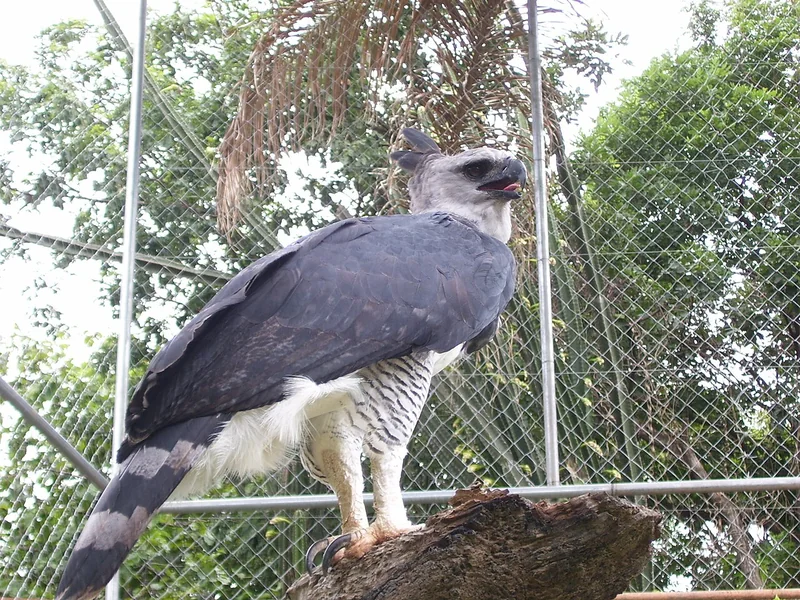 Featured photoharpy-eagle.jpg
Harpia harpyja, the harpy eagle, is the largest and most powerful eagle of the Americas and one of the largest eagles in the world. Adults are 86 to 107 cm long with a wingspan of 176 to 224 cm; females weigh up to 9 kg. The species hunts large arboreal mammals — sloths and monkeys — through the rainforest canopy with extraordinary agility. The IUCN lists the species as Vulnerable, with a declining population due to deforestation and hunting.
Quick facts
- Habitat
- Lowland tropical rainforest and adjacent foothill forest, primarily below 900 m. Requires extensive tracts of mature tall-canopy forest for nesting and hunting. Sensitive to logging and forest fragmentation — one of the first species to disappear from disturbed forest.
- Range
- Neotropical: from southern Mexico through Central America (now rare) south through Amazonia to Bolivia, Brazil, and northeastern Argentina. The largest remaining populations are in the Brazilian Amazon and the Guiana Shield.
- Size
- 86–107 cm body · 176–224 cm wingspan · 4000–9000 g
- Plumage
- Adults have a pale grey head with a distinctive split double crest (unique among large eagles), a white face and supercilium, a dark grey-black upper breast band, white lower breast and belly, dark grey-black upperparts, and a long banded tail. The eyes are pale grey. The bill is large and strongly hooked; the talons are enormous — the rear talons of a large female reach 12.5 cm, comparable to a grizzly bear's claws.
- Song
- A series of mournful, wavering shrieks and whistles — rarely heard but far-carrying. The call is more frequently heard near the nest during the breeding season. Juveniles are noisier than adults.
- Migration
- Sedentary. Adults maintain very large territories — up to 100 km² per pair — and do not migrate. Territories are permanent and pairs use the same nest tree for many years.
- Conservation
- Vulnerable (VU)
Overview
Harpia harpyja is the sole member of its genus and is the national bird of Panama. It is named after the Harpies of Greek mythology — winged spirits that seized people and carried them away — reflecting the species' extraordinary power and the terror it evokes in its prey. The species is the national bird of Panama. The harpy eagle's nearest relatives are the Philippine eagle (Pithecophaga jefferyi) and the Papuan eagle (Harpyopsis novaeguineae), and together these large forest eagles represent convergent evolution of a similar apex predator role in three separate rainforest systems.
Aerial pursuit through the canopy
The harpy eagle hunts large arboreal mammals with extraordinary agility through the closed canopy of Amazonian rainforest. The relatively short, broad wings and long tail allow tight manoeuvring through forest gaps, accelerating suddenly to chase prey through the trees. The eagle locates prey visually or by the sounds of movement in the canopy, then launches a pursuit that may involve chasing a monkey or sloth through several hundred metres of dense canopy before the prey is seized with the talons. The rear talons of a large female are comparable in size to a grizzly bear's claws and can crush the prey's spine on impact.
Slow reproduction and vulnerability
Harpy eagles have one of the slowest reproductive rates of any eagle. A pair raises only one chick at a time, and the nestling remains in or near the nest for up to 18 months — one of the longest nestling periods of any eagle. After fledging, the young eagle may remain dependent on its parents for 2–3 years. As a result, a successful pair raises only one chick every two to three years. This exceptionally slow rate means that adult mortality from hunting or that habitat loss translates rapidly into population decline. The species is IUCN Vulnerable and has disappeared from much of its former range in Central America.
Sources & further reading (2)
- iucn-red-list — accessed 2026-05-07
- encyclopedia — accessed 2026-05-07
Frequently asked questions
How big are the harpy eagle's talons?
The rear talons (hallux talons) of a large female harpy eagle reach approximately 12.5 cm — comparable in size to a grizzly bear's claws and among the largest talons of any eagle in the world. These massive talons allow the eagle to seize and crush the spine or skull of large prey such as sloths and monkeys with a single strike. The front talons are shorter but still formidable. Male harpy eagles are substantially smaller than females, with proportionally smaller talons.
What does the harpy eagle eat?
The harpy eagle's primary prey are large arboreal mammals — particularly two-toed and three-toed sloths and various monkey species (howler, capuchin, woolly, spider monkeys). Sloths are thought to be the most frequently taken prey in many study areas. The eagle also takes large opossums, kinkajous, coatis, agoutis, large birds, and reptiles. A single adult eagle may kill and consume approximately 200–300 prey animals per year within its large territory.
Why is the harpy eagle Vulnerable?
The harpy eagle is classified as Vulnerable because its global population has declined due to deforestation — which removes the mature tall-canopy rainforest it requires — and direct persecution from hunters. The species is one of the first to disappear from logged or fragmented forest. Its extremely slow reproductive rate (one chick every 2–3 years) means populations recover very slowly from adult mortality. The species has already been eliminated from much of Central America and is reduced to small populations in many parts of its range.