Melospiza melodia
Song Sparrow (Melospiza melodia)
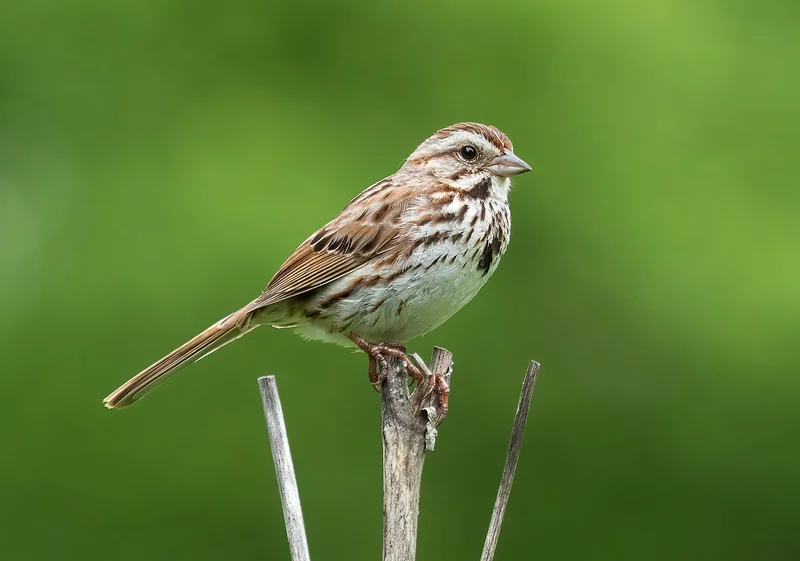 Featured photosong-sparrow.jpg
Melospiza melodia, the song sparrow, is a medium-sized New World sparrow of the family Passerellidae. Adults are 11 to 18 cm long with a wingspan of 18 to 24 cm and weigh 12 to 53 g (varies enormously across the species' subspecies range). The plumage is streaked brown above and below with a central dark breast spot. The IUCN lists the species as Least Concern. The song sparrow is one of the most geographically variable small songbirds in North America, with over twenty named subspecies.
Quick facts
- Habitat
- Brushy edges, hedgerows, marshes, weedy fields, and suburban gardens. The species occupies an unusually wide habitat range across its continental distribution.
- Range
- Across most of North America from southern Alaska and Canada south through the United States to northern Mexico. The species' range covers a wider habitat span — coastal salt marsh to high mountain canyon to suburban hedgerow — than almost any other small American sparrow.
- Size
- 11–18 cm body · 18–24 cm wingspan · 12–53 g
- Plumage
- Adults show heavily streaked brown upperparts and a streaked white-and-brown breast that converges into a central dark spot. The face has a grey supercilium and a brown crown with a paler central crown stripe. Subspecies vary dramatically — Aleutian song sparrows (M. m. maxima) are nearly twice the body mass of southwestern desert subspecies — but the streaky breast spot is consistent across the species' range.
- Song
- A loud, varied phrase opening with two or three clear introductory notes (often 'sweet sweet sweet') followed by a rapid trill or buzz. Each male has a small repertoire of distinct song types; song matches between neighbouring territory holders are documented.
- Migration
- Partial migrant. Northern populations move south for winter; populations across the central US and the Pacific coast are largely resident.
- Conservation
- Least Concern (LC)
Overview
Melospiza melodia is one of three Melospiza species (with Lincoln's sparrow M. lincolnii and the swamp sparrow M. georgiana). Among small sparrows, the song sparrow is unusually geographically variable: over thirty described subspecies span coastal Aleutian populations almost twice the size of southwestern desert populations, and plumage tones from rich rufous to grey-brown. The species is also one of the longest-studied wild songbird populations, with continuous research at Mandarte Island, British Columbia, since 1975.
Distribution
The breeding range covers most of forested and edge habitat across North America from southern Alaska to northern Mexico. The species occupies an exceptionally wide habitat range — coastal salt marsh, high alpine canyon, suburban hedgerow, weedy farmland — and shows correspondingly strong subspecific variation in size, bill shape, and plumage saturation.
Song dialects
Song sparrows learn their song from older males in the natal area during the first year of life, producing well-defined regional dialects. Long-running studies show that neighbouring males share most of their song repertoire, while territories several kilometres apart have distinct song types. The pattern is one of the textbook examples of cultural transmission of song dialect in birds.
Sources & further reading (2)
- iucn-red-list — accessed 2026-04-29
- encyclopedia — accessed 2026-04-29
Frequently asked questions
Why are song sparrows so geographically variable?
The species occupies an exceptionally wide range of habitats across the North American continent — coastal salt marsh, suburban hedgerow, high mountain canyon, Aleutian island shoreline. Local adaptation to these very different environments has produced over thirty named subspecies. Aleutian song sparrows are nearly twice the body mass of southwestern desert song sparrows, and plumage tones range from saturated rufous-brown to pale grey-buff.
What is the breast spot for?
The central dark breast spot is the most consistent field mark across the species' subspecies range and is a useful identification cue separating the song sparrow from other streaky brown sparrows. The functional or sexual-selection significance of the spot is not well understood — it appears in both sexes and across all subspecies. The trait may simply be a phylogenetic legacy of the genus rather than the target of current selection.
Do song sparrows really sing year-round?
Resident populations sing through every month of the year, though most intensively in spring. The female of some populations also sings, especially in coastal subspecies. The song serves both territory defence and mate attraction; the year-round territoriality of resident populations corresponds to year-round song. Migratory northern populations sing only seasonally, in the breeding range.