Anser caerulescens
Snow Goose (Anser caerulescens)
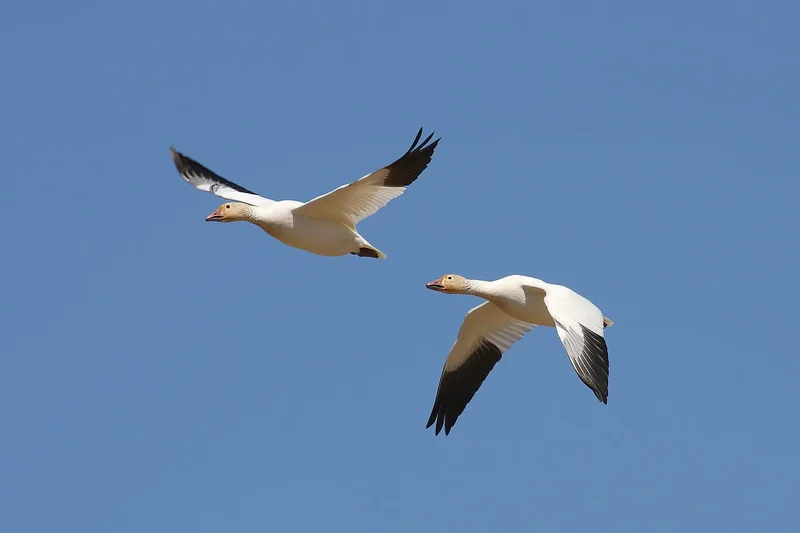 Featured photosnow-goose.jpg
Anser caerulescens, the snow goose, is a medium-sized Arctic-breeding goose. Adults are 64 to 79 cm long with a wingspan of 1.35 to 1.65 m and weigh 2 to 3 kg. The species has two distinct colour morphs — a white morph with black wingtips and a 'blue morph' with grey-blue body and white head. The IUCN lists the species as Least Concern. North American snow goose populations have grown explosively over recent decades to the point that some populations are considered overabundant.
Quick facts
- Habitat
- Arctic tundra during the breeding season; agricultural fields, coastal marshes, and large open wetlands during winter. The species' shift to agricultural feeding has driven dramatic population growth.
- Range
- Breeds across the high Arctic of North America from northern Alaska east through Canada to Greenland and small populations on Wrangel Island in the Russian Arctic. Winters in the southern United States and northern Mexico, particularly the Gulf coast, central California, and the Mississippi River delta.
- Size
- 64–79 cm body · 135–165 cm wingspan · 2–3 kg
- Plumage
- Two distinct colour morphs occur, both within the same species. White-morph adults are pure white throughout the body with conspicuous black wingtips visible in flight and a pink bill. Blue-morph adults show a dark grey-blue body with a clean white head and neck. Both morphs occur within the same flocks and breeding pairs, and morphs interbreed freely. Juveniles of both morphs are duller grey-brown.
- Song
- A loud nasal honking 'aow-aow-aow' delivered both in flight and from the ground. Migrating V-formations vocalize continuously; the call carries kilometres across open Arctic and coastal habitat. Snow goose flocks are among the most acoustically obvious migration spectacles in North America.
- Migration
- Long-distance migrant. Arctic breeders travel south to the southern United States and Mexico — typical annual round-trips are 4,000-6,000 km. Migration concentrations along the Mississippi and Pacific flyways can reach hundreds of thousands of geese per stopover.
- Conservation
- Least Concern (LC)
Overview
Anser caerulescens is one of about ten Anser goose species worldwide. The blue and white morphs were once thought to be separate species (the 'blue goose'), but molecular evidence has confirmed they are the same species with a simple Mendelian colour polymorphism.
Population growth
North American snow goose populations have grown explosively over the late twentieth century — the central Arctic population approximately tripled between 1970 and 2000. The shift to feeding on agricultural waste grain in the southern wintering range substantially increased winter survival; combined with reduced market hunting and protected breeding tundra, the population has reached levels that some authorities consider overabundant. Tundra vegetation damage at major breeding colonies has prompted special hunting regulations.
Colour polymorphism
Snow geese exhibit a clear two-morph colour polymorphism — white-morph and blue-morph adults occur within the same flocks and breeding pairs. The polymorphism is determined by a single autosomal locus with the blue allele dominant. Mate choice is positively assortative — birds tend to choose mates of the same morph as their own parents — which maintains both morphs in the population without driving either to fixation.
Sources & further reading (2)
- iucn-red-list — accessed 2026-04-30
- encyclopedia — accessed 2026-04-30
Frequently asked questions
What's the difference between snow goose colour morphs?
Snow geese occur in two colour morphs within the same species. White-morph adults are pure white with black wingtips and a pink bill. Blue-morph adults show a dark grey-blue body with a white head and neck. Both morphs interbreed freely, and morph mate choice is positively assortative — birds tend to choose mates of the same morph as their own parents. The polymorphism is determined by a single autosomal gene with blue dominant over white.
Why have snow goose populations grown so explosively?
North American snow goose populations approximately tripled between 1970 and 2000. The drivers were the shift to agricultural waste-grain feeding in the southern wintering range, reduced market hunting, and protected breeding tundra. The population has reached levels that some authorities consider overabundant — tundra vegetation damage at major breeding colonies has prompted special expanded-bag hunting regulations to slow population growth.
Are blue and snow geese the same species?
Yes — modern molecular evidence confirms that 'blue goose' and 'snow goose' are simply the two colour morphs of a single species (Anser caerulescens). The two were once thought to be separate species, and older field guides may list them separately. The morphs interbreed freely within mixed flocks; morph determination is a single Mendelian locus with blue dominant. The polymorphism is one of the textbook examples in undergraduate genetics.