Plectrophenax nivalis
Snow Bunting (Plectrophenax nivalis)
 Featured photosnow-bunting.jpg
Plectrophenax nivalis, the snow bunting, is a passerine bird of the family Calcariidae that breeds further north than any other songbird — reaching latitudes above 82°N in the High Arctic. Adults are 15 to 18 cm long with a wingspan of 32 to 38 cm and weigh 28 to 50 g. Breeding males are strikingly white and black; wintering birds show warm buff-brown tones. The IUCN lists the species as Least Concern. Wintering flocks swirl over coastal fields like drifting snowflakes.
Quick facts
- Habitat
- Breeds in rocky tundra, scree slopes, boulder fields, cliff faces, and rocky coasts of the High Arctic and alpine zones. Winters on open coastal and agricultural land, sandy beaches, salt marshes, and windswept grasslands at temperate latitudes.
- Range
- Breeds in a circumpolar High Arctic belt — the most northerly-breeding passerine. Northern Scotland and Iceland host the southernmost populations. Winters on North Sea and Baltic coasts, the Great Plains of North America, and Central Asia.
- Size
- 15–18 cm body · 32–38 cm wingspan · 28–50 g
- Plumage
- Breeding males are brilliant white overall with a pure black back, black wing-tips, and a black bill — one of the most striking black-and-white patterns of any northern songbird. Breeding females are white with a streaky brown-and-rufous crown and back. In winter, both sexes acquire warm buff-brown tones on the face, crown, and back, with white body and extensive white in the wing. The flashing white wing-patches in flight are a diagnostic field mark year-round.
- Song
- A sweet, rich, rolling warble delivered in a sky-lark-like song flight over the tundra breeding territory. The contact call is a musical 'teu' or a rippling 'dirr-irr'. Winter flocks produce a soft twittering.
- Migration
- Long-distance migrant. High Arctic populations travel to temperate coastal regions in autumn, often arriving in large flocks. Some birds travel over 2,000 km from breeding to wintering areas.
- Conservation
- Least Concern (LC)
Overview
Plectrophenax nivalis is the most northerly-breeding passerine in the world, recorded nesting above 82°N in the Canadian High Arctic and northern Greenland — farther north than any other songbird. The species is placed in the family Calcariidae (longspurs and snow buntings) — a small family of ground-nesting Arctic and alpine sparrow-like birds. The English name 'snowflake' refers to the flickering white flash of the wings in undulating flocks over winter beaches.
High Arctic breeding
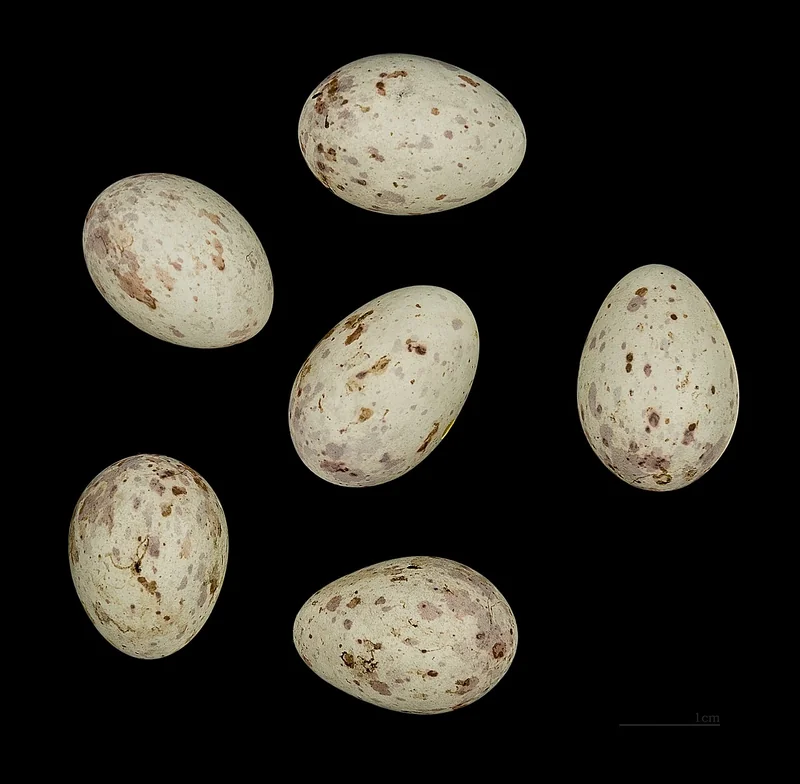
Snow buntings breed in rock crevices, boulder fields, and cliff faces of the High Arctic, arriving on breeding grounds weeks before the snow melts in spring. Males arrive first — sometimes in February in Svalbard — and establish territories in conditions of -30°C and blizzards. This early arrival is possible because males can store food caches under snow. The nest is built in a deep rock crevice that provides insulation and predator protection. The female incubates the 4–6 eggs for 12–13 days while the male feeds her; the species' nest location in deep crevices is unusual for a passerine and a direct adaptation to the Arctic environment.
Winter flocks and coastal behaviour
In winter, snow buntings form tight flocks of dozens to hundreds of birds that feed on seeds on open coasts, beaches, and agricultural fields. The flock has a characteristic rolling movement — birds at the back fly to the front, creating a constantly rippling wave of movement across a field. The flashing white wing-patches catch the light as the flock wheels in unison, producing the 'snowflake' appearance that inspired the popular English name. Wintering flocks in northern Britain, Scandinavia, and the Great Plains of North America are a regular winter spectacle.
Sources & further reading (2)
- iucn-red-list — accessed 2026-05-07
- encyclopedia — accessed 2026-05-07
Frequently asked questions
Why are snow buntings the most northerly-breeding passerine?
Snow buntings nest in rock crevices and boulder fields that provide deep insulation from wind and cold — a site unavailable to other passerines, which typically need trees or shrubs. Males arrive on the breeding grounds weeks before snow melt in conditions down to -30°C, sustained by food caches stored under snow from the previous autumn. These adaptations allow the species to exploit a breeding niche at latitudes above 82°N that no other songbird can use.
How do wintering snow bunting flocks find food?
Wintering snow buntings use a 'rolling' flock feeding strategy: as the flock moves across a beach or field, birds at the rear fly to the front, creating a continuously advancing wave. This behaviour ensures every bird in the flock gets access to un-depleted food ahead of the group. The white wing-patches flash as birds take off, and the coordinated movement of the flock may also confuse raptors.
What is the difference between snow buntings and snowflakes?
They are the same bird — 'snowflake' is a popular colloquial name for the snow bunting, particularly in North America and northern Britain. The name refers to the fluttering, flickering appearance of winter flocks as the birds' white wings catch the light, resembling drifting snowflakes. The official English name recognised by the IOC and AOS is 'snow bunting'.