Sagittarius serpentarius
Secretary Bird (Sagittarius serpentarius)
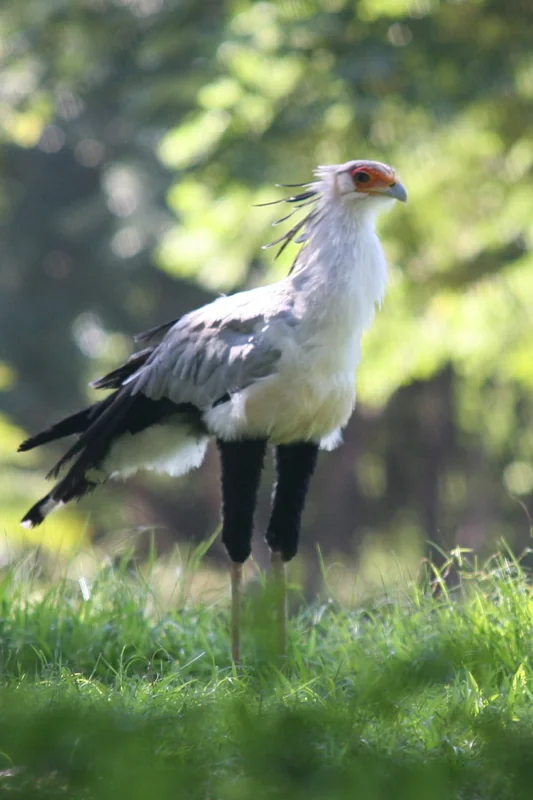 Featured photosecretary-bird.jpg
Sagittarius serpentarius, the secretary bird, is a large, ground-hunting raptor of the family Sagittariidae and the only member of its genus. Adults stand 112 to 150 cm tall with a wingspan of 191 to 220 cm and weigh 2.3 to 4.3 kg. The species is unique among raptors for hunting primarily on foot — walking up to 20 km per day across open savanna to stamp prey with powerful kicks. The IUCN lists the species as Vulnerable, with the global population declining.
Quick facts
- Habitat
- Open savanna, grassland, and lightly wooded bushveld across sub-Saharan Africa. Strongly associated with open ground and short grass where prey is visible. Avoids dense woodland and forest. Roosts and nests in flat-topped acacia trees.
- Range
- Sub-Saharan Africa from Senegal and Sudan south to South Africa. Absent from forest zones of central Africa and the Sahel. Range has contracted in parts of West Africa due to habitat degradation.
- Size
- 112–150 cm body · 191–220 cm wingspan · 2300–4270 g
- Plumage
- Adults are pale grey above with black wing-feathers and black thigh patches. The undersides are white to pale grey. The most striking features are the long crane-like legs with black thighs and pale lower legs; the black-tipped crest of long quill-like feathers projecting from the nape; and the bare orange-red facial skin around a hooked eagle bill. The tail is long and tapered with two elongated central feathers.
- Song
- A deep, guttural croaking or loud braying call — rarely heard but given near the nest or in aerial display. Otherwise largely silent during daily foraging walks.
- Migration
- Largely sedentary. Pairs maintain large territories of 15–100 km² and walk them systematically on daily foraging circuits. No regular migration.
- Conservation
- Vulnerable (VU)
Overview
Sagittarius serpentarius is one of the most distinctive raptors in Africa and the world. The family Sagittariidae is monotypic — the secretary bird is the only member — and its closest relatives are thought to be the New World vultures (Cathartidae) and ospreys (Pandionidae) rather than the typical hawks and eagles (Accipitridae). The species name serpentarius means 'serpent-hunter' — a reference to the snake-killing behaviour, though snakes represent only a fraction of the actual diet. The English name 'secretary bird' is thought to derive from the crest feathers, which resemble the quill pens that 18th-century secretaries tucked behind their ears.
Snake-stomping behaviour
The secretary bird's most famous behaviour is its ability to kill venomous snakes, including cobras, puff adders, and black mambas, by delivering rapid, powerful stamps with its feet. High-speed camera studies have shown that each kick is delivered in approximately 15 milliseconds — too fast for the snake to respond with a strike — and delivers a force of approximately 195 N (five times the bird's body weight). The bird typically stamps the snake's head to the ground and uses the wing to shield itself from any strike. The feet and legs are covered in thick scales providing additional protection. The stamping technique is highly efficient for disabling large prey that cannot be seized safely with the bill.
Conservation concern
The secretary bird is classified as Vulnerable by the IUCN following documented population declines across much of its range. Estimated global populations have declined by approximately 30% over three generations (about 45 years). The primary threats are loss of open grassland and savanna habitat to agriculture and bush encroachment, nest disturbance, and persecution. The species is sensitive to overgrazing and agricultural intensification that converts grassland to dense scrub — habitat it cannot effectively forage in. Conservation efforts focus on protecting large open savanna ecosystems and reducing direct persecution.
Sources & further reading (2)
- iucn-red-list — accessed 2026-05-07
- encyclopedia — accessed 2026-05-07
Frequently asked questions
Why is it called the 'secretary bird'?
The most widely accepted explanation is that the long crest feathers projecting from the nape resemble the quill pens that 18th-century office secretaries tucked behind their ears while writing. The name 'secretary' was in common use for the species by the late 18th century and has persisted despite the obsolescence of quill-pen secretaries. Alternative etymologies involving Arabic or French words for 'hunter bird' have been proposed but are less well supported.
How does the secretary bird kill venomous snakes without getting bitten?
The secretary bird delivers rapid, powerful stamps to the snake's head — each kick in approximately 15 milliseconds, too fast for the snake to respond. The force per kick is about five times the bird's body weight. The bird also uses its outstretched wings as a shield against potential strikes. The thick scales covering the tarsi and toes provide additional protection against venomous bites. The combination of speed, force, and protective scaling makes the secretary bird uniquely effective at subduing dangerous prey.
Is the secretary bird an eagle?
Not in the strict taxonomic sense. The secretary bird is placed in its own family (Sagittariidae) and is now thought to be most closely related to the New World vultures and ospreys rather than to the typical eagles and hawks (Accipitridae). It is a raptor — a diurnal bird of prey — but its long evolutionary lineage has been separate from the true eagles for tens of millions of years. Its superficially eagle-like bill and hunting behaviour reflect convergent evolution rather than close relationship with Accipitridae.