Ara macao
Scarlet Macaw (Ara macao)
 Featured photoscarlet-macaw.jpg
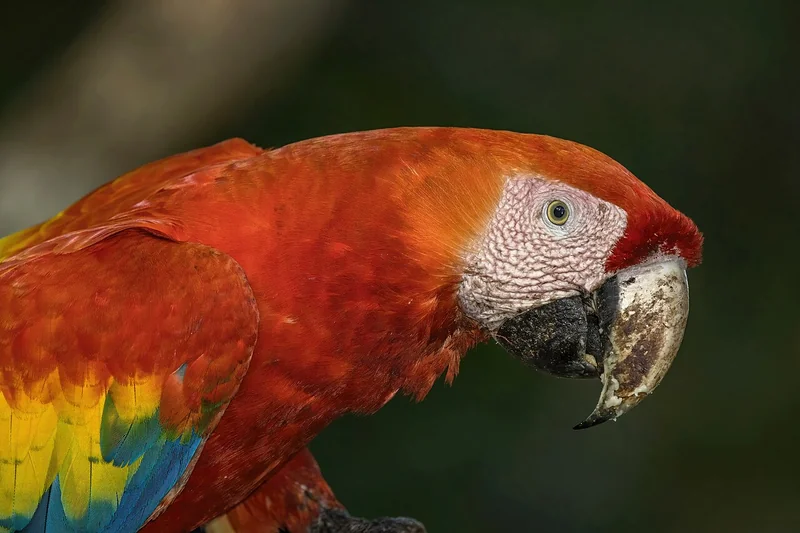
Ara macao, the scarlet macaw, is a large parrot of the family Psittacidae, distributed across humid lowland forests of southern Mexico, Central America, and northern South America. Adults are 81 to 96 cm long with a wingspan of 1.0 to 1.2 m and weigh 0.9 to 1.5 kg. The plumage is brilliant scarlet on the body with bright blue-and-yellow wings and a long red tail. The IUCN lists the species as Least Concern, but several Central American populations have declined sharply from habitat loss and trade.
Quick facts
- Habitat
- Humid lowland tropical forest, riverine forest, and forest edges with abundant large fruit-bearing trees. The species requires intact mature forest with hollow snag trees for nesting.
- Range
- Southern Mexico, Belize, Guatemala, eastern Honduras, eastern Nicaragua, Costa Rica, Panama, and most of South America east of the Andes south to Bolivia and northern Brazil. Two named subspecies span the range.
- Size
- 81–96 cm body · 100–120 cm wingspan · 0.9–1.5 kg
- Plumage
- Adults show a brilliant scarlet body, head, and tail; the upper wing shows yellow median coverts shading to green at the tips and bright blue primary and secondary feathers. The bare white facial skin is finely streaked with red lines. The bill is heavy, two-toned (upper mandible pale, lower mandible black), and powerful enough to crack hard palm nuts. Both sexes look alike.
- Song
- A loud, raucous, descending squawk delivered both in flight and from a perch — the call carries over a kilometre through tropical forest. The species also gives various harsh chattering notes during social interactions.
- Migration
- Sedentary across the breeding range. Local seasonal movements between forest patches occur but no regular migration.
- Conservation
- Least Concern (LC)
Overview
Ara macao is one of the largest of the eight Ara macaw species. The species' brilliant plumage and large size have made it an iconic bird of the Neotropics. The Latin epithet 'macao' is from a Portuguese word for the bird used in colonial Brazil. Two subspecies are recognized: the Mesoamerican A. m. cyanopterus (from southern Mexico to northern Nicaragua) and the South American A. m. macao.
Distribution and decline
The historical range covered humid lowland forest from southern Mexico south through Central America to the Amazon basin and adjacent slopes. Mesoamerican populations have declined sharply from habitat loss, hunting, and trapping for the international trade in live birds; Costa Rican and Honduran populations are now restricted to small protected areas. South American populations remain larger but face similar pressures. International trade is regulated under CITES Appendix I.
Clay licks and cognition
Wild scarlet macaws and other Neotropical parrots gather at clay licks — riverbank clay outcrops — and ingest the mineral-rich clay. Several hypotheses have been proposed: the clay may neutralize toxic compounds in the seeds and unripe fruits the parrots eat, supplement dietary sodium, or both. The clay-lick gatherings are spectacular wildlife events and a major draw for ecotourism in the western Amazon. The species is also among the most cognitively studied parrots, with evidence of complex social structure and tool use in captivity.
Sources & further reading (2)
- iucn-red-list — accessed 2026-04-30
- encyclopedia — accessed 2026-04-30
Frequently asked questions
Why do scarlet macaws visit clay licks?
Wild scarlet macaws and other Neotropical parrots gather daily at clay licks — exposed riverbank clay outcrops — and ingest mineral-rich clay. Two main hypotheses are debated: the clay may chelate (bind) toxic alkaloid compounds present in unripe fruits and seeds the parrots eat, neutralizing them before digestion; or the clay may supplement scarce dietary sodium. Both functions may apply. The clay-lick spectacle is one of the iconic wildlife events of the western Amazon.
Are scarlet macaws threatened in the wild?
The IUCN globally lists the species as Least Concern, but populations vary dramatically across the range. Mesoamerican populations have declined sharply from habitat loss, hunting, and live-bird trade; Costa Rican and Honduran populations are restricted to small protected areas. South American populations in the Amazon basin remain larger but face similar pressures. International trade is regulated under CITES Appendix I.
How do scarlet macaws crack hard nuts?
The macaw's bill is one of the most powerful for body size of any bird. The hooked upper mandible levers against the lower mandible to crack hard palm nuts and other tough seeds that smaller forest birds cannot access. The bite force per unit body mass approaches that of small mammals. The macaw also uses its prehensile tongue to manipulate cracked seeds and extract the kernel — coordination unusual among birds.