Ara ararauna
Blue-and-yellow Macaw (Ara ararauna)
 Featured photoblue-and-yellow-macaw.jpg
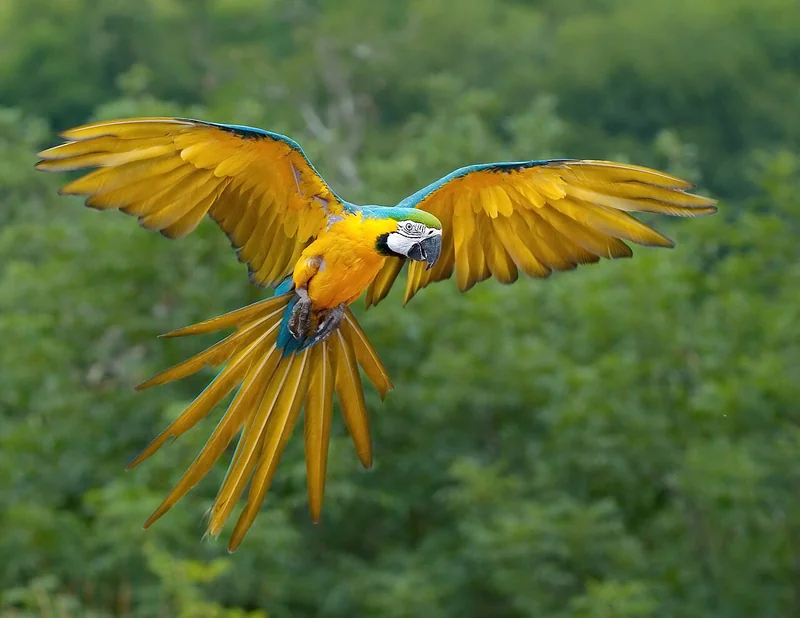
Ara ararauna, the blue-and-yellow macaw, is a large parrot of central and northern South America. Adults are 76 to 86 cm long with a wingspan of 1.04 to 1.14 m and weigh 0.9 to 1.3 kg. The plumage is bright turquoise-blue above and bright yellow below, with a green forehead, white face with fine black-and-blue lines, and a heavy black bill. The IUCN lists the species as Least Concern. The species is widespread across the Amazon basin and adjacent forests, and shows the characteristic two-tone macaw colouration that the species name describes.
Quick facts
- Habitat
- Humid lowland tropical forest, riverine gallery forest, palm swamps, and forest edges. The species depends on large old trees with cavities for nesting and large palm-fruit crops for food.
- Range
- Most of central and northern South America east of the Andes, from eastern Panama south through Colombia, Venezuela, the Guianas, Brazil, eastern Peru, eastern Bolivia, and northern Paraguay. The species' range is among the largest of any Ara macaw.
- Size
- 76–86 cm body · 104–114 cm wingspan · 0.9–1.3 kg
- Plumage
- Adults show bright turquoise-blue upperparts, wings, and tail; bright golden-yellow underparts from chin to undertail; a green forehead and crown; and a sharply contrasting white facial skin patch finely lined with black and blue feather lines. The bill is heavy and entirely black. Both sexes are alike. Juveniles resemble adults with shorter tail feathers and a paler bill.
- Song
- A loud, harsh, descending squawk delivered both in flight and from a perch. Pairs and family groups maintain near-constant contact calls when foraging together; the calls carry over a kilometre through forest canopy.
- Migration
- Sedentary across the breeding range. Local seasonal movements between forest patches occur but no regular migration.
- Conservation
- Least Concern (LC)
Overview
Ara ararauna is one of the most widely distributed of the eight Ara macaw species. The Latin epithet 'ararauna' is from a Tupí-Guaraní term for the species — an unusual case where both common and scientific names trace to indigenous lowland South American languages. The two-tone plumage (blue back, yellow belly) is the species' diagnostic feature and one of the most striking colour patterns of any Neotropical bird.
Distribution
The breeding range covers most of central and northern South America east of the Andes — from eastern Panama south through the Amazon basin to northern Paraguay. The range is the largest of any Ara macaw species. Population trends vary regionally: deep-Amazon populations remain large, while peripheral populations (Trinidad, southeastern Brazil) have declined or been extirpated from habitat loss and the live-bird trade.
Behaviour
Blue-and-yellow macaws are highly social. Pairs are bonded for life and travel together year-round; family groups including the previous year's offspring may forage as a unit. Foraging flocks of dozens to over a hundred birds gather at productive fruiting trees and at clay licks. The species' loud calls maintain group contact across the forest canopy. Pairs nest in tree cavities high in mature trees, returning to the same cavity for many years.
Sources & further reading (2)
- iucn-red-list — accessed 2026-04-30
- encyclopedia — accessed 2026-04-30
Frequently asked questions
Are blue-and-yellow macaws monogamous?
Yes — blue-and-yellow macaws form long-term pair bonds and are believed to mate for life. Pairs travel together year-round, often visible flying side-by-side over the forest canopy with synchronized wingbeats. The same pair returns to the same nesting cavity for many years and may continue to feed and travel with the previous year's offspring even after fledging.
Why is the species' Latin name from a native language?
The species' Latin epithet 'ararauna' is from a Tupí-Guaraní term for the bird used by indigenous peoples in lowland South America. The naturalist Carl Linnaeus adopted the indigenous name when formally describing the species in 1758. The case is unusual — most species' Latin names come from Greek or Latin roots — but reflects the long pre-European awareness of these striking birds in their native range.
Do blue-and-yellow macaws need clay licks too?
Yes. Blue-and-yellow macaws and many other Neotropical parrots gather at clay licks — riverbank clay outcrops — and ingest mineral-rich clay. The clay may neutralize toxic alkaloid compounds in unripe seeds and fruits the parrots eat, or supplement dietary sodium. Both functions may apply. Clay-lick gatherings of dozens of macaws and other parrots are among the iconic wildlife events of the western Amazon.