Antigone antigone
Sarus Crane (Antigone antigone)
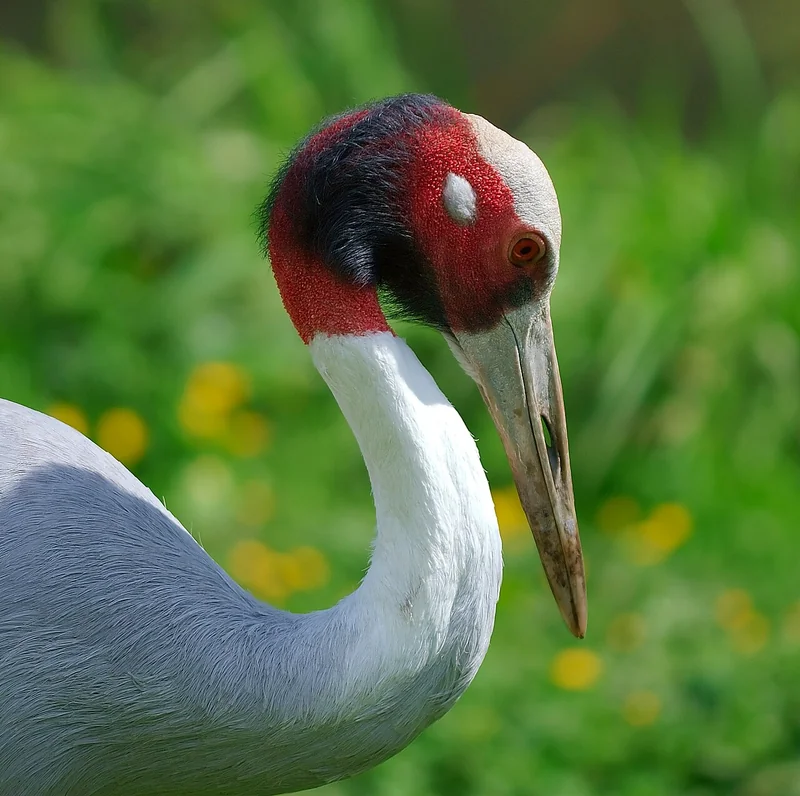 Featured photosarus-crane.jpg
Antigone antigone, the sarus crane, is the tallest flying bird in the world, with adults standing up to 176 cm tall and weighing 6.8 to 8.4 kg. The wingspan reaches 220 to 250 cm. The species breeds across the Indian subcontinent, Southeast Asia, and northern Australia. The large bare red head and grey body make it unmistakable. The IUCN lists the species as Vulnerable. The sarus crane is sacred in India and revered for its lifelong monogamous pair bond.
Quick facts
- Habitat
- Open wetlands — rice paddies, marshes, flooded plains, and shallow lakes — as well as adjacent agricultural land and irrigated farmland across the Indian subcontinent, Southeast Asia, and the Murray-Darling Basin of Australia. Tolerates human presence near traditional nesting sites.
- Range
- Three disjunct populations: Indian subcontinent (the largest), mainland Southeast Asia (Myanmar, Cambodia, Vietnam — greatly reduced), and northern Australia (Queensland). Formerly more widespread in Southeast Asia.
- Size
- 115–176 cm body · 220–250 cm wingspan · 6800–8400 g
- Plumage
- Adults are pale grey overall with a large, bare red-to-orange head and upper neck, white ear coverts, and red legs. The red skin of the head intensifies during breeding season. The innermost flight feathers (tertials) are elongated and drooping. Juveniles have a brownish-grey body and a feathered, brownish head without the red bare skin.
- Song
- A loud, resonant trumpeting 'karr-karr' or 'kaa-kaa' — given by pairs in unison and audible several kilometres away. Pairs perform loud unison calls with synchronized wing-raising as part of their pair-bond reinforcement display.
- Migration
- Largely sedentary. Pairs remain on or near their breeding territory year-round. Some local seasonal movement between wetland and agricultural areas in response to monsoon flooding and drying.
- Conservation
- Vulnerable (VU)
Overview
Antigone antigone is the tallest flying bird alive — it exceeds the similarly large whooping crane (Grus americana) and the wattled crane (Bugeranus carunculatus) in standing height. The species was long placed in the genus Grus with most other cranes but has been moved to the genus Antigone following molecular phylogenetic analysis. Three subspecies are recognised: A. a. antigone (Indian subcontinent), A. a. sharpii (Southeast Asia), and A. a. gillae (Australia). The Southeast Asian subspecies has declined dramatically and is now classified separately as critically endangered by some authorities.
Pair bonding and cultural reverence
Sarus cranes are monogamous and pair for life — a pair bond that is one of the strongest of any bird. Pairs perform elaborate unison call displays, dancing, and mutual preening to reinforce the bond year-round. If one partner is killed, the survivor sometimes pines visibly and may not re-pair for years. In Indian culture the sarus crane (called 'sarasa' in Sanskrit) is a symbol of faithful love and marital devotion — referenced in the Ramayana and in the Valmiki story of witnessing a hunter kill a mating sarus and composing the first Sanskrit verse in grief. The species is protected by cultural taboo in many communities, and farmers in India often tolerate and protect nesting pairs on their land.
Conservation concern
The sarus crane is classified as Vulnerable by the IUCN and its global population has declined sharply. The Southeast Asian population (Myanmar, Cambodia, Vietnam) is severely reduced — from tens of thousands to a few hundred — due to hunting, wetland drainage, and pesticide use in rice paddies. The Indian population remains the largest (estimated 8,000–10,000 birds) and is partially protected by cultural attitudes, but faces pressure from wetland conversion and agricultural intensification. The Australian population is approximately 5,000 birds and is currently stable. Conservation efforts focus on protecting wetland breeding habitats and reducing pesticide use in rice-farming areas.
Sources & further reading (2)
- iucn-red-list — accessed 2026-05-07
- encyclopedia — accessed 2026-05-07
Frequently asked questions
Is the sarus crane really the tallest flying bird?
Yes — the sarus crane holds the record for the tallest flying bird alive, with adults standing up to 176 cm tall. It exceeds the whooping crane, wattled crane, and great bustard in standing height. The ostrich is taller at up to 280 cm but is flightless. Among flying birds, the sarus crane's combination of long legs and long neck produces the greatest standing height of any bird currently living.
Why is the sarus crane sacred in India?
The sarus crane is venerated in Indian culture as a symbol of faithful love because pairs mate for life and reportedly mourn profoundly if a partner is killed. The Sanskrit epic Ramayana connects the species to the poet Valmiki, who composed the first Sanskrit verse in grief after witnessing a hunter kill a mating sarus pair. The species is called 'sarasa' in Sanskrit and appears in Indian poetry, painting, and folk culture as an emblem of marital devotion. Many farming communities protect nesting sarus cranes on their land out of respect.
Why has the Southeast Asian sarus crane population collapsed?
The Southeast Asian sarus crane population (subspecies A. a. sharpii) declined from tens of thousands to a few hundred over the second half of the 20th century, primarily due to hunting during and after the Vietnam War (when the species was shot for food by people under extreme food stress) and subsequent loss of wetland habitats to drainage, agricultural expansion, and pesticide contamination of rice paddies. The population is now centred on the Mekong Delta and certain protected wetlands in Cambodia but remains critically threatened.