Calidris alba
Sanderling (Calidris alba)
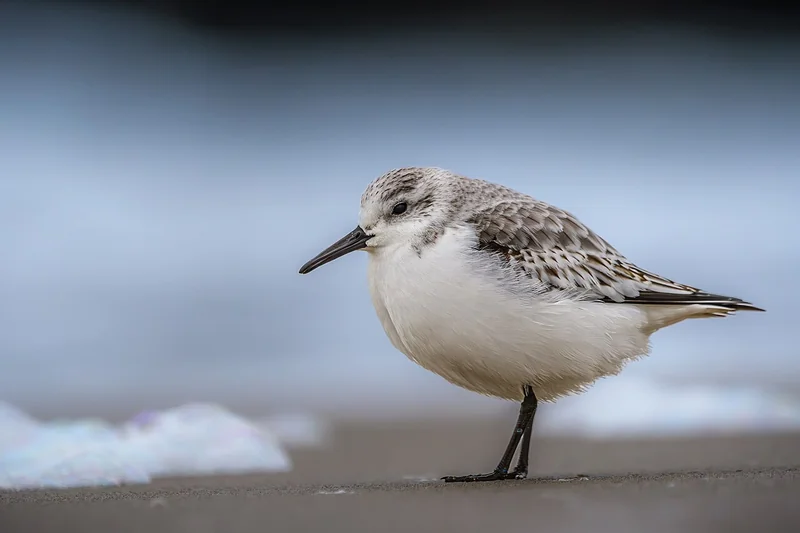 Featured photosanderling.jpg
Calidris alba, the sanderling, is a small sandpiper with one of the broadest non-breeding distributions of any shorebird. Adults are 18 to 22 cm long with a wingspan of 35 to 39 cm and weigh 40 to 100 g. Non-breeding plumage is uniformly pale grey-and-white; breeding plumage is rich rusty-red on the head and breast. The IUCN lists the species as Least Concern. Sanderlings breed only on the high Arctic tundra but winter on sandy beaches across nearly every continent.
Quick facts
- Habitat
- Sandy ocean beaches and tidal mudflats during the non-breeding season; high Arctic tundra during breeding. The species' restless wave-chasing on sandy beaches is one of the most familiar shorebird behaviours worldwide.
- Range
- Breeds on high Arctic tundra of North America, Greenland, Svalbard, and Russian Arctic islands. Winters on sandy beaches across the Americas, Europe, Africa, Asia, and Australia — one of the broadest non-breeding distributions of any bird.
- Size
- 18–22 cm body · 35–39 cm wingspan · 40–100 g
- Plumage
- Non-breeding adults are uniformly pale grey-and-white throughout — paler than any other small Calidris sandpiper, the easiest field separation. Breeding adults show a rich rusty-red head, breast, and back contrasting with white underparts. Sanderlings lack the hind toe (the small backward-facing fourth toe present on most sandpipers) — an unusual feature among shorebirds that is consistent with the species' running-and-chasing beach behaviour.
- Song
- A sharp 'kip' or 'kit' contact call delivered constantly by foraging flocks. The species has no loud territorial song; the contact calls are the species' acoustic signature on beaches worldwide.
- Migration
- Long-distance migrant. Arctic breeders travel south to non-breeding grounds across nearly every continent. Annual round-trip migrations of 10,000-20,000 km are typical — among the longest documented of any shorebird relative to body size.
- Conservation
- Least Concern (LC)
Overview
Calidris alba is one of about 25 Calidris sandpipers. The Latin epithet 'alba' means 'white', a reference to the species' pale non-breeding plumage. The English name 'sanderling' is from a German word combining 'sand' with the diminutive suffix '-ling'. The species is one of the most widely distributed shorebirds in the world during the non-breeding season.
Wave-chasing
Sanderlings forage by chasing retreating waves on rapidly twinkling legs and gleaning small marine invertebrates exposed by the wet sand. The technique exploits the brief window after each wave retreat when prey is briefly exposed before the next incoming wave covers it. Sanderling flocks on a sandy beach show one of the most familiar shorebird behaviours worldwide — birds running back and forth in close synchronization with wave timing. The species' loss of the hind toe is consistent with this running-and-chasing lifestyle.
Migration
Sanderlings undertake some of the longest migrations of any shorebird relative to body size. Arctic breeders may travel as far south as Tierra del Fuego, southern Africa, or southern Australia for the non-breeding season — annual round-trip migrations of 10,000-20,000 km are typical. The species' broad non-breeding distribution and reliance on coastal stopover sites make it sensitive to coastal-development impacts on migratory staging beaches.
Sources & further reading (2)
- iucn-red-list — accessed 2026-04-30
- encyclopedia — accessed 2026-04-30
Frequently asked questions
Why do sanderlings chase waves?
Sanderlings forage by chasing retreating waves on rapidly twinkling legs. The wave-retreat exposes wet sand briefly, and small marine invertebrates (mole crabs, polychaete worms, small crustaceans) become accessible for the few seconds between wave retreat and the next incoming wave. The bird snatches prey from the exposed sand, then runs back as the next wave approaches. The technique is highly efficient and is one of the most-recognized shorebird behaviours on sandy beaches worldwide.
Why don't sanderlings have a hind toe?
Most sandpipers have a small backward-facing fourth toe (the 'hallux' or hind toe) used for perching grip. Sanderlings have lost this toe — an unusual feature among shorebirds. The loss is consistent with the species' running-and-chasing lifestyle on flat sandy beaches, where the hind toe would be a hindrance rather than an aid. Among the world's hundreds of sandpiper species, sanderlings are one of only a few without a hallux.
How long does a sanderling's annual migration get?
Arctic breeders may travel as far south as Tierra del Fuego in southern South America, southern Africa, or southern Australia for the non-breeding season. Annual round-trip migrations of 10,000-20,000 km are typical — among the longest documented of any shorebird relative to body size. The migration involves a network of coastal stopover sites where birds refuel between long flight segments; loss of stopover habitat is the major conservation concern for the species.