Baryphthengus martii
Rufous Motmot (Baryphthengus martii)
 Featured photorufous-motmot.jpg
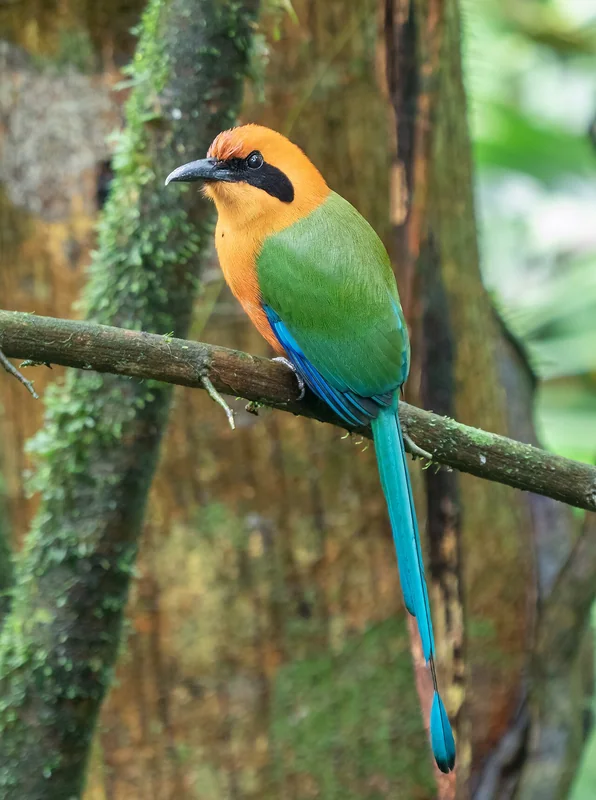
Baryphthengus martii, the rufous motmot, is the largest member of the family Momotidae, found in humid lowland rainforest from Nicaragua to Bolivia and Brazil. Adults are 43 to 46 cm long with a wingspan of 35 to 45 cm and weigh 145 to 180 g. The species displays bright rufous-cinnamon plumage with a black facial mask, blue-green wings, and a long tail with distinctive racket-shaped tips that the bird swings side-to-side like a pendulum. The IUCN lists the species as Least Concern.
Quick facts
- Habitat
- Humid primary lowland rainforest and tall secondary forest from sea level to about 1,200 m. Strongly associated with closed-canopy forest with dense understorey. Perches motionless for long periods in dim forest light before sallying to capture prey.
- Range
- Nicaragua through Costa Rica, Panama, Colombia, Ecuador, Peru, Bolivia, and Amazonian Brazil. The most widespread motmot of the Amazonian lowlands.
- Size
- 43–46 cm body · 35–45 cm wingspan · 145–180 g
- Plumage
- Adults are bright rufous-cinnamon on the head, neck, breast, and belly, with blue-green wings and upper tail. A black mask extends through the eye with a small black breast spot. The long tail has bare-shafted central feathers ending in round racket-shaped tips of blue-green — formed by natural feather wear that removes the central barbs. The tail rackets are swung like a pendulum, particularly when the bird is alert.
- Song
- A deep, resonant 'whoot' or 'hoot-hoot' call, often given at dawn from a prominent perch. Pairs may call in duet. The call carries well through closed forest.
- Migration
- Sedentary. The species is resident throughout its range and does not migrate. Pairs maintain year-round territories in mature forest.
- Conservation
- Least Concern (LC)
Overview
Baryphthengus martii is one of ten motmot species in the family Momotidae — a family restricted to the Americas and absent from North America except for a few species reaching Mexico. The rufous motmot and the closely related rufous-capped motmot (B. ruficapillus) of eastern Brazil are the two members of the genus Baryphthengus, both being the largest motmots in their respective ranges. All motmots share the racket-tipped tail, though the mechanism by which the rackets form (natural feather wear) was not understood until the 20th century.
The racket tail and pendulum display
The racket-tipped tail of motmots is formed by passive feather wear rather than by the bird actively removing barbs. The central tail feathers grow fully barbed, but the barbs in a section near the tail-tip are loosely connected and fall off quickly with normal preening and movement — leaving bare shaft segments that frame the remaining tip as a 'racket'. The bird then swings this tail from side to side in a pendulum movement, particularly when alert or communicating. The functional significance of the pendulum display is debated — it may signal vigilance to predators or communicate to conspecifics.
Forest understory ecology
Rufous motmots are patience hunters — they sit motionless on a low-to-mid-canopy perch in dim forest light for minutes to tens of minutes, scanning the forest floor and vegetation for movement. When prey is spotted — a large insect, lizard, or small snake — the bird swoops down, seizes the prey in the bill, returns to the perch, and beats large or struggling prey against the branch before swallowing. The species also takes fruit, which makes motmots important seed dispersers for some large-seeded forest plants. Their tunnelled nests in earth banks are shared with kingfishers as a nesting strategy.
Sources & further reading (2)
- iucn-red-list — accessed 2026-05-07
- encyclopedia — accessed 2026-05-07
Frequently asked questions
How do motmots get their racket-tipped tails?
Contrary to earlier belief, motmots do not pluck the barbs off their tail feathers — the rackets form passively by natural feather wear. The barbs in the bare-shaft section of the tail are loosely attached and fall off quickly with normal preening and movement, leaving a bare quill that frames the remaining barbed tip as a racket. The process is complete within a few days of the fresh feather growing in. The bird then swings the racket tips in a characteristic pendulum motion.
What does the pendulum tail-swinging mean?
The functional significance of motmot tail-swinging is not fully established. Proposed explanations include predator signalling — communicating to a predator that the bird has spotted it and is vigilant (making a stealth approach futile), similar to the tail-flagging of other prey animals. It may also function as an intraspecific communication signal between territorial individuals. The behaviour increases in frequency when the bird is alert or observing a potential threat.
Is the rufous motmot the largest motmot species?
The rufous motmot (Baryphthengus martii) is the heaviest motmot, competing for the title of 'largest' with the blue-crowned motmot complex. By body length the tody motmot is the smallest. Among motmots in Amazonian lowland forest, the rufous motmot is the dominant large species and one of the most frequently encountered motmots in intact lowland rainforest from Nicaragua to Bolivia.