Selasphorus rufus
Rufous Hummingbird (Selasphorus rufus)
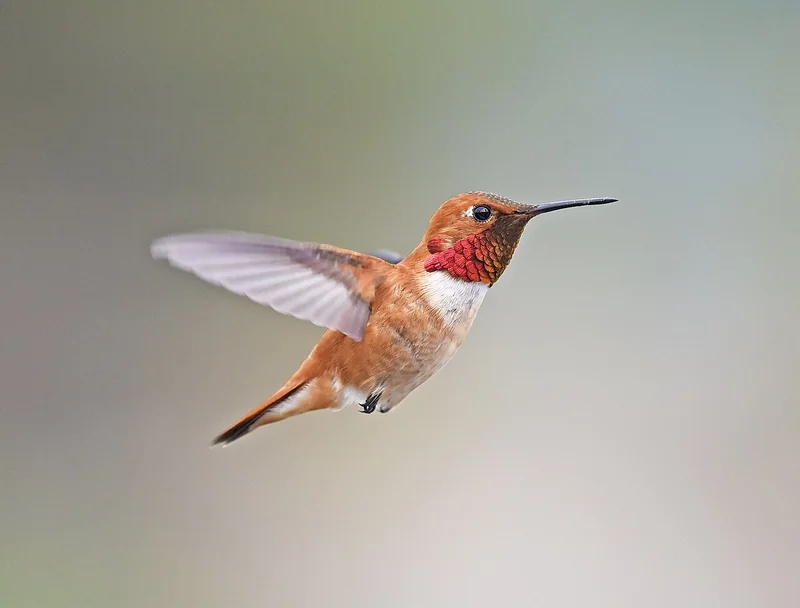 Featured photorufous-hummingbird.jpg
Selasphorus rufus, the rufous hummingbird, is a small hummingbird of the family Trochilidae, distributed across western North America. Adults are 7 to 9 cm long with a wingspan of 11 cm and weigh 2 to 5 g. Adult males show brilliant rufous-orange body plumage with a fiery iridescent orange-red gorget; females are green above and rufous-flecked below. The IUCN lists the species as Least Concern, although populations have declined modestly over recent decades. Rufous hummingbirds undertake one of the longest-distance migrations of any hummingbird relative to body size.
Quick facts
- Habitat
- Mountain meadows, forest edges, and open conifer woodland during the breeding season; gardens and feeder stations during migration. The species favours open habitat with abundant flowering plants.
- Range
- Breeds across western North America from southern Alaska south through British Columbia, Washington, Oregon, and into northern California, Idaho, and Montana. Winters in central and southern Mexico. The species' breeding range is the most northerly of any hummingbird.
- Size
- 7–9 cm body · 11 cm wingspan · 2–5 g
- Plumage
- Adult males show brilliant rufous-orange body plumage on the back, flanks, and tail, with a fiery iridescent orange-red gorget on the throat that flashes when sunlight catches the structural colour. Adult females are duller green above with a rufous-flecked breast and a small central gorget patch. Juvenile males resemble females in their first year. The structural orange-red gorget appears different shades depending on viewing angle.
- Song
- A series of high-pitched chittering chatters delivered both in flight and from a perch. The species' wingbeat produces a distinctive whining hum at about 52 wingbeats per second. Males also produce a metallic 'chee-chip' tail-whistle during display, similar to but more nasal than Anna's hummingbird.
- Migration
- Long-distance migrant. Breeds as far north as Alaska; winters in central and southern Mexico. The annual round-trip migration covers approximately 6,000 km — one of the longest hummingbird migrations relative to body size in the world.
- Conservation
- Least Concern (LC)
Overview
Selasphorus rufus is one of about ten Selasphorus hummingbird species in the New World. The species' breeding range is the most northerly of any hummingbird — reaching southern Alaska — and the migration to Mexican wintering grounds is correspondingly one of the longest among hummingbirds. The Latin epithet 'rufus' simply means 'red' or 'reddish', a reference to the male's brilliant rust-orange plumage.
Migration
Rufous hummingbirds undertake one of the longest hummingbird migrations relative to body size. Spring migration moves north along the Pacific coast and Cascade-Sierra mountain ranges; autumn migration returns south through the Rocky Mountains, taking advantage of high-elevation flower blooms. The clockwise migration loop is unusual among North American songbirds and is one of the textbook examples of seasonal migration-route switching in birds.
Aggressive territorial behaviour
Rufous hummingbirds are among the most aggressive hummingbirds at flower clusters and feeders. Males defend high-quality nectar sources against any conspecific or interspecific intruders — including larger Anna's, broad-tailed, and calliope hummingbirds. The aggression is so consistent that the species often dominates flower or feeder access despite its small body size. The behaviour is documented in detail by hummingbird-migration banding stations across the western United States.
Sources & further reading (2)
- iucn-red-list — accessed 2026-04-30
- encyclopedia — accessed 2026-04-30
Frequently asked questions
How long is the rufous hummingbird's migration?
The annual round-trip migration covers approximately 6,000 km — one of the longest hummingbird migrations relative to body size in the world. Spring migration moves north along the Pacific coast and Cascade-Sierra mountain ranges; autumn migration returns south through the Rocky Mountains, taking advantage of high-elevation flower blooms. The clockwise migration loop is unusual among North American songbirds and supports the species' reach to southern Alaska.
Why are rufous hummingbirds so aggressive?
Rufous hummingbirds are among the most aggressive hummingbirds at flower clusters and feeders. The species' high metabolic demand means controlling access to a high-quality nectar source provides a substantial energetic advantage. Males defend nectar sources against any intruders — including larger Anna's, broad-tailed, and calliope hummingbirds. The aggression is so consistent that the species often dominates flower or feeder access despite its small body size.
How can such a small bird migrate so far?
Rufous hummingbirds (and many other small hummingbirds) make their long-distance migrations through pre-migration fat-loading that can double the bird's body mass. The fat stores fuel sustained flight; the bird stops at flower clusters along the migration route to refuel between long flight segments. Migration is typically diurnal, in short hops between feeding sites, rather than the long non-stop flights of larger migrating songbirds.