Bonasa umbellus
Ruffed Grouse (Bonasa umbellus)
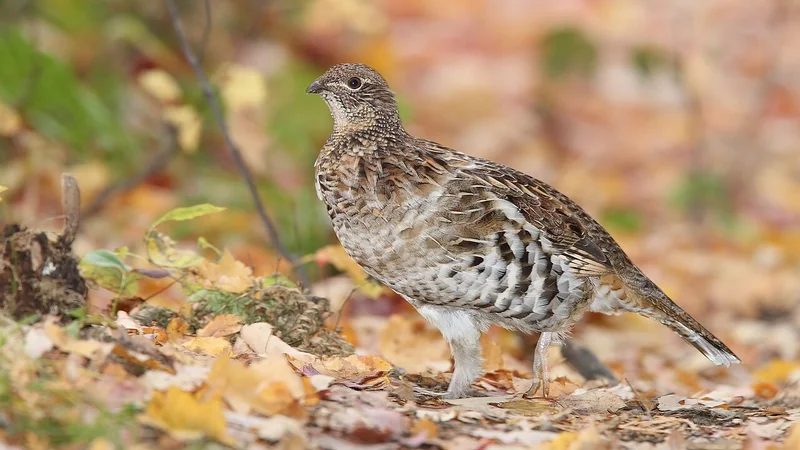 Featured photoruffed-grouse.jpg
Bonasa umbellus, the ruffed grouse, is a medium-sized gamebird of the family Phasianidae, distributed across mixed and deciduous forests of North America. Adults are 40 to 50 cm long with a wingspan of about 56 cm and weigh 450 to 750 g. The plumage is heavily mottled brown-and-buff with a fan-shaped tail that has a dark band near the tip. The IUCN lists the species as Least Concern. Male ruffed grouse perform a famous 'drumming' display — beating the wings rapidly against the air to produce a deep low-frequency sound that carries kilometres through forest.
Quick facts
- Habitat
- Mixed and deciduous forest with abundant aspen, birch, and other early-successional species. The species favours forest mosaics with both mature trees (for winter cover) and dense young thickets (for nesting and brood-rearing).
- Range
- Across most of forested North America from Alaska and Canada south through the eastern and central United States to northern Georgia and Arkansas. The species is the most widely distributed grouse in North America and is the state bird of Pennsylvania.
- Size
- 40–50 cm body · 56 cm wingspan · 450–750 g
- Plumage
- Adults occur in two colour morphs — a grey morph and a rufous morph, both within the same populations. The plumage is heavily mottled brown-and-buff (in either morph) above with paler buff-and-black-banded underparts. The neck has a ruff of dark feathers (most prominent in displaying males) that gives the species its English name. The tail is fan-shaped with a dark broad band near the tip. Both sexes look alike but males are slightly larger.
- Song
- Males perform a famous 'drumming' display — beating the wings rapidly against the air at increasing speed (the 'drum' starts slowly and accelerates over about ten seconds) to produce a deep low-frequency sound. The drumming carries kilometres through forest and is one of the most distinctive forest-bird sounds in eastern North America.
- Migration
- Resident year-round throughout the range; no regular migration.
- Conservation
- Least Concern (LC)
Overview
Bonasa umbellus is one of three Bonasa grouse species worldwide (with the hazel grouse B. bonasia of Eurasia and the Chinese grouse B. sewerzowi). The species is the most widely distributed grouse in North America and is the state bird of Pennsylvania. The English name 'ruffed' references the dark ruff of feathers on the male's neck, which is most prominent during the displaying drumming sequence.
Drumming display
Male ruffed grouse perform one of the most distinctive courtship displays in North American birds. The bird stands on a log or rock in dense forest, raises the wings, and beats them rapidly against the air at increasing speed. The wing-beats produce low-frequency pressure pulses that combine into a 'drum' sound starting slowly and accelerating over about ten seconds. The drumming carries kilometres through forest and serves both territorial advertisement and mate attraction. The sound is so deep that some humans feel it as a body-vibration before hearing it as sound.
Distribution and population cycles
The breeding range covers most of mixed and deciduous forest across North America from Alaska south to the southern Appalachians. The species shows pronounced 10-year population cycles across much of the range — boom-and-bust dynamics linked to predator-prey cycles with goshawks, foxes, and lynx. Population densities can vary by an order of magnitude between cycle peaks and troughs at the same site. The cycles are one of the textbook examples of population dynamics in temperate gamebirds.
Sources & further reading (2)
- iucn-red-list — accessed 2026-04-30
- encyclopedia — accessed 2026-04-30
Frequently asked questions
How does a grouse 'drum'?
Male ruffed grouse drum by beating the wings rapidly against the air at increasing speed. The bird stands on a log or rock in dense forest, raises the wings above the body, and beats them in an accelerating sequence — slow at first, then faster, building to a rapid blur over about ten seconds. The wing-beats produce low-frequency pressure pulses that combine into the characteristic 'drum' sound. The drumming serves both territorial advertisement and mate attraction; the sound carries kilometres through forest.
Why are there grey and rufous morphs?
Ruffed grouse occur in two colour morphs — a grey morph and a rufous morph, both within the same populations. The grey morph is more common in northern populations and conifer-dominated forests; the rufous morph dominates in southern populations and deciduous forests. The morph difference is genetic and may correlate with climate-driven differences in cryptic match against forest leaf-litter colour. Both morphs interbreed freely; the polymorphism is maintained by climate-related differential mortality.
Why do ruffed grouse populations cycle?
Ruffed grouse populations show pronounced 10-year cycles across much of the range. Boom-and-bust dynamics are linked to predator-prey cycles with goshawks, foxes, and lynx; the grouse population peaks every ten years or so before predator populations build up enough to crash the grouse, after which the predators decline and the grouse recover. The cycles are one of the textbook examples of population dynamics in temperate gamebirds, and have been intensively studied in the Canadian boreal zone.