Campylorhynchus brunneicapillus
Cactus Wren (Campylorhynchus brunneicapillus)
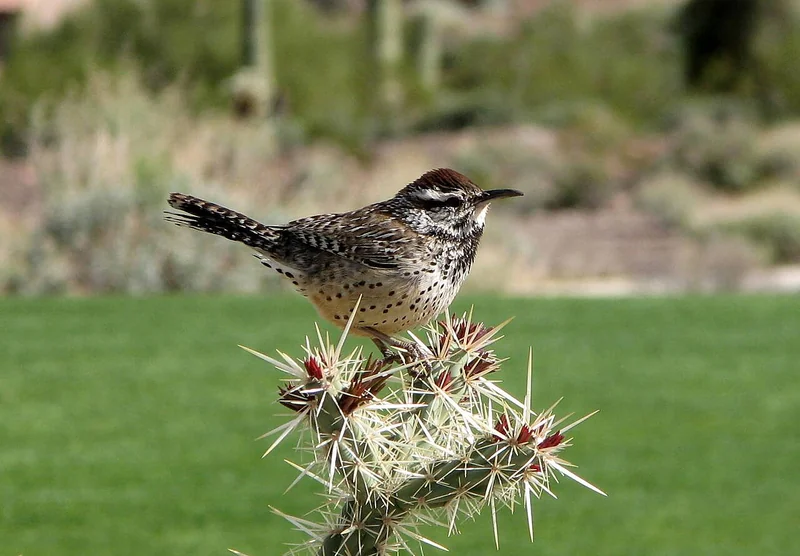 Featured photocactus-wren.jpg
Campylorhynchus brunneicapillus, the cactus wren, is the largest wren in North America. Adults are 18 to 22 cm long with a wingspan of 28 cm and weigh 32 to 47 g. The plumage is heavily streaked brown-and-black above with a paler heavily-spotted breast and a bold white supercilium. The IUCN lists the species as Least Concern. Cactus wrens are obligate desert specialists and the only North American wrens that build dense ball-shaped nests inside thorny cholla cacti for predator protection.
Quick facts
- Habitat
- Sonoran and Chihuahuan desert scrub of the southwestern United States and northern Mexico. The species depends on cholla cactus (Cylindropuntia) for nesting cover and is rarely found outside intact desert scrub.
- Range
- Southwestern United States from California, southern Nevada, Arizona, New Mexico, and west Texas south through northern and central Mexico to Michoacán. The species is the state bird of Arizona.
- Size
- 18–22 cm body · 28 cm wingspan · 32–47 g
- Plumage
- Adults show heavily streaked brown-and-black upperparts, pale buff underparts heavily spotted with black across the breast (heaviest on the centre), a bold white supercilium running back from the bill, and a long streaky tail. The species' size and bold spotting separate it easily from all other North American wrens. Both sexes look alike.
- Song
- A loud, harsh, accelerating 'cha-cha-cha-cha-cha' delivered from the top of a cactus or shrub. The call is one of the most familiar desert sounds across the southwestern United States and is unmistakable when heard.
- Migration
- Resident year-round throughout the range; no regular migration.
- Conservation
- Least Concern (LC)
Overview
Campylorhynchus brunneicapillus is the largest of the North American wrens and one of the most familiar desert birds across the southwestern United States. The species is the state bird of Arizona and is a textbook example of obligate desert specialization in songbirds. The Latin epithet 'brunneicapillus' means 'brown-haired' and references the chestnut crown of the bird.
Cholla nesting
Cactus wrens build dense ball-shaped nests of grass, plant fibres, and feathers inside thorny cholla cactus stems. The cholla's dense backwards-pointing thorns provide nearly impenetrable predator protection — most predators cannot enter the cactus interior to reach the nest. Pairs build several nests per breeding season; one becomes the active nest, the others serve as decoys or as winter roosts. The behaviour is one of the textbook examples of plant-mediated nest-site defence in birds.
Distribution
The breeding range covers Sonoran and Chihuahuan desert scrub of the southwestern United States and northern Mexico. Coastal southern California populations have declined sharply over recent decades from habitat loss to development. Inland populations remain widespread and broadly stable across intact desert habitat.
Sources & further reading (2)
- iucn-red-list — accessed 2026-04-30
- encyclopedia — accessed 2026-04-30
Frequently asked questions
Why do cactus wrens nest in cholla cactus?
Cholla cactus stems provide nearly impenetrable predator protection — the dense backward-pointing thorns prevent most predators from accessing the cactus interior. Cactus wrens build ball-shaped nests of grass and plant fibres inside cholla branches, and the protected cactus interior provides one of the safest nesting microhabitats available in southwestern desert habitat. Pairs build multiple nests each season as decoys or roosts.
Why are cactus wrens so large?
At 18-22 cm and 32-47 g, the cactus wren is much larger than most other Troglodytidae wrens — typically half again the size of a Carolina wren. The larger body provides better thermal regulation in extreme desert temperatures and allows the species to take a broader prey range (small reptiles, large insects). The size advantage in extreme habitats is a recurring pattern across desert-specialist songbirds.
How do cactus wrens survive the desert without drinking?
Cactus wrens rarely drink free water. The species obtains nearly all hydration from the moisture in insect, spider, and cactus-fruit prey. Insect haemolymph and cactus pulp are both 70-90 per cent water by weight, and the species' physiology is adapted for efficient water extraction. The behaviour is shared with several other obligate desert birds (verdin, phainopepla) and is a textbook example of ecophysiological adaptation to arid environments.