Calidris pugnax
Ruff (Calidris pugnax)
 Featured photoruff.jpg
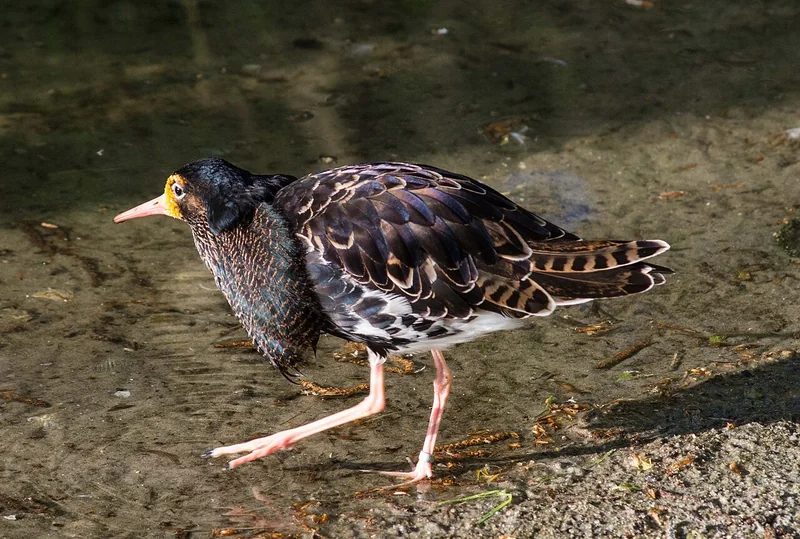
Calidris pugnax, the ruff, is a large sandpiper of the family Scolopacidae, breeding across the Palearctic and wintering in Africa and South Asia. Males are 26 to 32 cm long with a wingspan of 54 to 60 cm; females (reeves) are significantly smaller. Males grow a spectacular ornamental ruff of feathers around the neck for the breeding season, with individually unique coloration. The IUCN lists the species as Least Concern.
Quick facts
- Habitat
- Breeds on moist grassland, tundra margins, and wet meadows of the Palearctic. Outside the breeding season occupies shallow freshwater wetlands, flooded fields, mudflats, and rice paddies across Africa, South Asia, and Southeast Asia.
- Range
- Breeds from western Europe (Netherlands, Scandinavia) east through Russia to eastern Siberia. Winters primarily in sub-Saharan Africa and the Indian subcontinent, with smaller numbers in Southeast Asia and western Europe.
- Size
- 26–32 cm body · 54–60 cm wingspan · 70–230 g
- Plumage
- Breeding males grow a spectacular erectile ruff of feathers around the neck and head tufts, with individually unique coloration — combinations of black, white, chestnut, buff, purple, and barred patterns. The ruff is shed after the breeding season. Non-breeding males and females (reeves) are uniformly scaly brown above, pale below. Females are much smaller than males — marked sexual dimorphism.
- Song
- Largely silent. Males at leks produce quiet hissing or grunting sounds but no loud song. Flight call is a soft 'tu-whit'.
- Migration
- Long-distance migrant. Palearctic breeders travel to sub-Saharan Africa and South Asia — journeys of 4,000–10,000 km. Migrate in flocks and regularly stop at inland wetlands and flooded rice fields.
- Conservation
- Least Concern (LC)
Overview
Calidris pugnax was previously placed in the monotypic genus Philomachus before molecular phylogenies confirmed it belongs within Calidris. The species has the most extreme sexual dimorphism in plumage of any sandpiper — the ornamental breeding-season ruff of males varies individually in colour and pattern, producing a near-endless variety of designs among males at any given lek. The female is referred to in English as the 'reeve' — one of the rare cases in English ornithology where the female has a distinct name.
Lekking behaviour and mating strategies
Male ruffs gather at traditional lekking grounds — small areas of short grass or mud — and compete for females through display rather than direct combat. Three male plumage morphs exist: independent males (coloured ruffs, hold central lek territories), satellite males (white ruffs, tolerated at leks to attract females), and faeder males (female-like plumage, sneaker strategy). All three morphs are genetically distinct. This is one of the most complex avian mating systems known, with the three male strategies maintained simultaneously in populations by frequency-dependent selection.
Wintering ecology
During the non-breeding season, ruffs gather in large flocks at African wetlands and the Indian subcontinent. The species is a notable feature of East African wetlands such as Lake Victoria and the Rift Valley lakes, where flocks of thousands congregate on shallow mudflats. The species readily uses flooded rice paddies across the wintering range. Population monitoring has shown broad-front declines in some European breeding populations, linked to drainage of moist grassland breeding habitat.
Sources & further reading (2)
- iucn-red-list — accessed 2026-05-07
- encyclopedia — accessed 2026-05-07
Frequently asked questions
Why do male ruffs have such different-coloured ruffs?
The ruff coloration is individually unique — each male grows a distinctive combination of colour and pattern that other males can recognise, which reduces the need for physical combat at leks. Three genetically distinct male morphs exist: independent males (coloured ruffs), satellite males (white ruffs that tolerate other males), and faeder males (female-like plumage used as a sneaker strategy). This three-strategy system is maintained by frequency-dependent selection.
What is a 'reeve'?
The female ruff is called a reeve — one of the rare instances in English ornithology where the two sexes of the same species have distinct English names. Reeves are significantly smaller than males (roughly two-thirds the body mass) and lack the ornamental ruff entirely. They visit leks to choose a mate but perform all incubation and chick-rearing without male involvement.
How far do ruffs migrate?
Ruffs are long-distance migrants, travelling from European and Siberian breeding grounds to wintering areas in sub-Saharan Africa and South Asia — journeys of 4,000–10,000 km. Geolocator studies have documented individual ruffs completing the Palearctic–Africa round trip entirely within a single annual cycle, including a non-stop crossing of the Sahara.