Platalea ajaja
Roseate Spoonbill (Platalea ajaja)
 Featured photoroseate-spoonbill.jpg
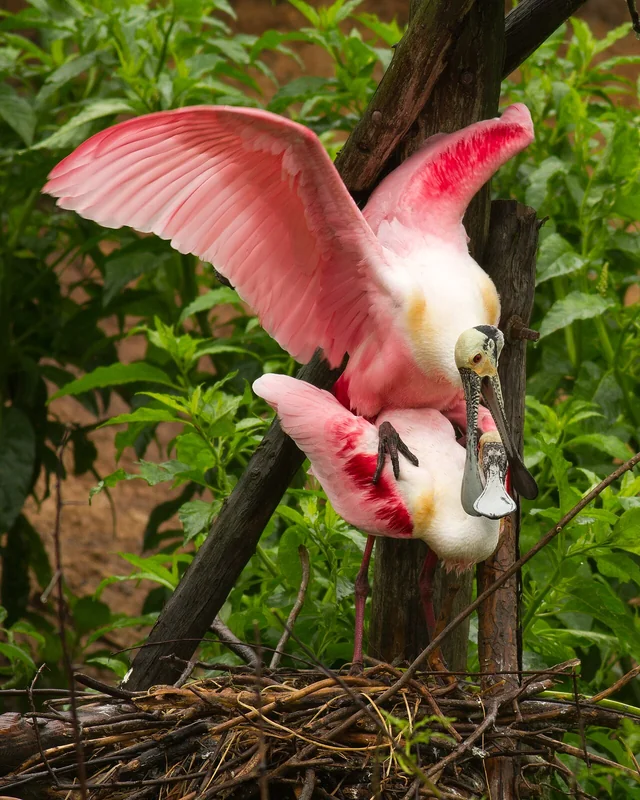
Platalea ajaja, the roseate spoonbill, is a large pink wading bird of the family Threskiornithidae. Adults are 71 to 86 cm long with a wingspan of 1.2 to 1.3 m and weigh 1.2 to 1.8 kg. The plumage is bright pink overall with deeper red shoulder patches, and the bill is grey, flat, and broadly spatulate at the tip. The IUCN lists the species as Least Concern. Roseate spoonbills are the only pink wading birds in the Americas, often confused with flamingos at a glance but unrelated.
Quick facts
- Habitat
- Coastal mangrove swamps, freshwater and brackish marshes, and mudflats. The species favours warm-water shallow wetlands with dense small invertebrate populations.
- Range
- Coastal Florida, southern Texas, southern Louisiana, the Caribbean, Mexico, and most of South America to northern Argentina. The species recovered strongly during the twentieth century from late-nineteenth-century plume-hunting.
- Size
- 71–86 cm body · 120–130 cm wingspan · 1.2–1.8 kg
- Plumage
- Adults are bright pink throughout, with deeper red carmine wing-shoulder patches and tail feathers, an unfeathered greenish-grey head, and a long flat grey bill broadening to a spoon shape at the tip. Juveniles are paler pink-white and develop the rich adult colour over two to three years. Pink intensity is carotenoid-driven and varies with diet quality.
- Song
- A low grunting 'huh-huh-huh' delivered at colonies; the species is mostly silent while foraging. Wing-flapping in flight produces a soft whoosh.
- Migration
- Largely sedentary across the tropical range. Florida and northern Texas populations make short-distance movements south for winter; tropical populations are resident.
- Conservation
- Least Concern (LC)
Overview
Platalea ajaja is the only New World spoonbill — the other five spoonbills are Old World. The species is one of three pink wading birds in the world (with the two American flamingos and the unrelated greater flamingo populations); the resemblance is convergent evolution on carotenoid-rich wetland-invertebrate diets and is not a phylogenetic relationship. The species' Latin name 'ajaja' is from a Tupí-Guaraní word for the species in lowland South America.
Distribution
The breeding range covers coastal Florida, southern Texas, southern Louisiana, the Caribbean, Mexico, Central America, and most of South America to northern Argentina. Late-nineteenth-century plume-hunting reduced US populations dramatically; recovery began with colony protection in the early twentieth century and has been strong across most of the historical range. Florida populations have steadily expanded north along the Atlantic coast in recent decades.
Bill and foraging
The flat spatulate bill of the roseate spoonbill is its diagnostic feature. The bird walks slowly through shallow water with the bill partly open, sweeping it from side to side in a continuous arc. The bill's nerve endings detect any small invertebrate contact and snap the bill shut on the prey. The technique works well for small shrimp, fish fry, and aquatic insects in muddy water where visual hunting would fail.
Sources & further reading (2)
- iucn-red-list — accessed 2026-04-30
- encyclopedia — accessed 2026-04-30
Frequently asked questions
Are roseate spoonbills related to flamingos?
No. The pink colour is convergent — both groups eat carotenoid-rich shrimp and other crustaceans, and both deposit the carotenoids into their feathers. Roseate spoonbills are in the family Threskiornithidae (with the white ibis); flamingos are in the family Phoenicopteridae and have only a distant evolutionary relationship to spoonbills. The pink colour is a dietary signal that has appeared independently in several wetland-bird lineages.
Why are spoonbills so pink?
Roseate spoonbills feed heavily on small shrimp and other crustaceans rich in carotenoid pigments (canthaxanthin, astaxanthin). The carotenoids are deposited unchanged into the feathers during moult, producing the vivid pink colour. The intensity is diet-dependent: birds in poor-quality habitat are duller pink; birds in shrimp-rich coastal mangroves can be brilliantly saturated. The same physiology produces the pink in flamingos.
How does the spoonbill's bill find prey?
The flat spatulate bill is densely packed with mechanoreceptive nerve endings along its inner surface. As the bird sweeps the bill side-to-side through shallow water with the mouth slightly open, any small prey contacting the bill triggers a fast snap-shut response. The technique works in muddy or low-visibility water where visual fishing would fail and is most effective for small fish fry, shrimp, and aquatic insects.