Buceros rhinoceros
Rhinoceros Hornbill (Buceros rhinoceros)
 Featured photorhinoceros-hornbill.jpg
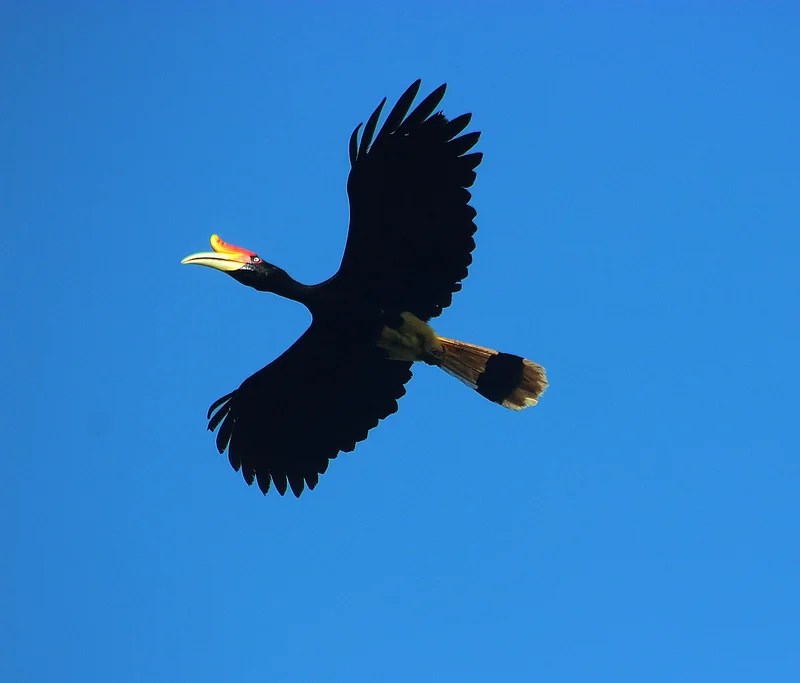
Buceros rhinoceros, the rhinoceros hornbill, is a large hornbill of the family Bucerotidae native to the lowland rainforests of the Malay Peninsula, Sumatra, Java, and Borneo. Adults are 80 to 90 cm long with a wingspan of 110 to 127 cm and weigh 2.1 to 2.7 kg. The species is recognised by its massive yellow and red bill topped with a large upturned orange-red casque. The IUCN lists the species as Vulnerable following rapid deforestation of its lowland forest habitat.
Quick facts
- Habitat
- Lowland and foothill tropical rainforest up to about 1,400 m — associated with large stands of primary dipterocarp forest with emergent fruiting trees. Requires large trees with suitable cavities for nesting. Found in peninsular Malaysia, Sumatra, Java, and Borneo. Cannot persist in heavily logged or plantation-converted forest.
- Range
- Malay Peninsula (southern Thailand and Malaysia), Sumatra, Java, and Borneo (Malaysia, Indonesia, Brunei). The national bird of Malaysia. Three subspecies are recognised; the Bornean populations are the most widely known.
- Size
- 80–90 cm body · 110–127 cm wingspan · 2100–2700 g
- Plumage
- Adults have predominantly black plumage with a white belly and white tail with a broad black subterminal band. The bill is large and strongly curved — yellow at the base, with a vivid orange-red casque rising from the top of the upper mandible and curving upward at the tip like a rhinoceros horn. The orbital skin is red. Sexes are similar but the male has a red iris and the female a white iris.
- Song
- A loud, resonant 'gok-gok-gok' or 'kok-kok' repeated several times, amplified by the casque. Pairs often call together in a loud duet. The call carries far through the forest canopy and is used to advertise territory and locate mates.
- Migration
- Sedentary. Pairs maintain large home ranges within primary or mature forest but do not undertake seasonal migrations. Local movements track fruiting peaks of key tree species.
- Conservation
- Vulnerable (VU)
Overview
Buceros rhinoceros is a member of the genus Buceros within the family Bucerotidae, which contains approximately 60 species of hornbills across Africa and Asia. The rhinoceros hornbill is the national bird of Malaysia and one of the most iconic wildlife symbols of Borneo. It is among the largest hornbills of Asia, comparable in size to the great hornbill (Buceros bicornis). The species is considered sacred by the Dayak peoples of Borneo — its casque feathers and tail feathers are used in traditional regalia and ceremonies. The Iban people of Sarawak use rhinoceros hornbill imagery prominently in longhouse decoration, textiles, and war costumes.
The casque: form and function
The rhinoceros hornbill's casque — a large, upwardly curved projection on top of the bill — is unique in its rhinoceros-horn profile. Unlike the hollow casque of the great hornbill, the rhinoceros hornbill's casque is composed of solid keratin and has been valued historically as a carving material. In China, rhinoceros hornbill casques ('ho-ting' or 'golden jade') were carved into decorative objects for centuries, creating a trade that significantly pressured wild populations. The function of the casque in living birds includes amplification of the resonant call (the casque acts as a resonating chamber), individual recognition, and possibly species recognition between the several co-occurring hornbill species in Bornean forest.
Nesting behaviour and wall-sealing
Rhinoceros hornbills, like most of their family, nest in natural tree cavities. Once a suitable cavity is found, the female enters and seals herself inside using a mixture of mud, droppings, food remains, and bark strips — plastered over the entrance until only a narrow slit remains. The male feeds the female and, later, the chicks through this slit for the entire incubation and brooding period, which lasts approximately four months. The sealed entrance protects the nest against predators. The female breaks out of the nest once the chicks are partially grown, and the chicks then reseal the entrance and are fed by both parents until they are ready to fledge. This extraordinary nesting behaviour is a hallmark of the hornbill family worldwide.
Sources & further reading (2)
- iucn-red-list — accessed 2026-05-07
- encyclopedia — accessed 2026-05-07
Frequently asked questions
Why is the rhinoceros hornbill Malaysia's national bird?
The rhinoceros hornbill was designated the national bird of Malaysia in recognition of its cultural significance to the indigenous peoples of Borneo and its status as an iconic and distinctive representative of Malaysian biodiversity. The bird is deeply embedded in Dayak tradition — its casque and tail feathers are used in traditional headdresses, war costumes, and ceremonial regalia. Its imposing presence and distinctive appearance made it a natural choice as a national symbol.
What is the upturned casque on the bill for?
The rhinoceros hornbill's casque serves several functions: it amplifies the bird's resonant calls by acting as a resonating chamber; it may function in species and individual recognition among the multiple co-occurring hornbill species in Bornean forest; and it has historically been prized as a carving material. The casque is composed of solid keratin and develops progressively with age. Its shape — curving upward at the tip like a rhinoceros horn — is unique to this species.
How long is the female sealed inside the nest?
The female rhinoceros hornbill seals herself inside the nest cavity for the entire incubation and brooding period — approximately four months in total. During this time she is entirely dependent on the male for food, which he delivers through the narrow slit in the plastered entrance. The seal is broken by the female when the chicks are partially grown; the chicks then reseal the entrance and continue to be fed by both parents until fledging.