Pharomachrus mocinno
Resplendent Quetzal (Pharomachrus mocinno)
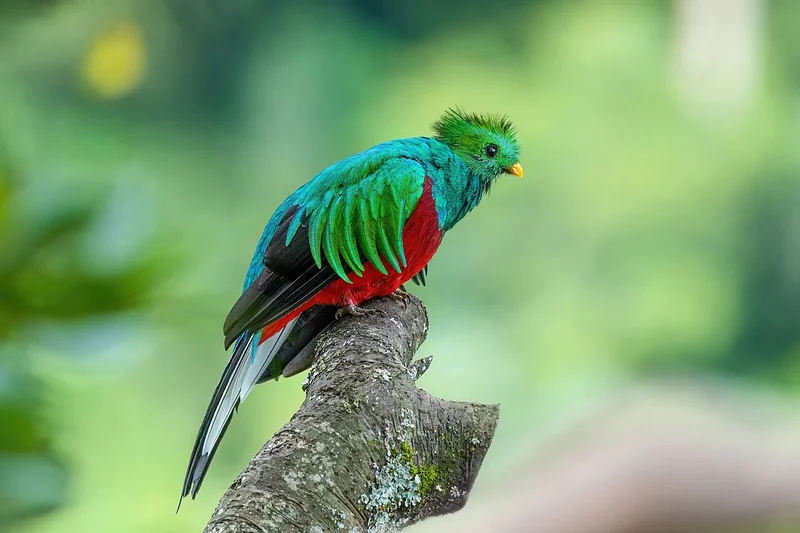 Featured photoresplendent-quetzal.jpg
Pharomachrus mocinno, the resplendent quetzal, is a medium-sized trogon of the family Trogonidae, native to Mesoamerican cloud forests. Adult males are 35 to 40 cm long (excluding tail-coverts that trail another 65 cm in breeding plumage) and weigh 180 to 210 g. The plumage is brilliant iridescent emerald-green above with a vivid crimson breast and belly. The IUCN lists the species as Near Threatened, reflecting cloud-forest habitat loss across the range. The species is the national bird of Guatemala and the namesake of the Guatemalan currency (quetzal).
Quick facts
- Habitat
- Mesoamerican cloud forest at elevations of 1,000-3,000 metres. The species is highly specialized for cloud forest and cannot persist in disturbed or fragmented habitat.
- Range
- Southern Mexico, Guatemala, Belize, Honduras, El Salvador, Nicaragua, Costa Rica, and western Panama. The species' total range is small, restricted to montane cloud-forest belts on both Caribbean and Pacific slopes.
- Size
- 35–40 cm body · 50–60 cm wingspan · 180–210 g
- Plumage
- Adult males in breeding plumage show brilliant iridescent emerald-green head, back, breast, and tail, plus a vivid crimson belly and undertail; the central upper-tail-coverts are extraordinarily elongated, trailing 60-65 centimetres beyond the body in flight. Females are duller — bronze-green head and back, paler grey breast, similar crimson belly, no elongated tail-coverts. Juveniles resemble females. The iridescent green colour is structural, produced by feather microstructure scattering light.
- Song
- Adults give a soft, melancholy two-note whistled 'koy-yo, koy-yo' delivered from a high cloud-forest perch — described in Guatemalan folk culture as the call of the deity Quetzalcoatl. Various harsher chattering calls accompany pair interactions.
- Migration
- Altitudinally migratory. Most populations move between higher-elevation breeding sites and lower-elevation wintering sites within the cloud-forest belt. Long-distance horizontal migration is absent.
- Conservation
- Near Threatened (NT)
Overview
Pharomachrus mocinno is the most spectacular of the five Pharomachrus quetzal species. The species is the national bird of Guatemala, the namesake of the Guatemalan currency (the quetzal), and figures prominently in Mesoamerican mythology — the deity Quetzalcoatl ('feathered serpent') was associated with the species' iridescent plumage. The Mexican naturalist Pablo de la Llave named the species in 1832 after the indigenous Mexican biologist José Mariano Mociño.
Cloud-forest specialization
The species is one of the most specialized cloud-forest birds in the Americas. Resplendent quetzals depend on intact mature cloud-forest at 1,000-3,000 metre elevations and on the wild avocados (Persea) that dominate the diet — both are highly sensitive to forest fragmentation, climate-driven cloud-belt shifts, and direct logging. The IUCN lists the species as Near Threatened reflecting these pressures, and several local populations have been functionally extirpated by deforestation.
Tail-coverts
Adult male resplendent quetzals grow extraordinarily elongated central upper-tail-coverts during the breeding season — trailing 60-65 centimetres beyond the body, twice the body's own length. The tail-coverts (not tail feathers proper) are used in courtship display and trail behind the male in undulating flight, producing one of the most striking flight silhouettes among Neotropical birds. The tail-coverts moult off after the breeding season and regrow each year.
Sources & further reading (2)
- iucn-red-list — accessed 2026-04-30
- encyclopedia — accessed 2026-04-30
Frequently asked questions
How long is a male quetzal's tail?
The 'tail' that trails behind a male quetzal is actually composed of two extraordinarily elongated central upper-tail-coverts (not tail feathers proper). The coverts trail 60-65 centimetres beyond the body in breeding plumage — twice the body's own length. The tail-coverts are used in courtship display and produce one of the most striking flight silhouettes among Neotropical birds. They moult off after the breeding season and regrow each year.
Why is the quetzal the national bird of Guatemala?
The species is closely associated with Mesoamerican mythology — the deity Quetzalcoatl ('feathered serpent') was associated with the species' iridescent plumage. The Mayan and Aztec civilizations harvested male quetzal tail feathers (without killing the birds) as ceremonial regalia for high-status individuals. The bird's modern role as Guatemala's national symbol traces to this pre-Columbian cultural significance; the country's currency (the quetzal) is named after the bird.
Why is the species threatened?
The IUCN lists resplendent quetzal as Near Threatened reflecting cloud-forest habitat loss across the range. The species is highly specialized for intact mature cloud-forest at 1,000-3,000 metre elevations and on wild avocados (Persea) that dominate the diet — both are sensitive to forest fragmentation, climate-driven cloud-belt shifts, and direct logging. Several local populations have been functionally extirpated by deforestation in Costa Rica, Mexico, and elsewhere.