Colinus virginianus
Northern Bobwhite (Colinus virginianus)
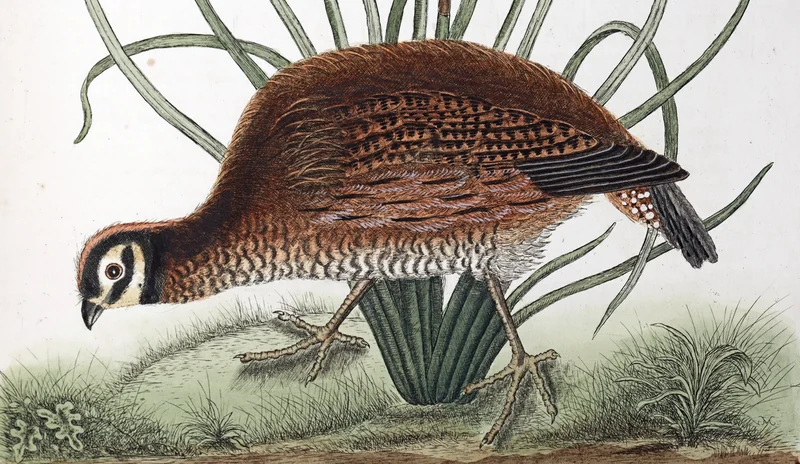 Featured photonorthern-bobwhite.jpg
Colinus virginianus, the northern bobwhite, is a small New World quail of the family Odontophoridae, distributed across the eastern half of the United States and into Mexico. Adults are 24 to 28 cm long with a wingspan of 33 to 38 cm and weigh 140 to 180 g. The plumage is mottled chestnut-brown and grey with bold facial markings — males show a white face, females a buff face. The IUCN lists the species as Near Threatened, reflecting steep population declines across much of the historical range over recent decades.
Quick facts
- Habitat
- Native warm-season grasslands, brushy field margins, agricultural hedges, and pine savanna with grassy understorey. The species requires a mosaic of bare ground, low cover, and herbaceous vegetation that has become rarer with intensification of modern farmland.
- Range
- Eastern half of the United States from southern New England west to the Great Plains and south through Texas and northeastern Mexico to Honduras. Several insular populations in Cuba and elsewhere are isolated.
- Size
- 24–28 cm body · 33–38 cm wingspan · 140–180 g
- Plumage
- Both sexes show mottled chestnut-and-grey upperparts with the boldly streaked underparts characteristic of the genus Colinus. Adult males show a clean white face with a black eyestripe and black crown; adult females show a buff face with the same dark eyestripe. The plumage is cryptic against grass cover and is one of the textbook examples of disruptive camouflage in ground-nesting birds.
- Song
- Males give a clear two- or three-note whistled 'bob-WHITE' or 'bob-bob-WHITE' from spring perches — the source of the species' English name. Coveys also exchange softer 'covey calls' as contact signals when separated.
- Migration
- Resident year-round throughout the range; no regular migration. Local seasonal habitat use shifts but the species generally holds the same area through life.
- Conservation
- Near Threatened (NT)
Overview
Colinus virginianus is one of four Colinus species, all New World quails. The species' breeding range historically covered the entire eastern half of the United States; populations have declined sharply across most of the range over the last fifty years and the IUCN uplisted the species to Near Threatened. The clear two-syllable whistle is one of the most familiar warm-month sounds across the southern US — folk culture has rendered the call as 'bob-WHITE' since the early nineteenth century.
Population decline
Northern bobwhite populations have declined by approximately seventy per cent across the breeding range since the 1960s — one of the most-discussed declines among non-game-listed North American birds. Drivers include the intensification of modern row-crop agriculture (eliminating brushy field margins), suppression of fire in pine savannas (allowing canopy closure that shades out herbaceous understory), and loss of native warm-season grass habitat. Active management programmes have stabilized populations in some southern states.
Behaviour
Northern bobwhites form coveys of twelve to thirty birds outside the breeding season. Coveys roost on the ground in tight rosette formations — birds arranged in a circle facing outward — that conserve heat through cold winter nights and provide all-around predator surveillance. The covey structure dissolves in spring as pairs form for breeding and reassembles after broods fledge. Pairs are socially monogamous; both parents share incubation.
Sources & further reading (2)
- iucn-red-list — accessed 2026-04-30
- encyclopedia — accessed 2026-04-30
Frequently asked questions
Why do bobwhite populations roost in a circle?
Wintering bobwhite coveys roost on the ground in a tight rosette — birds arranged in a circle facing outward, tail to tail. The arrangement conserves heat through cold nights (each bird shares warmth with neighbours), reduces snow exposure, and provides all-around predator surveillance. The circular roost is one of the textbook examples of cooperative thermoregulation and predator avoidance in birds.
Why has the species declined so sharply?
Long-term breeding bird surveys show northern bobwhite populations have declined by approximately seventy per cent since the 1960s. Drivers include modern row-crop agriculture eliminating brushy field margins, fire suppression allowing pine savanna canopies to close and shade out the herbaceous understory the species needs, and broader loss of native warm-season grass habitat across the southeastern United States. The IUCN uplisted the species to Near Threatened reflecting the trend.
Why is the call rendered as 'bob-white'?
The male's spring territorial whistle is a clear two-note rising-then-rising-higher phrase. Folk renderings have transcribed it as 'bob-WHITE' or 'bob-bob-WHITE' (with three notes) since the early nineteenth century — the human-language fit is unusually close to the actual call shape. The convention has produced both the species' English name and the colloquial verb 'to bobwhite' for the call's distinctive cadence.