Aptenodytes forsteri
Emperor Penguin (Aptenodytes forsteri)
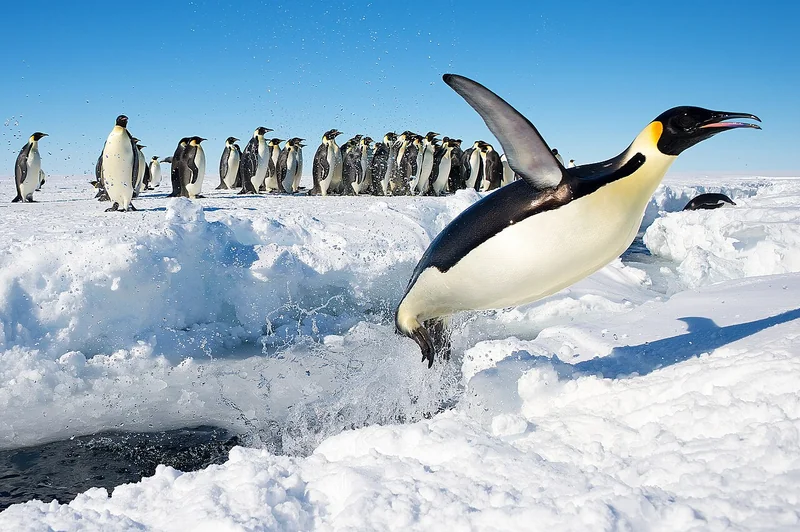 Featured photoemperor-penguin.jpg
Aptenodytes forsteri, the emperor penguin, is the largest and heaviest penguin species and the only animal that breeds through the antarctic winter on the sea ice. Adults are 100 to 130 cm tall and weigh 22 to 45 kg. The plumage is a striking pattern of black back and head, white belly, and a vivid yellow-orange neck patch. The IUCN lists the species as Near Threatened, reflecting projected sea-ice loss under climate change. Adult males incubate the single egg through the entire 65-day antarctic winter, fasting for over four months in blizzards reaching –50 °C.
Quick facts
- Habitat
- Antarctic sea ice and adjacent open water of the Southern Ocean. The species depends on stable winter sea ice for breeding; pack-ice instability under climate warming threatens nearly all known colonies.
- Range
- Circumpolar antarctic. Approximately 60 known breeding colonies on antarctic sea ice; the largest are in the Ross Sea and Weddell Sea regions. Vagrants occasionally reach southern New Zealand and southern South America.
- Size
- 100–130 cm body · 76–89 cm wingspan · 22–45 kg
- Plumage
- Adults show a sharply contrasting pattern: glossy black back, head, and chinstrap; pure white belly and underwings; and a vivid yellow-orange patch behind the eye and along the upper neck. Both sexes look alike. Chicks are covered in dense grey down with a black-and-white face pattern. The flight feathers are dramatically reduced and the wings function as flippers underwater rather than for flight.
- Song
- Adults give complex multi-note vocalizations used for individual recognition between mate pairs and between parents and chicks within the dense colony. The calls function much like signature whistles in dolphins, allowing individuals to find each other among thousands of similar-looking neighbours.
- Migration
- Sedentary on antarctic sea ice; movements track ice extent seasonally. The breeding-season migration is short — adults walk overland on the ice to the breeding colony each March-April.
- Conservation
- Near Threatened (NT)
Overview
Aptenodytes forsteri is the largest of the seventeen modern penguin species and one of the most extreme breeders in the animal kingdom. The species was named in honour of the German naturalist Johann Reinhold Forster, who accompanied James Cook's second voyage to Antarctic waters in 1772-75 and provided the first scientific description of the species. Emperor penguins are the only animal — bird or otherwise — that breeds during the antarctic winter.
Winter breeding
Emperor penguins begin their breeding cycle in March-April, walking up to 120 kilometres overland from open water to the colony site on stable winter sea ice. The female lays a single egg in May and immediately departs back to open sea to feed; the male takes over incubation. For the next 65 days, through the depths of the antarctic winter — blizzards exceeding –50 °C and 200 km/h winds — the male incubates the egg balanced on his feet under a brood pouch of feathers and skin, fasting the entire time. Males huddle in dense aggregations of thousands to share warmth, with individuals rotating from the cold periphery to the warm centre on a continuous cycle.
Diving
Emperor penguins are the deepest-diving birds known. Dives routinely reach 200-500 metres in pursuit of fish and squid; the deepest recorded dive is 564 metres, and the longest recorded duration is 22 minutes. The species is physiologically specialized for the dives — solid bones (most birds have hollow bones), high blood-oxygen capacity, slowed metabolism during dives, and tolerance of high blood-CO2 levels that would cause confusion in most birds. The diving capability supports foraging in the deep krill-and-fish layers below the antarctic sea ice.
Sources & further reading (2)
- iucn-red-list — accessed 2026-04-30
- encyclopedia — accessed 2026-04-30
Frequently asked questions
How do emperor penguins survive the antarctic winter?
Emperor penguins are the only animal that breeds through the antarctic winter. Three adaptations work together: extreme insulation (a layer of dense down beneath the contour feathers, plus 2-3 cm of subcutaneous fat); social huddling (males in incubation huddle in dense aggregations of thousands, rotating from the cold periphery to the warm centre on a continuous cycle); and metabolic suppression (males slow their basal metabolic rate substantially during the four-month fast). The adult male loses 40 per cent of body mass over the incubation period.
How deep can an emperor penguin dive?
Emperor penguins are the deepest-diving birds known. Routine foraging dives reach 200-500 metres; the deepest recorded dive is 564 metres, and the longest recorded duration is 22 minutes. Specialized physiology — solid bones, high blood-oxygen capacity, slowed metabolism during dives, and high CO2 tolerance — supports the extreme diving. The species exceeds the diving performance of any flying bird and rivals that of marine mammals.
Why is the species listed as Near Threatened?
The IUCN uplisted emperor penguin to Near Threatened in 2012 reflecting projected sea-ice loss under climate change. The species depends on stable winter fast-ice for breeding — colonies on unstable ice fail when the ice breaks up before chicks have fledged, and projected antarctic sea-ice declines under continued warming threaten most known colonies. Some current colonies are projected to be functionally extinct by 2100 under high-emissions climate scenarios.