Centrocercus urophasianus
Greater Sage-Grouse (Centrocercus urophasianus)
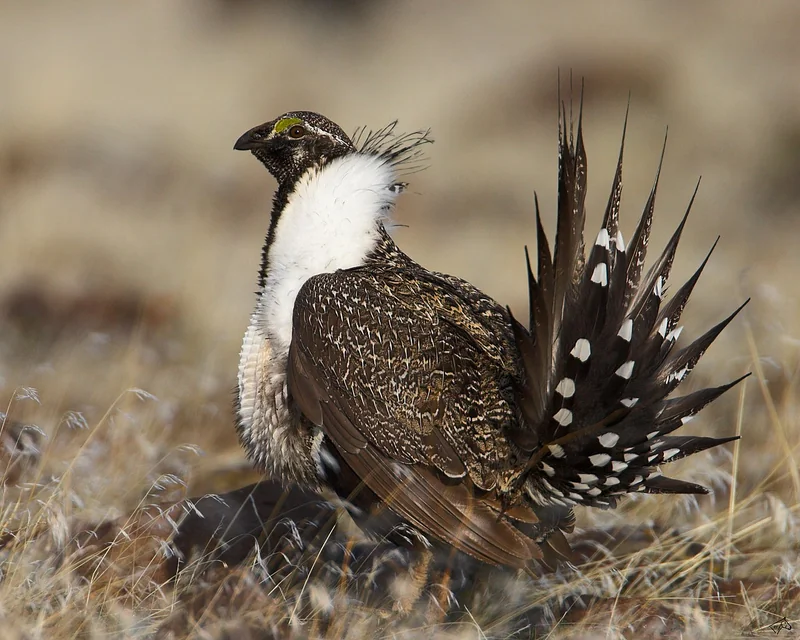 Featured photogreater-sage-grouse.jpg
Centrocercus urophasianus, the greater sage-grouse, is a large gamebird of the family Phasianidae, restricted to sagebrush habitats of the western United States and southern Canada. Adults are 65 to 75 cm long with a wingspan of 88 to 102 cm and weigh 1.4 to 3.2 kg. The plumage is mottled grey-brown with a white breast (more conspicuous in males); males show inflatable yellow air sacs on the throat used in display. The IUCN lists the species as Near Threatened, reflecting habitat loss and population fragmentation across much of the range.
Quick facts
- Habitat
- Sagebrush steppe — open semi-arid grass-and-shrub plains dominated by Artemisia sagebrush. The species is an obligate sagebrush specialist and cannot persist in habitat where sagebrush is absent or degraded.
- Range
- Western United States and southern Canada from southern British Columbia and Alberta south to California, Nevada, Utah, and Colorado. The historical range was substantially larger; current populations are fragmented and reduced.
- Size
- 65–75 cm body · 88–102 cm wingspan · 1.4–3.2 kg
- Plumage
- Adults show heavily mottled grey-brown upperparts that match sagebrush perfectly. Males in display show a brilliant white breast, two large inflatable yellow throat sacs that produce loud popping sounds when discharged, long stiff tail feathers fanned in display, and pointed tufts of feathers behind the head. Females are uniformly cryptic mottled grey-brown.
- Song
- Display males produce a complex sequence of soft cooing notes interspersed with loud pop-pop sounds from inflating and rapidly deflating the air sacs. The vocalizations carry several hundred metres across open sagebrush.
- Migration
- Largely sedentary, with some local seasonal movements between summer and winter sagebrush habitat. No long-distance migration.
- Conservation
- Near Threatened (NT)
Overview
Centrocercus urophasianus is the larger of two Centrocercus sage-grouse species (with the Gunnison sage-grouse C. minimus, split off in 2000). The species is one of the most-studied lek-breeding birds in North America. Sagebrush is essentially the species' only winter food and only effective habitat — the obligate dependence makes the species highly vulnerable to sagebrush loss, fragmentation, and conversion.
Lek breeding
Greater sage-grouse males display on traditional 'leks' — open patches of bare ground or short grass within sagebrush — gathering in groups of dozens to over a hundred males each spring. Each male holds a small territory on the lek and performs the elaborate strutting display: tail fanned, breast puffed, air sacs inflated and discharged in rapid pop sequences. Females visit the lek, observe the males, and mate with the few highest-ranking dominant males. Lek breeding is the textbook example of female mate choice driving extreme male sexual ornamentation.
Conservation
Greater sage-grouse populations have declined substantially across most of the historical range due to sagebrush habitat loss to agriculture, energy development, road construction, and invasive grass conversion. The IUCN listing is Near Threatened; some US states have considered or adopted formal conservation status. Active sagebrush restoration and lek-protection programmes are ongoing across the western US, but the obligate sagebrush dependency makes the species highly sensitive to any loss of intact habitat.
Sources & further reading (2)
- iucn-red-list — accessed 2026-04-30
- encyclopedia — accessed 2026-04-30
Frequently asked questions
What is a lek?
A lek is a traditional open ground site where males gather to perform mating displays for visiting females. Each male holds a small territory on the lek and performs the species' display; females visit, observe the males, and mate with the few highest-ranking individuals. Lek breeding is documented in many bird groups but reaches its most elaborate form in the grouse, manakins, and birds-of-paradise — sage-grouse leks are one of the canonical examples in ornithology textbooks.
Why are sage-grouse so dependent on sagebrush?
Greater sage-grouse are one of the only bird species in North America that subsist on a leaf-only diet through autumn and winter — and the leaves they take are almost exclusively from Artemisia sagebrush. The plant provides both food and the visual concealment from predators that the species' camouflage plumage relies on. Loss or degradation of intact sagebrush habitat eliminates both food and shelter, making the species an obligate sagebrush specialist.
Why is the species declining?
Sagebrush habitat across the western United States has been reduced by agriculture, energy development (oil, gas, wind), road construction, and conversion to invasive grasses such as cheatgrass that fuel wildfire cycles unfavourable to sagebrush regeneration. Greater sage-grouse populations have correspondingly declined and fragmented. The species is listed as Near Threatened by the IUCN; active habitat restoration and lek protection are ongoing across the range.