Agelaius phoeniceus
Red-winged Blackbird (Agelaius phoeniceus)
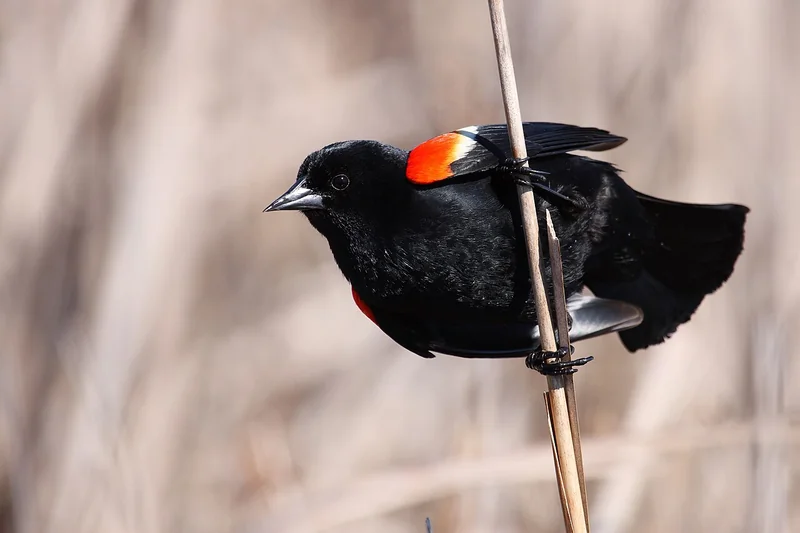 Featured photored-winged-blackbird.jpg
Agelaius phoeniceus, the red-winged blackbird, is a medium-sized icterid blackbird widely distributed across North America. Adults are 17 to 23 cm long with a wingspan of 31 to 40 cm and weigh 32 to 77 g. Adult males are uniformly glossy black with bright red shoulder patches edged in yellow; females are streaky brown and easily mistaken for a sparrow at a distance. The IUCN lists the species as Least Concern. The red-winged blackbird is among the most numerous breeding birds in North America, with a continental population of well over one hundred million.
Quick facts
- Habitat
- Freshwater and brackish marshes, wet meadows, hayfields, and increasingly upland farmland. Cattail marshes are the textbook breeding habitat, but the species also nests heavily in roadside ditches and grain fields.
- Range
- Most of North America from southern Alaska and Canada south through the contiguous United States to Mexico and Central America. Northern populations migrate; central and southern populations are resident year-round.
- Size
- 17–23 cm body · 31–40 cm wingspan · 32–77 g
- Plumage
- Adult males are glossy black throughout with a bright scarlet shoulder patch edged below by a thinner yellow band — the 'red-and-yellow epaulet' that gives the species its name. The patch is normally partly covered when the bird is at rest; territorial males flash and erect it during display. Females and juveniles are heavily streaked brown above and below with a paler pinkish-buff supercilium.
- Song
- A loud, distinctive 'konk-la-ree!' or 'oak-a-lee!' delivered from a high perch — typically a cattail stalk or fencepost — with the wings spread to flash the red epaulets.
- Migration
- Partial migrant. Northern populations move south for winter; southern populations are resident. Wintering flocks at Gulf-coast roosts can number in the millions.
- Conservation
- Least Concern (LC)
Overview
Agelaius phoeniceus is one of the most numerous breeding birds in North America, with a continental population estimated by Partners in Flight at over one hundred eighty million. The species is classically polygynous — a single male defends a marsh territory and pairs with multiple females (sometimes ten or more) — and brood sex ratios across multi-female territories show the textbook pattern of female-biased investment when male territory quality is high.
Distribution
The breeding range covers most of North America from southern Alaska and Canada south through the contiguous United States to northern Central America. Cattail marshes and wet meadows are the core habitat, but the species has expanded into upland hayfields and grain agriculture across much of the United States Midwest, increasing its overall numbers despite local marsh loss.
Display
Territorial male red-winged blackbirds give a stereotyped 'song-spread' display from a high perch: the bird sings the loud 'konk-la-ree' phrase while spreading its wings, raising the shoulder feathers, and erecting the red epaulets to maximum visibility. Experimentally darkening or removing the red patch in captured males drops their territory-holding success sharply — the patch is the primary signal of male competitive ability.
Sources & further reading (2)
- iucn-red-list — accessed 2026-04-29
- encyclopedia — accessed 2026-04-29
Frequently asked questions
Why are male red-winged blackbirds polygynous?
Male red-winged blackbirds defend high-quality marsh territories that vary substantially in food and nest-site availability. Females select territories more than males, and a male holding an excellent territory can attract multiple females sequentially — sometimes ten or more — while a male on a poor territory may attract none. The polygyny is therefore a consequence of variation in territory quality, not of male coercion.
What does the red shoulder patch signal?
The red epaulets are a primary territorial signal. Experimental painting of the patches black sharply reduces a male's ability to defend his territory; both other males and approaching females respond to the visible red as the indicator of an intact male competitor. The yellow lower edge of the patch may signal age and condition, with older males showing more saturated yellow.
Why do female red-winged blackbirds look like sparrows?
Females are heavily streaked brown above and below — superficially much like several streaky brown sparrows. The cryptic plumage likely reflects different selection pressures on the two sexes: males face strong sexual selection for conspicuous epaulets, while females incubate and brood close to nest height in cattails and benefit from camouflage. The size and shape — pointed bill, longer tail — separate them from true sparrows on closer view.