Buteo jamaicensis
Red-tailed Hawk (Buteo jamaicensis)
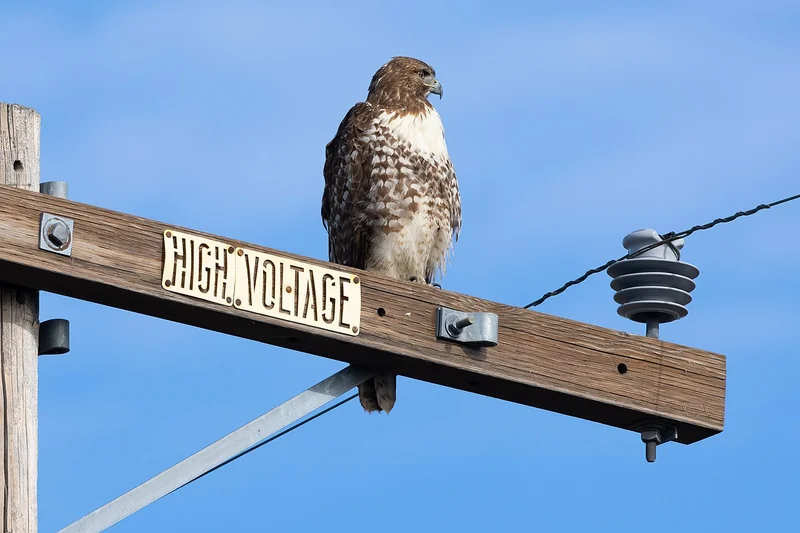 Featured photored-tailed-hawk.jpg
Buteo jamaicensis, the red-tailed hawk, is a large buteonine hawk of the family Accipitridae, distributed across most of North America. Adults are 45 to 65 cm long with a wingspan of 110 to 145 cm and weigh 0.7 to 1.6 kg. The plumage is highly variable across regional morphs but the diagnostic adult feature — a brick-red tail — is consistent. The IUCN lists the species as Least Concern. The red-tailed hawk is the most numerous and widely seen large hawk in North America, frequently observed soaring over highways and farmland.
Quick facts
- Habitat
- Open and partly wooded country — fields, prairies, marshes, deserts, woodland edges, and roadside corridors. The species is among the most adaptable raptors in North America and occurs from coastal sea level to high mountain alpine zones.
- Range
- Across most of North America from Alaska and Canada south through the United States, Mexico, and Central America to Panama, plus the West Indies. The species shows considerable regional plumage variation across over a dozen subspecies.
- Size
- 45–65 cm body · 110–145 cm wingspan · 0.7–1.6 kg
- Plumage
- Highly variable. Most adults show dark brown upperparts, a pale buff to white breast and belly with a darker 'belly band' of streaks across the lower abdomen, and the diagnostic brick-red upper tail. Several regional morphs exist — the western 'Krider's' form is much paler, the 'Harlan's' form (formerly a separate species) is dark sooty-grey-brown with a paler tail, the eastern dark morph is uniformly chocolate brown.
- Song
- A loud, descending raspy scream often transcribed as 'keeer-r-r' — among the most familiar raptor calls in North America. Hollywood films routinely use this call as a generic 'large bird of prey' sound, even for unrelated species.
- Migration
- Partial migrant. Northern populations move south for winter; central and southern populations are largely resident. Migration concentrations along major flyways (Hawk Mountain, Cape May) routinely number in the thousands.
- Conservation
- Least Concern (LC)
Overview
Buteo jamaicensis is one of the most numerous and widely distributed large raptors in the Americas. Over a dozen recognized subspecies span the geographic and ecological range, with substantial plumage variation among regional morphs. The 'Harlan's hawk', formerly treated as a separate species (B. harlani), is now lumped as a dark-morph subspecies of the red-tail. The species is one of the most-studied raptors in North American falconry and ecology.
Distribution
The breeding range covers nearly all of North America from Alaska to Panama, plus the West Indies. The species' adaptability and broad diet have driven a continental population estimated by Partners in Flight at over two million individuals — among the highest of any large raptor. Roadside utility poles and fence posts provide ideal hunting perches in agricultural areas, and the species is among the most-seen raptors from American highways.
Behaviour
Red-tailed hawks hunt from a perch, dropping or gliding onto prey with a short attack flight. The species' broad wings and short tail are classic Buteo body plan, optimized for soaring on thermals over open country. Pairs are socially monogamous and often use the same nest for many years, adding material each spring. The species is a popular falconry bird in North America, particularly with novice falconers, partly because of its adaptability and tolerance of training.
Sources & further reading (2)
- iucn-red-list — accessed 2026-04-29
- encyclopedia — accessed 2026-04-29
Frequently asked questions
Why does the Hollywood 'eagle scream' actually come from a red-tailed hawk?
The bald eagle's actual call is a weak, high-pitched chittering — not cinematically dramatic. Hollywood films and television routinely overdub bald eagle visuals with the descending raspy scream of the red-tailed hawk, which is louder, lower-pitched, and far more dramatic. The convention is so consistent that most viewers genuinely believe the red-tail's scream is the eagle's call.
Why is the red-tailed hawk so variable in plumage?
The species occupies an exceptionally wide range of habitats across the Americas, and over a dozen subspecies show local adaptation in plumage. The pale 'Krider's' form is associated with open prairie, the dark 'Harlan's' form with the boreal forest of Alaska and northwestern Canada, the eastern dark morph with northern forest, and so on. The brick-red tail is the most consistent field mark across the variation.
Why is the red-tailed hawk so common from highways?
Two factors combine. The species is broadly tolerant of human-modified habitat and hunts effectively from a fixed perch. Highway utility poles, fence posts, and roadside trees give a tall stable lookout overlooking open ground (mowed verges, agricultural fields) where small mammals are abundant and visible. Roadside hunting therefore concentrates the species at exactly the places that human travellers see them.