Phalaropus lobatus
Red-necked Phalarope (Phalaropus lobatus)
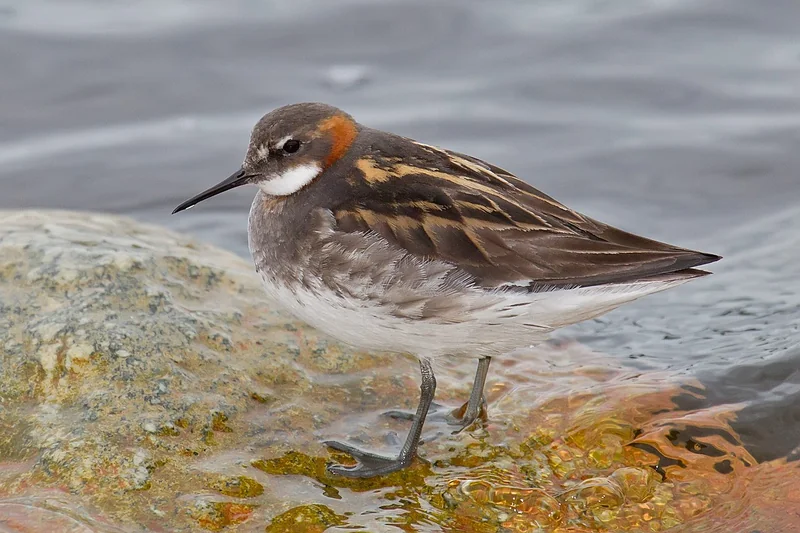 Featured photored-necked-phalarope.jpg
Phalaropus lobatus, the red-necked phalarope, is a small shorebird of the family Scolopacidae that spends most of its life on the open ocean. Adults are 18 to 19 cm long with a wingspan of 31 to 34 cm and weigh 25 to 45 g. The species is famous for reversed sexual roles — females are the more brightly coloured sex and compete for males, while males incubate eggs and rear chicks. The IUCN lists the species as Least Concern.
Quick facts
- Habitat
- Breeds on shallow pools, bogs, and wetland margins of the subarctic and low Arctic. Outside the breeding season, spends most of its time on the open ocean — particularly upwelling zones of the Arabian Sea, Pacific, and Atlantic.
- Range
- Breeds in a circumpolar subarctic belt from Iceland, Scandinavia, and Russia through Alaska and northern Canada. Winters mainly on the open ocean — Bay of Bengal, Arabian Sea, Pacific off Peru, and Atlantic off West Africa.
- Size
- 18–19 cm body · 31–34 cm wingspan · 25–45 g
- Plumage
- Breeding females (the brighter sex) show a dark grey-brown head and back, rich chestnut-orange patch on the neck sides and throat, white supercilium, and white underparts. Breeding males are duller, with paler neck patches. Non-breeding adults are pale grey above and white below with a black eye-patch. The needle-fine bill distinguishes phalaropes from other sandpipers.
- Song
- A sharp 'whit' or 'kit' flight call, often repeated. The species is largely silent at sea. On breeding grounds gives a low chatter during territorial interactions.
- Migration
- Long-distance transoceanic migrant. Breeding populations in the Northern Hemisphere fly to tropical and subtropical ocean upwelling zones, travelling thousands of kilometres over open water. Rarely seen on land outside the breeding season.
- Conservation
- Least Concern (LC)
Overview
Phalaropus lobatus is one of three phalarope species — the others are the red phalarope (P. fulicarius) and Wilson's phalarope (P. tricolor). All three show some degree of reversed sex roles. The genus name Phalaropus means 'coot-foot' in Greek, referring to the lobed toes that allow the birds to swim buoyantly on the open ocean. The red-necked phalarope is the smallest and most northerly-breeding of the three, nesting within the subarctic belt rather than the full Arctic.
Spinning behaviour and prey capture
Red-necked phalaropes are famous for spinning rapidly on the water surface — up to 60 rotations per minute — creating a small vortex that sucks invertebrates up from the substrate or water column to within bill reach. The behaviour is seen both on freshwater pools and at sea. At ocean upwelling zones, large aggregations of phalaropes gather where zooplankton concentrations are highest, and the birds may spin for hours, picking items from the churned water with rapid bill movements.
Reversed sexual roles
In red-necked phalaropes, the usual avian sex-role pattern is reversed. Females are larger and more brightly coloured than males, arrive first on breeding grounds, establish territories, and compete aggressively for males. After laying 3–4 eggs, the female leaves and may attempt to acquire another mate. The male alone incubates the eggs (18–20 days) and raises the chicks to fledging at 17–21 days. This polyandry is rare among birds and is associated with the ecology of short Arctic breeding seasons, where speed of breeding favours division of roles.
Sources & further reading (2)
- iucn-red-list — accessed 2026-05-07
- encyclopedia — accessed 2026-05-07
Frequently asked questions
Why do red-necked phalaropes spin on the water?
The spinning creates a small vortex that sucks invertebrates — zooplankton, insect larvae, small crustaceans — upward from the substrate or water column to within bill reach. The behaviour is highly energy-efficient for the bird's small size and is a unique foraging adaptation. It works both on freshwater pools on the breeding grounds and on the open ocean, where the birds concentrate at upwelling zones rich in surface zooplankton.
Why are female phalaropes more colourful than males?
The reversal of the usual bird colour dimorphism is linked to reversed sex roles. Because males perform all incubation and chick-rearing, females compete for access to males. Selection for traits that attract mates (bright plumage, larger size, aggressiveness) therefore acts on females rather than males — the reverse of the typical avian pattern. This is called sex-role reversal and is associated with polyandrous mating systems where females pair with multiple males.
Where do red-necked phalaropes spend the winter?
Most winter on the open tropical and subtropical ocean, particularly in areas of high biological productivity: the Arabian Sea off Oman, the Bay of Bengal, the Pacific off Peru, and zones off West Africa. They are pelagic birds — spending months at sea without landing — and associate with upwelling zones where zooplankton concentrations are highest. Some winter off the Pacific coast of Central America.