Phaethon aethereus
Red-billed Tropicbird (Phaethon aethereus)
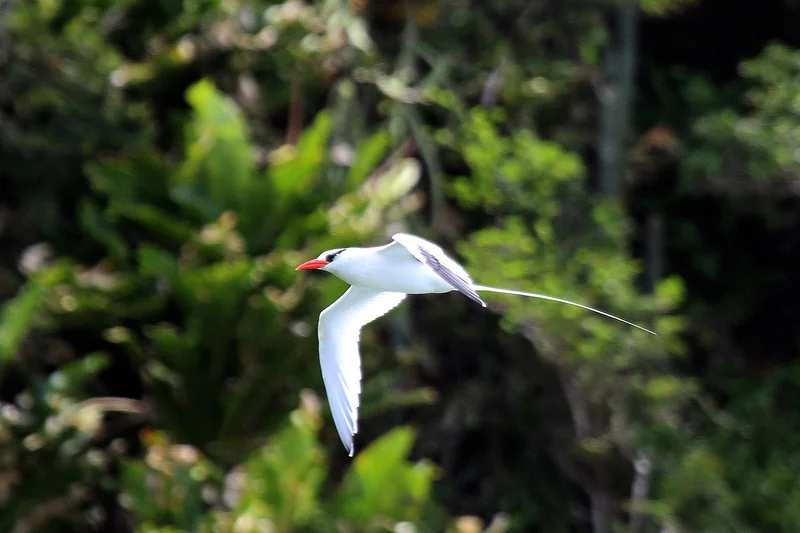 Featured photored-billed-tropicbird.jpg
Phaethon aethereus, the red-billed tropicbird, is a medium-to-large seabird of the family Phaethontidae that breeds on remote islands across the tropical Atlantic, Indian Ocean, and eastern Pacific. Adults measure 90 to 105 cm including the elongated white central tail streamers, with a wingspan of 99 to 106 cm and weight of 600 to 800 g. The species is recognised by its vivid red bill, white plumage with black barring, and long white tail streamers. The IUCN lists the species as Least Concern.
Quick facts
- Habitat
- Open tropical and subtropical ocean far from land — foraging over deep water, especially above areas of oceanic upwelling where flying fish and squid are concentrated. Breeds on rocky oceanic islands and sea cliffs, nesting in crevices and ledges. Returns to land only to breed.
- Range
- Breeds on islands across the tropical Atlantic (including Ascension Island, St Helena, the Caribbean), the Red Sea, Persian Gulf, and Indian Ocean, and in the eastern tropical Pacific. A pantropical species of open ocean. Three subspecies are recognised.
- Size
- 90–105 cm body · 99–106 cm wingspan · 600–800 g
- Plumage
- Adults are predominantly white with a fine black barring on the upperparts, a black mask through the eye, black outer primary feathers, and two extremely long white central tail streamers that may exceed 50 cm. The bill is vivid red. Immature birds lack the tail streamers and have more extensive black barring. The finely barred upperpart pattern and red bill distinguish this species from the red-tailed tropicbird (P. rubricauda) and white-tailed tropicbird (P. lepturus).
- Song
- A harsh, grating 'kek-kek-kek' or rattling call given at nest sites and during aerial chases. Largely silent at sea. Colonial nesting areas produce a cackling chorus during territorial disputes.
- Migration
- Largely sedentary around breeding islands but ranges widely over open ocean between breeding attempts. Not a traditional long-distance migrant. Wanders far from breeding colonies during the non-breeding season and is occasionally recorded well outside its normal range.
- Conservation
- Least Concern (LC)
Overview
Phaethon aethereus is one of three species in the family Phaethontidae — the tropicbirds — a small, distinctive family of pelagic seabirds whose closest relatives have been the subject of significant taxonomic debate. Morphological and molecular analyses have placed tropicbirds variously with pelicans and gannets (Suliformes), with sungrebes and other near-passerines, and most recently in their own order, Phaethontiformes. Tropicbirds are specialist aerial plunge-divers of open tropical ocean, rarely coming to land except to breed and entirely unable to walk or stand — they can only shuffle on their bellies at the nest site.
Plunge-diving technique and prey capture
The red-billed tropicbird forages by flying at height over open ocean — typically 10–30 m above the surface — scanning for the movement of flying fish or squid near the surface. Upon detecting prey, the bird folds its wings and dives steeply, entering the water at high speed with the bill. Tropicbird plunge dives are less steeply angled than those of gannets and boobies — the birds typically enter the water at around 45 degrees. After brief pursuit underwater, the bird surfaces and swallows the prey whole before taking flight again. Flying fish are attracted to bright moonlit nights near the surface, and tropicbirds are known to forage nocturnally on moonlit nights.
Breeding biology and courtship
Red-billed tropicbirds breed on remote oceanic islands, nesting in rock crevices, cliff ledges, or under boulders where shade provides some protection from tropical heat. Courtship involves aerial displays in which two or more birds fly in tight spiralling groups, with tail streamers rippling behind — one of the most visually distinctive courtship displays of any seabird. A single egg is laid directly on bare rock or into a crevice. Incubation is shared by both parents and takes approximately 45 days. The chick is brooded and fed at the nest for approximately 70–90 days before fledging. Parents locate and return to nest sites with great fidelity across years.
Sources & further reading (2)
- iucn-red-list — accessed 2026-05-07
- encyclopedia — accessed 2026-05-07
Frequently asked questions
What are the long white streamers on tropicbirds?
The long central tail streamers of the red-billed tropicbird are elongated, ribbon-like central tail feathers — the two innermost tail feathers (rectrices) are greatly extended into flexible white streamers that may reach 50 cm or more in length. They flutter behind the bird in flight, giving it a distinctive kite-like silhouette. The streamers are likely a sexually selected ornament — longer-streamered individuals may be preferred as mates, as in other birds with elongated tail ornaments. The streamers are shed and regrown annually.
Why can't tropicbirds walk?
Tropicbirds have legs set very far back on the body — an adaptation for swimming and plunge-diving that renders them nearly incapable of standing upright or walking on land. They shuffle on their bellies when at the nest site, pushing themselves along with their feet. This body plan is shared with other highly pelagic seabirds such as loons, but is extreme in tropicbirds. The birds are entirely at ease on the water and in the air, spending most of their lives over open ocean, but are helpless on flat ground.
How is the red-billed tropicbird different from other tropicbirds?
Three tropicbird species occur globally: the red-billed (P. aethereus), the red-tailed (P. rubricauda), and the white-tailed (P. lepturus). The red-billed is the largest of the three and is distinguished by its vivid red bill (the red-tailed has a red tail and a yellow-orange bill; the white-tailed has a yellow bill and white or red tail streamers depending on subspecies), its barred upperparts, and its distribution across the Atlantic, Indian Ocean, and eastern Pacific — the widest ocean range of the three species.