Trichoglossus moluccanus
Rainbow Lorikeet (Trichoglossus moluccanus)
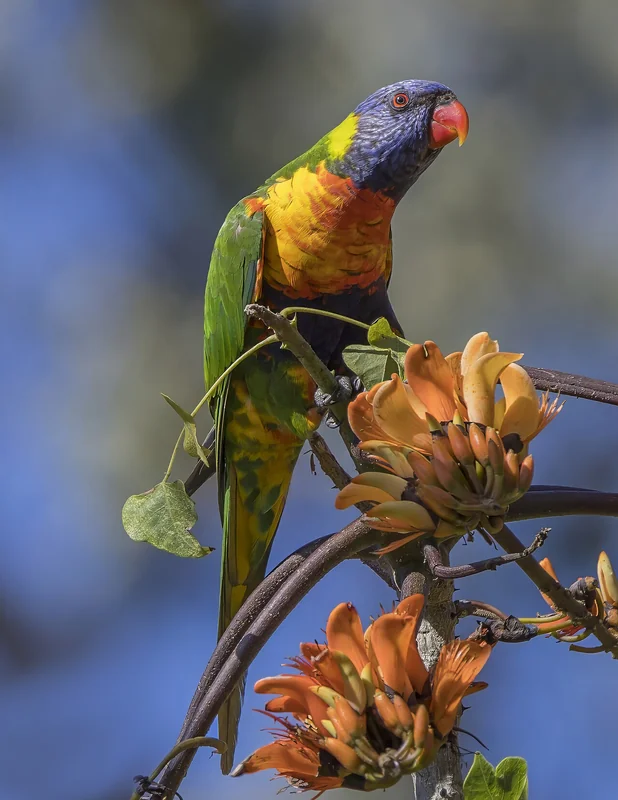 Featured photorainbow-lorikeet.jpg
Trichoglossus moluccanus, the rainbow lorikeet, is a medium-sized parrot of the family Psittacidae, one of the most colourful and abundant birds of eastern Australia. Adults are 25 to 30 cm long with a wingspan of 43 to 48 cm and weigh 75 to 157 g. The plumage combines blue, green, yellow, red, and orange in a vivid pattern matched by few other birds worldwide. The IUCN lists the species as Least Concern. Introduced feral populations exist in southwestern Australia and New Zealand.
Quick facts
- Habitat
- Tropical and subtropical forest, rainforest edges, woodland, heath, suburban parks, and gardens across eastern Australia. Highly adaptable — one of the most common birds in Australian coastal cities wherever flowering trees are planted. Also found in the Moluccas, New Guinea, and the Bismarck Archipelago.
- Range
- Eastern Australia from Cape York Peninsula south through Queensland, New South Wales, Victoria, and South Australia to Kangaroo Island. Also occurs naturally in eastern Indonesia and New Guinea. Introduced and established in Perth (Western Australia) and Auckland (New Zealand).
- Size
- 25–30 cm body · 43–48 cm wingspan · 75–157 g
- Plumage
- Adults are vivid green on the back, wings, and tail; blue on the head, belly, and thighs; red on the breast with yellow-orange breast-streaks; and yellow-green on the nape collar. The bill is orange-red. The combination of five or more distinct colours in bold, high-contrast patches gives the species its popular name. Sexes are similar; juveniles are duller with a darker bill.
- Song
- A loud, shrill, rolling screech — one of the most noisy parrots of Australia. Large flocks produce a continuous chattering roar audible hundreds of metres away. Also gives softer chirruping calls in close contact.
- Migration
- Largely nomadic, following the sequential flowering of eucalypts across the landscape. Large flocks move through coastal and inland areas tracking the most productive flower crops. Not a regular long-distance migrant.
- Conservation
- Least Concern (LC)
Overview
Trichoglossus moluccanus was until recently treated as a subspecies of the rainbow lorikeet complex (T. haematodus), but is now recognised as a distinct species by most authorities including the IOC. The genus name Trichoglossus means 'hair-tongue' in Greek — a reference to the brush-tipped tongue. The species is one of a subfamily of lorikeets (Loriinae) — a group of approximately 50 parrots specialised for nectarivory, found from Australia and New Guinea through the Pacific islands. Lorikeets represent the most extensive radiation of nectarivorous parrots globally.
Brush-tipped tongue
The rainbow lorikeet's tongue tip is covered with papillae — fine, brush-like projections that collect pollen and nectar more efficiently than a smooth tongue. When the bird inserts its tongue into a flower, the papillae trap pollen grains and the liquid nectar is wicked upward by capillary action. The species can lick a flower many times per second during feeding. This specialised tongue distinguishes lorikeets from all other parrots (which are primarily seed-eaters with smooth, fleshy tongues) and is the defining morphological adaptation of the Loriinae subfamily.
Urban colonisation and communal roosts
Rainbow lorikeets have undergone a dramatic expansion into Australian coastal cities during the 20th and 21st centuries, tracking the planting of exotic and native flowering trees in suburban gardens and parks. The species is now the most abundant parrot in Sydney, Brisbane, and Melbourne, with large communal roosts (sometimes exceeding 10,000 birds) in urban trees at sunset. Introduced populations in Perth (Western Australia) — where the species was not native — and New Zealand have required management due to competition with native nectar-feeding birds and agricultural damage to fruit crops.
Sources & further reading (2)
- iucn-red-list — accessed 2026-05-07
- encyclopedia — accessed 2026-05-07
Frequently asked questions
How does the brush-tipped tongue work?
The rainbow lorikeet's tongue tip is covered with fine brush-like papillae that collect pollen grains and help wick nectar from flower surfaces. The rapid licking motion — up to several licks per second — efficiently harvests nectar and pollen from flowers. The species is an important pollinator of many Australian flowering plants, transferring pollen between flowers as it forages. The tongue tip is visibly different from the smooth tongue of seed-eating parrots.
Are rainbow lorikeets good pollinators?
Yes — rainbow lorikeets are significant pollinators of many Australian flowering plants, particularly eucalypts, banksias, and grevilleas. Pollen collects on the bird's face and tongue during feeding and is transferred to the next flower visited. Studies have shown that some eucalypt species depend substantially on rainbow lorikeet pollination, particularly in urban areas where bees are less abundant. The species' nomadic movements also transfer pollen between trees separated by greater distances than bees typically travel.
Why are rainbow lorikeets considered a problem in Perth and New Zealand?
Rainbow lorikeets are not native to Perth (Western Australia) or New Zealand and were introduced accidentally or deliberately. In Perth, the introduced population competes with native honeyeaters and other nectar-feeding birds for flowers, and raids stone fruit orchards. In New Zealand the species competes with native birds and is classified as an unwanted organism. Management programmes including trapping and culling have been implemented in both locations to control population growth.