Spinus pinus
Pine Siskin (Spinus pinus)
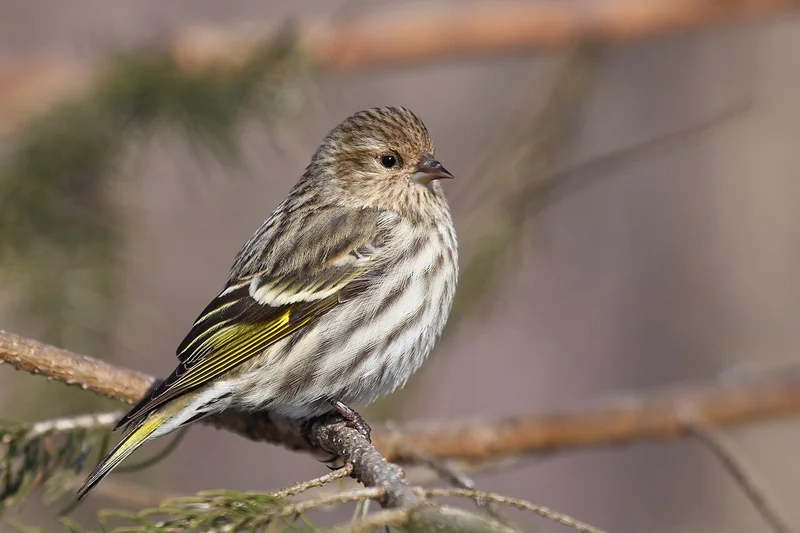 Featured photopine-siskin.jpg
Spinus pinus, the pine siskin, is a small finch of the family Fringillidae, distributed across North American boreal and montane conifer forests. Adults are 11 to 14 cm long with a wingspan of 18 to 22 cm and weigh 12 to 18 g. The plumage is heavily streaked brown-and-buff with bright yellow patches in the wings and tail visible in flight. The IUCN lists the species as Least Concern. Pine siskins are highly nomadic and undertake unpredictable irruptive movements south from the boreal range in years when conifer-seed crops fail.
Quick facts
- Habitat
- Coniferous and mixed forest across the boreal and montane zones. In irruption winters the species visits backyard feeders and weedy fields anywhere south of the breeding range.
- Range
- Breeds across boreal Canada and the western mountain ranges south to central Mexico. Winters irregularly across most of the United States and northern Mexico, with year-to-year variation driven by cone-crop conditions on the breeding range.
- Size
- 11–14 cm body · 18–22 cm wingspan · 12–18 g
- Plumage
- Both sexes show heavily streaked brown-and-buff upperparts and underparts, with thin sharp dark streaking running across the entire body. Bright yellow patches at the base of the wing primaries and along the basal edges of the tail flash conspicuously in flight — the most reliable field mark separating pine siskin from other small streaky finches. Sexes are similar; juveniles are slightly more buff-toned.
- Song
- A long warbling jumble of musical phrases similar to other Spinus finches, often interrupted by a distinctive ascending buzzy 'zzzzzeee' note unique to the species. The flight call is a sharp 'bzzz-jeet'.
- Migration
- Highly irruptive and nomadic. In years when boreal conifer-seed crops fail, large flocks move far south to lower latitudes; in good cone-crop years, most birds remain on the breeding range. The species' winter occurrence in any region varies enormously between years.
- Conservation
- Least Concern (LC)
Overview
Spinus pinus is one of about a dozen Spinus species worldwide (with the closely related American goldfinch S. tristis). The species was historically placed in the genus Carduelis but was moved to Spinus on molecular evidence. The species' English name 'siskin' is from a German word for the closely related Eurasian siskin (Spinus spinus), originally onomatopoeic from the species' call.
Irruption ecology
Pine siskin populations show some of the most pronounced irruptive movements among North American songbirds. In years when boreal conifer-seed crops fail, large flocks move far south to lower latitudes — sometimes reaching the Gulf coast and northern Mexico. In good cone-crop years, most birds remain on the breeding range. The species' winter occurrence at any given feeder station can vary by a factor of one hundred or more between consecutive years.
Behaviour
Pine siskins are highly social and travel in tight flocks of dozens to hundreds, especially during the non-breeding season. The flocks descend on suitable seed-rich habitat and remain for days or weeks before moving on. The species' tameness around humans during irruption winters — birds will often allow approach to within a metre or two — has made it a familiar feeder visitor across most of North America in irruption years.
Sources & further reading (2)
- iucn-red-list — accessed 2026-04-30
- encyclopedia — accessed 2026-04-30
Frequently asked questions
What is a pine-siskin irruption?
An irruption is a year in which pine siskins move much further south than typical, sometimes reaching the Gulf coast and northern Mexico. Irruption years follow conifer-seed-crop failures on the boreal breeding range — the surplus birds move south in search of food. Irruption years are unpredictable and may bring flocks of dozens to hundreds of pine siskins to backyard feeders in regions where the species is normally rare or absent.
How do pine siskins extract conifer seeds?
Pine siskins use their slim pointed bill to pry open the scales of conifer cones and extract the seeds inside. The species hangs upside-down from cone clusters at branch tips, working through one cone at a time. Larger conifer cones (Douglas fir, white spruce) are routine; smaller cones (alder, birch) are easily handled. Foraging dexterity is similar to that of crossbills, the most-specialized cone-feeding finches.
How far south do pine siskins move in big irruption years?
Major irruption years can bring pine siskins as far south as the Gulf coast and into northern Mexico. The 2008-09 irruption was one of the largest documented, with flocks of pine siskins reported at backyard feeders across the eastern United States and the Gulf states. Banding studies show individual birds can travel over 2,000 km from the breeding range during a single irruption season.