Dryocopus pileatus
Pileated Woodpecker (Dryocopus pileatus)
 Featured photopileated-woodpecker.jpg
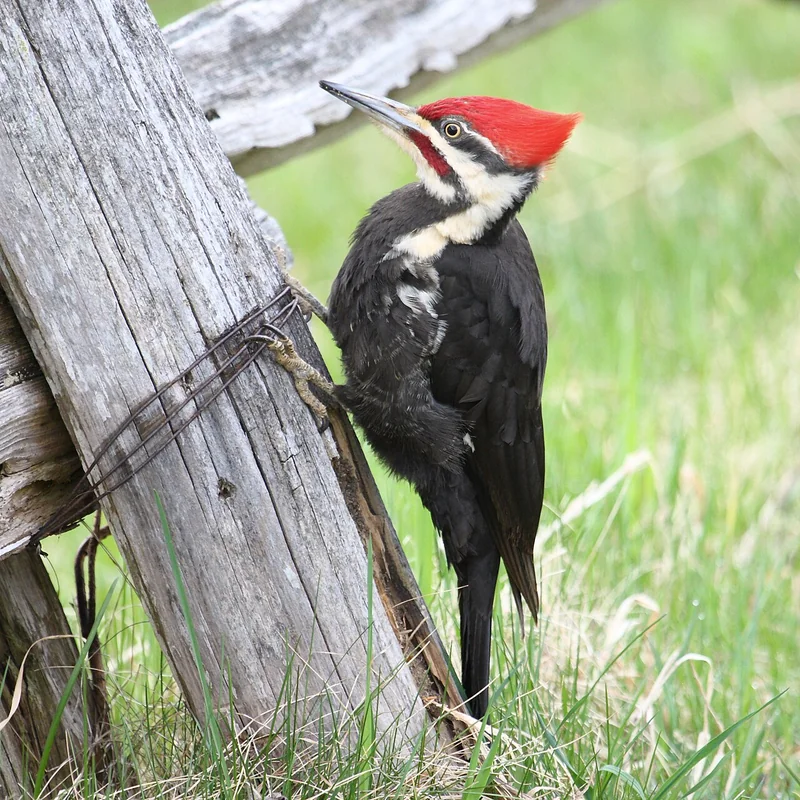
Dryocopus pileatus, the pileated woodpecker, is the largest extant woodpecker in North America. Adults are 40 to 49 cm long with a wingspan of 66 to 75 cm and weigh 250 to 400 g. The plumage is mostly black with a brilliant red triangular crest, white face stripes, and white underwing flashes visible in flight. The IUCN lists the species as Least Concern. Pileated woodpeckers excavate distinctive rectangular feeding holes in dead trees that are unmistakable across the species' range.
Quick facts
- Habitat
- Mature deciduous and mixed forest with abundant standing dead trees. The species requires large dead-trunk substrate for both foraging and nest excavation, and is most numerous in unfragmented older-growth forests.
- Range
- Forested North America from southern Canada and the eastern United States south to the Gulf Coast, plus the Pacific Northwest. The historical range was reduced by old-growth-forest logging in the early twentieth century but the species has recovered substantially as eastern second-growth forests matured.
- Size
- 40–49 cm body · 66–75 cm wingspan · 250–400 g
- Plumage
- Adults show predominantly black body plumage with a brilliant scarlet triangular crest, a black-and-white striped head, and conspicuous white underwing patches visible in flapping flight. Males show a red 'moustache' streak running back from the bill; females show a black moustache. The dramatic crest, large size, and undulating flight make the species impossible to confuse with any other living North American woodpecker.
- Song
- A loud series of resonant 'wuk-wuk-wuk-wuk' notes — slower and more deliberate than the similar series of the smaller flicker. The drumming is also slow and resonant, lasting about three seconds and audible from over a kilometre away.
- Migration
- Resident year-round throughout the range; no regular migration. The species defends large permanent territories across most of its distribution.
- Conservation
- Least Concern (LC)
Overview
Dryocopus pileatus is the largest extant woodpecker in North America following the extinction (or possible extinction) of the ivory-billed woodpecker (Campephilus principalis). The species is one of three Dryocopus woodpeckers worldwide (with the European black woodpecker D. martius and the East Asian Andaman woodpecker D. hodgei). 'Pileated' comes from the Latin pileus, the conical felt cap of ancient Romans — a reference to the species' triangular red crest.
Range history
The species' historical range was reduced by old-growth logging in the early twentieth century — pileated woodpeckers require large dead-trunk substrate for both foraging and nest excavation, and the loss of mature forest left many regions with insufficient breeding habitat. Eastern second-growth forests have matured over the past century, and pileated populations have recolonized much of the original range. The species is now widely seen at the edge of suburbs and city parks where suitable dead trees remain standing.
Feeding excavations
Pileated woodpeckers excavate large rectangular holes — typically 10 to 30 centimetres long and 5 to 15 centimetres wide — in standing dead trees while feeding on carpenter ants and other wood-boring insects. The rectangular shape of the excavations is a textbook field sign that distinguishes pileated workings from the rounded holes of smaller woodpeckers and the shallow scaling of bark-foragers. The largest excavations expose substantial sections of inner trunk and may eventually weaken the tree to the point of collapse.
Sources & further reading (2)
- iucn-red-list — accessed 2026-04-29
- encyclopedia — accessed 2026-04-29
Frequently asked questions
Why is the species called 'pileated'?
'Pileated' comes from the Latin pileus, the conical felt cap of ancient Romans — a reference to the species' triangular bright-red crest. The English name has been in use since the eighteenth century. The crest is the species' most distinctive plumage feature and is visible from a long distance, often the first identification cue when a pileated flies through forest understorey.
What do pileated rectangular tree-holes mean?
The rectangular feeding excavations on dead trees — typically 10-30 cm long and 5-15 cm wide — are diagnostic of pileated woodpeckers. The species drills these large holes to access carpenter ant colonies and other wood-boring insects in the standing dead trunk. The rectangular shape distinguishes them from the rounded holes of smaller woodpeckers and the shallow scaling of bark-foragers, and the holes are a reliable sign of pileated presence in any forest.
Was there really a similar but extinct woodpecker?
Yes — the ivory-billed woodpecker (Campephilus principalis) was a slightly larger and very similar-looking woodpecker that occupied old-growth bottomland forests of the southeastern United States. Its decline through the twentieth century is one of the textbook North American extinction stories. Periodic claimed sightings since the 1990s remain controversial; the species was officially declared extinct by the US Fish and Wildlife Service in 2021, then withdrawn pending review. The current scientific consensus is that the species is most likely extinct.