Ceryle rudis
Pied Kingfisher (Ceryle rudis)
 Featured photopied-kingfisher.jpg
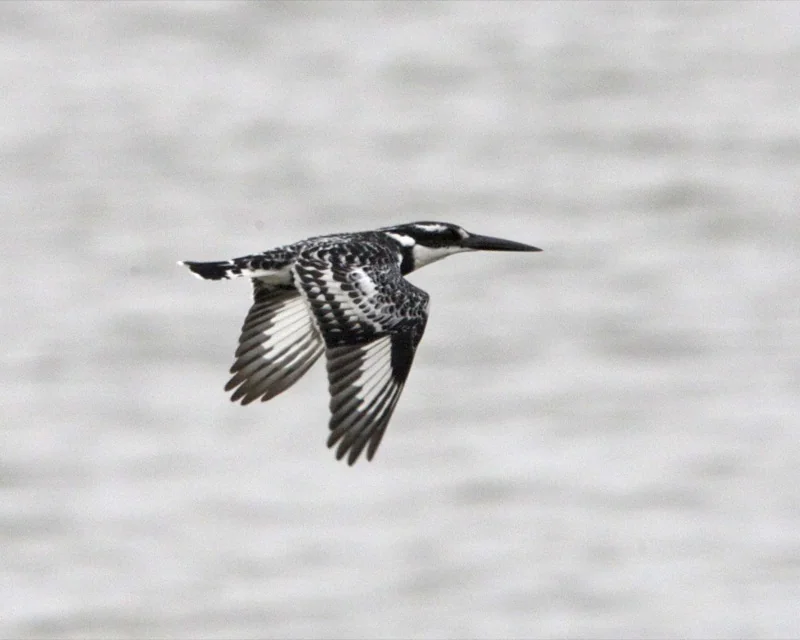
Ceryle rudis, the pied kingfisher, is a medium-sized kingfisher of the family Alcedinidae, widespread across Africa and South and Southeast Asia. Adults are 25 cm long with a wingspan of 30 to 34 cm and weigh 68 to 100 g. The species is unique among kingfishers for its ability to hover in sustained flight over open water — allowing it to hunt far from the bank. The plumage is black and white throughout. The IUCN lists the species as Least Concern.
Quick facts
- Habitat
- Rivers, lakes, estuaries, coastal lagoons, reservoirs, fish ponds, and slow-moving streams across sub-Saharan Africa and South and Southeast Asia. Strongly associated with clear, fish-rich water with open flight corridors for hovering. Tolerates human-modified water bodies including fish farms and irrigation canals.
- Range
- Sub-Saharan Africa from Senegal and Egypt south to South Africa; South Asia from Turkey and the Middle East through India and Sri Lanka; Southeast Asia east to South China. The most widely distributed kingfisher of the Old World tropics.
- Size
- 23–25 cm body · 30–34 cm wingspan · 68–100 g
- Plumage
- Adults are entirely black-and-white — black upperparts, head, and breast markings contrasting with white underparts. Males have two black breast bands (complete upper band, broken lower band); females have one breast band (broken). The bill is large, straight, and black. The crest is slightly ragged. Juveniles show brownish scaling on the upperparts.
- Song
- A sharp, high-pitched 'kik-kik-kik' or a loud chattering 'ki-ki-ki-ki' call, often given in flight. Colonial roosting sites produce a persistent chattering chorus at dusk.
- Migration
- Largely sedentary. The species is resident throughout its range. Some local movements track seasonal changes in water level and fish availability.
- Conservation
- Least Concern (LC)
Overview
Ceryle rudis is one of three kingfishers in the genus Ceryle (with the ringed kingfisher C. torquata of the Americas and the Amazon kingfisher C. amazona). The pied kingfisher is the only Old World kingfisher to have crossed the Wallace Line — it reaches as far east as southern China and Vietnam. The species is also the only kingfisher worldwide to hover independently over open water for sustained periods, which allows it to exploit fish prey far from a bank perch — a key ecological advantage over all other Old World kingfishers.
Hovering technique
The pied kingfisher's most distinctive behaviour is sustained hovering — the bird rises to 5–10 m above the water surface, faces into the wind, and beats its wings rapidly while scanning downward for fish. When a fish is sighted, the bird plunges vertically with wings closed, hitting the water bill-first at high speed. The ability to hover is rare among birds of comparable size — it requires a high wing-loading efficiency and sustained hovering power. This ability allows pied kingfishers to hunt over open water far from a bank perch, exploiting feeding areas unavailable to perch-dependent kingfisher species.
Cooperative breeding
Pied kingfishers show a complex cooperative breeding system. Beyond the primary breeding pair, colonies include 'primary helpers' (typically male offspring from previous seasons) that assist the breeding pair with food delivery and nest defence, and 'secondary helpers' (unrelated males that join the nest without contributing equally). Primary helpers significantly improve nest success — fledgling production is substantially higher for pairs with primary helpers than without. Secondary helpers may trade nest access and food delivery for future mating opportunities. This multi-tier cooperative breeding system is one of the most complex in any African bird.
Sources & further reading (2)
- iucn-red-list — accessed 2026-05-07
- encyclopedia — accessed 2026-05-07
Frequently asked questions
Why is the pied kingfisher the only hovering kingfisher?
Most kingfishers hunt from a fixed perch overlooking water — they watch for a fish, dive, catch it, and return to the perch. This requires a perch close enough to the water for a direct dive. The pied kingfisher's ability to hover allows it to hunt over open water far from any perch — expanding its foraging range dramatically. Sustained hovering requires specific wing and muscle adaptations that have not evolved in most other kingfisher species, possibly because it is energetically very costly and only advantageous in open-water environments with abundant prey.
How do pied kingfishers nest?
Pied kingfishers nest in burrows excavated in earth banks — typically vertical or near-vertical riverbanks, lake shores, or road cuttings. Both parents dig the burrow with their bills, producing a tunnel 0.5–1.5 m long leading to an unlined egg chamber. Colonies may contain dozens of adjacent nest burrows. The cooperative breeding system means nest burrows may be attended by the breeding pair plus 1–2 male helpers, all contributing to food delivery.
Is the pied kingfisher related to the common kingfisher?
Yes — both are members of the family Alcedinidae (kingfishers). However, the pied kingfisher (genus Ceryle) and the common kingfisher (genus Alcedo) belong to different subfamilies within Alcedinidae. The Ceryle kingfishers are larger and more distantly related to the small, jewel-coloured Alcedo kingfishers of the Old World tropics. The pied kingfisher's black-and-white plumage and hovering behaviour are distinct from all other Old World kingfisher species.