Passerina ciris
Painted Bunting (Passerina ciris)
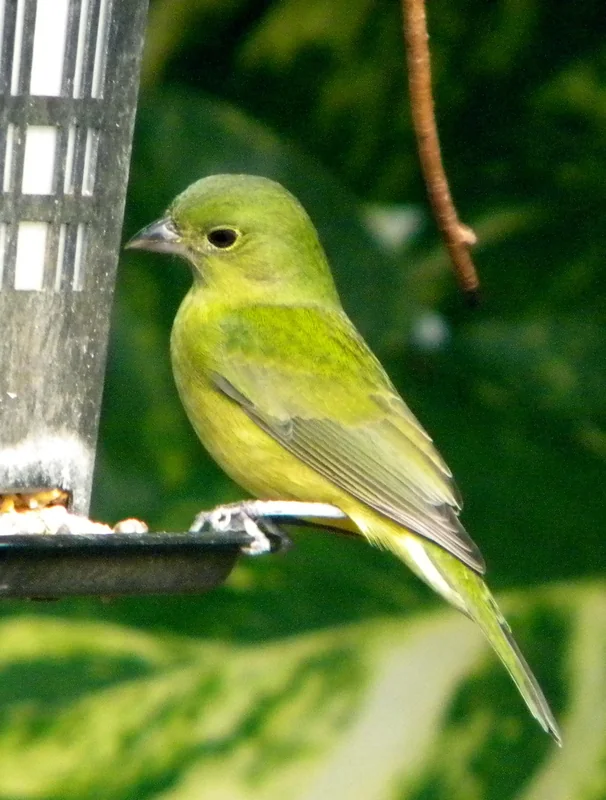 Featured photopainted-bunting.jpg
Passerina ciris, the painted bunting, is a small songbird of the family Cardinalidae, distributed across the southeastern and southern United States and into Mexico. Adults are 12 to 14 cm long with a wingspan of 21 to 23 cm and weigh 13 to 19 g. Adult males show one of the most spectacular plumage combinations of any North American bird — a blue head, red breast, and bright green back. The IUCN lists the species as Least Concern, although populations have declined modestly over recent decades.
Quick facts
- Habitat
- Brushy edges, abandoned farmland, woodland clearings, and dense scrub along the southeastern and southern US. The species favours dense low cover with scattered tall perches.
- Range
- Breeds across the southeastern United States (Florida, Georgia, the Carolinas, Alabama, Louisiana, Mississippi, Texas, Oklahoma) and into northern Mexico. Winters in southern Florida, the Caribbean, and Central America to Panama. Two genetically distinct populations (eastern and western) follow different migration routes.
- Size
- 12–14 cm body · 21–23 cm wingspan · 13–19 g
- Plumage
- Adult males show an indigo-blue head and nape; a bright red breast, belly, undertail, and rump; and a vivid emerald-green back, wings, and tail. The colour combination is among the most spectacular of any North American bird — males are sometimes called 'nonpareil' (French for 'unequalled'). Adult females show uniform bright lime-green-yellow plumage above and paler yellow underparts — equally striking but in a different colour register. First-year males resemble females and develop adult plumage over their second year.
- Song
- Males give a clear, sweet, warbling phrase delivered from a high exposed perch — typical Passerina pattern. The call is a sharp 'chip'.
- Migration
- Long-distance migrant. The eastern population winters in southern Florida, the Bahamas, and Cuba; the western population winters in Mexico and Central America to Panama. The two populations differ genetically and follow distinct migration routes that meet only briefly during passage.
- Conservation
- Least Concern (LC)
Overview
Passerina ciris is one of seven Passerina bunting species, all New World cardinalids. The species' male plumage is widely regarded as the most spectacular of any North American songbird; the French folk name 'nonpareil' ('unequalled') captures the response of nineteenth-century European naturalists encountering the species. The genus Passerina includes the closely related indigo, varied, and lazuli buntings, all bright-plumaged but none as boldly multicoloured as the painted bunting.
Two populations
Painted buntings exist in two genetically distinct populations: an eastern population (breeding from North Carolina south through Florida and along the South Atlantic coast) and a western population (breeding from Texas and Oklahoma through northern Mexico). The two populations differ genetically and follow distinct migration routes — eastern birds winter in southern Florida, the Bahamas, and Cuba, while western birds winter in Mexico and Central America. Some authorities have proposed splitting them as separate species; the lumped treatment remains majority view.
Population trends
Eastern painted bunting populations have declined modestly over recent decades from habitat loss as coastal pine-savanna and brushy edges have been developed. Western populations are larger and more stable. The species was historically heavily trapped for the live-bird trade in the nineteenth century — particularly males for their spectacular plumage — and the trade contributed to early-twentieth-century population reductions. International trade is now restricted under CITES Appendix II.
Sources & further reading (2)
- iucn-red-list — accessed 2026-04-30
- encyclopedia — accessed 2026-04-30
Frequently asked questions
Why is the male painted bunting so colourful?
The male's combination of indigo-blue head, vivid red breast, and emerald-green back is sexually selected — females consistently choose males with the brightest and most saturated plumage. The colour is produced by a combination of carotenoid pigments (red and yellow) and structural light scattering (blue and green). The female lays moderate variation in the colour intensity, the most-saturated males are also typically the most experienced (older) and successful, so colour is a reliable signal of male quality.
Are eastern and western painted buntings the same species?
Currently treated as one species (Passerina ciris) with two distinct genetic populations — an eastern population (breeding from North Carolina south through Florida) and a western population (breeding from Texas and Oklahoma through northern Mexico). The two populations differ genetically and follow distinct migration routes. Some authorities have proposed splitting them as separate species on the molecular evidence; the lumped treatment remains majority view but may yet be revised.
Why is the female so different from the male?
Adult female painted buntings show uniform bright lime-green-yellow plumage above and paler yellow underparts — strikingly different from the male's multicoloured plumage. The dichromatism reflects different selection pressures on the two sexes: males face strong sexual selection for conspicuous mate-attracting plumage, while females incubate and brood close to nest height in dense thickets and benefit from cryptic colouration. The female plumage is itself unusual — bright lime-green is rare among North American sparrows and cardinalids.