Pandion haliaetus
Osprey (Pandion haliaetus)
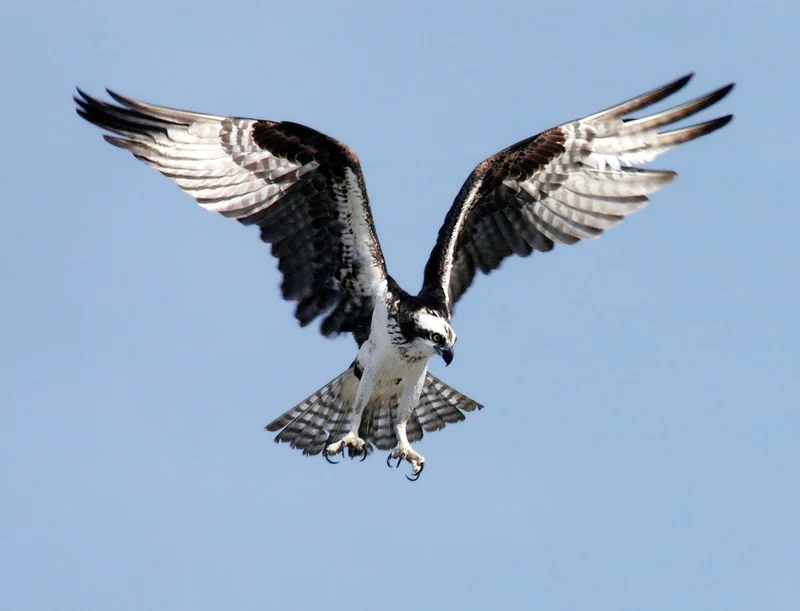 Featured photoosprey.jpg
Pandion haliaetus, the osprey, is a medium-large raptor and the only living species of the family Pandionidae. Adults are 50 to 66 cm long with a wingspan of 1.27 to 1.80 m and weigh 1.2 to 2 kg. The plumage is dark brown above with a white belly and a sharp dark eye-stripe; the species is found on every continent except Antarctica. The IUCN lists the species as Least Concern. Ospreys are obligate fish-eaters and have evolved several anatomical specializations — a reversible outer toe, spiny foot pads, dense oily plumage — for their specialized prey.
Quick facts
- Habitat
- Coastal estuaries, lakes, large rivers, and any inland or marine water with abundant fish. Nests are placed on tall isolated structures — dead trees, cliff ledges, utility poles, channel markers, and increasingly artificial nest platforms.
- Range
- Near-cosmopolitan. Breeds across North America, Europe, Asia, Africa, and Australia. Wintering grounds extend across most of the same continents and reach southern South America. The species is found on every continent except Antarctica.
- Size
- 50–66 cm body · 127–180 cm wingspan · 1.2–2 kg
- Plumage
- Both sexes show dark chocolate-brown upperparts and a bright white belly and underwing; a sharp dark stripe runs from the eye back through the cheek; the head is white with a dark crown. Females show some dark spotting on the breast that males largely lack. In flight, the wings show a strong M-shaped bend at the wrist, a reliable identification feature among raptors.
- Song
- A series of high-pitched whistled chirps, often delivered from the nest or in flight near the nest. The call is musical and far less raptor-like than most large-hawk vocalizations.
- Migration
- Highly variable. Northern Hemisphere populations are strongly migratory; tropical populations are largely resident. Long-distance migrations from northern Europe to West Africa or from North America to southern South America are well-documented.
- Conservation
- Least Concern (LC)
Overview
Pandion haliaetus is the only living member of the family Pandionidae and one of the most widely distributed of all raptors — found on every continent except Antarctica. The species is genetically and morphologically distant enough from typical Accipitridae hawks and eagles to merit its own family. Several specialized anatomical features adapt the osprey to its near-exclusive fish diet: a reversible outer toe, spiny foot pads, dense oily plumage, and a closing nostril valve.
Hunting
Ospreys hunt by flying ten to thirty metres above the water, hovering or coursing back and forth, and plunging feet-first when a fish is detected near the surface. The talon strike submerges the bird up to a metre underwater; the closing nostril valve and waterproofing oils protect against drowning. Successful hunt rates of twenty-five to over seventy percent are documented depending on water clarity, fish density, and weather. The captured fish is carried head-forward to reduce flight drag.
Conservation history
Osprey populations declined sharply in the mid-twentieth century from DDT-driven eggshell thinning — the species, like the bald eagle, sat near the top of an aquatic food chain that bioconcentrated the pesticide. The 1972 US ban on DDT (and similar bans elsewhere) drove a strong recovery, and the modern population is at or above pre-decline levels across most of the range. Artificial nest platforms have substantially expanded suitable nesting sites in many areas.
Sources & further reading (2)
- iucn-red-list — accessed 2026-04-29
- encyclopedia — accessed 2026-04-29
Frequently asked questions
Why is the osprey in its own family?
Molecular and morphological evidence places the osprey lineage as a deep early branch of the broader raptor radiation, distinct enough from typical Accipitridae hawks and eagles to merit its own family Pandionidae. The species also shows several anatomical specializations — a reversible outer toe (allowing two-toes-forward and two-back grip), spiny foot pads to hold slippery fish, and a closing nostril valve — that no Accipitridae shares.
How does an osprey carry such a large fish?
Ospreys carry captured fish head-forward in their talons, with the body aligned along the bird's flight axis. The orientation reduces aerodynamic drag substantially compared with carrying the fish sideways. The reversible outer toe of the osprey foot — unique among raptors — supports the two-pairs-of-talons grip that holds the fish stable. Fish weighing nearly half the osprey's own body mass are routinely carried back to the nest.
Is the osprey the same species worldwide?
Currently treated as one species (Pandion haliaetus) with four subspecies: the cosmopolitan haliaetus, the North American carolinensis, the Australian/eastern Asian leucocephalus (sometimes considered a separate species P. cristatus), and the resident Caribbean ridgwayi. Some authorities split the eastern Asian and Australian populations as a separate species P. cristatus on molecular grounds, but the broader four-subspecies treatment within one species remains majority view.