Aegolius acadicus
Northern Saw-whet Owl (Aegolius acadicus)
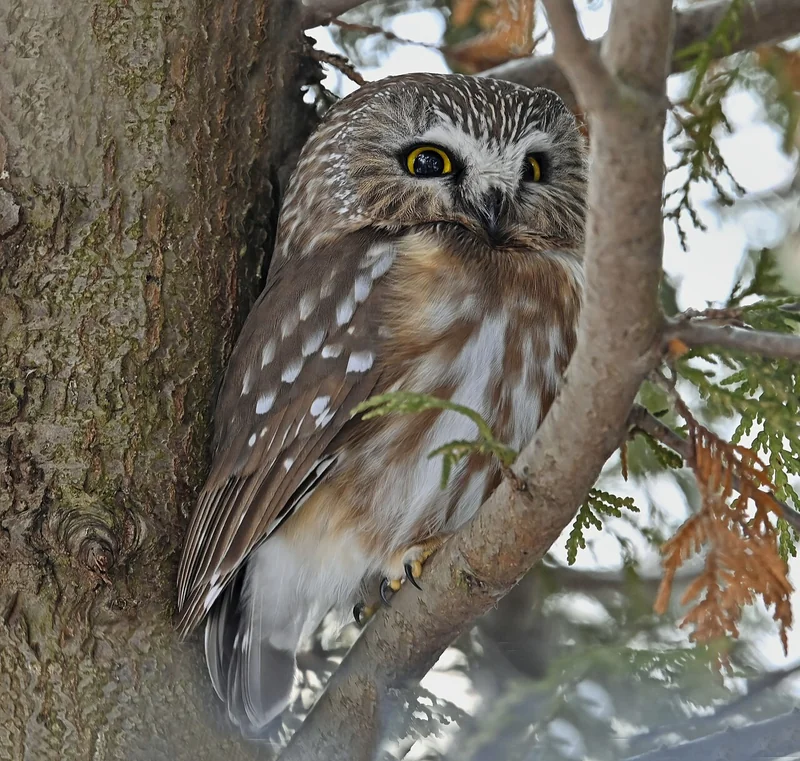 Featured photonorthern-saw-whet-owl.jpg
Aegolius acadicus, the northern saw-whet owl, is a small Strigidae of the family Strigidae, distributed across forested North America. Adults are 17 to 22 cm long with a wingspan of 42 to 56 cm and weigh only 54 to 151 g — among the smallest owls in North America. The plumage is mottled brown above with a streaked rufous-and-white face and lacks ear-tufts. The IUCN lists the species as Least Concern. Migration banding stations on Lake Ontario routinely capture hundreds in a single autumn night.
Quick facts
- Habitat
- Coniferous and mixed forest, particularly with dense conifer roost cover. Migrates through any wooded landscape; daytime roosts are typically deep in conifer foliage near the trunk.
- Range
- Across most of forested North America from southern Alaska and Canada south through the United States and into the highlands of central Mexico. The species is more widespread and common than was historically recognized; intensive autumn banding studies starting in the 1990s revealed substantial unsuspected populations.
- Size
- 17–22 cm body · 42–56 cm wingspan · 54–151 g
- Plumage
- Adults show mottled chocolate-brown upperparts with white spotting on the wings and back; rufous-and-white streaked underparts; a round earless head with a streaked rufous facial disc and bright yellow eyes; and small white spots on the forehead. Juveniles are uniformly chocolate-brown above and warm cinnamon below with a dark facial disc and a white V-shaped 'eyebrow' patch.
- Song
- A relentless, even-pitched, repeated single-note tooting — about two notes per second, sustained for minutes at a time during spring nights. The call sounds like a back-up beeping truck alarm and is the textbook spring forest sound across the species' range.
- Migration
- Strongly migratory but irregular. Most birds move south in autumn; many are caught at autumn banding stations along the Great Lakes flyway. Some northern birds are sedentary, others travel hundreds of kilometres south. Major irruption years occur every few years.
- Conservation
- Least Concern (LC)
Overview
Aegolius acadicus is one of four Aegolius owls worldwide. The species' English name derives from a fanciful interpretation of one of its less common calls — a sharp two-note 'skiew-skiew' sometimes likened to the sound of a saw being whetted (sharpened) on a stone. The far more common monotonous tooting call is the species' actual signature voice.
Distribution
The species is more widespread and abundant than was historically recognized. Project Owlnet and similar autumn banding programmes since the 1990s have documented major migration corridors along the Great Lakes, with single banding stations capturing hundreds of saw-whet owls in a single autumn night during peak passage. The species' nocturnal habits and small size mean most individuals go entirely unobserved by daytime birders.
Behaviour
Northern saw-whet owls are strictly nocturnal and famously inconspicuous by day. Daytime roosts are deep within conifer foliage close to the trunk, where the bird's mottled plumage matches the bark perfectly. The 'tame' reputation of the species comes from how reluctant a roosting bird is to flush — researchers can often approach a daytime saw-whet owl to within arm's length without the bird moving. The species is the most-banded migrant owl in North America.
Sources & further reading (2)
- iucn-red-list — accessed 2026-04-29
- encyclopedia — accessed 2026-04-29
Frequently asked questions
Why is it called a 'saw-whet' owl?
The English name comes from a fanciful interpretation of one of the species' less common calls — a sharp two-note 'skiew-skiew' that early observers likened to the sound of a saw being sharpened (whetted) on a stone. The far more common monotonous tooting call has nothing to do with the name. The folk-etymology has stuck despite generations of birders having to explain it.
Why are saw-whet owls so easy to approach?
Daytime roosting saw-whet owls are famously reluctant to flush. The species' anti-predator strategy depends on remaining still and trusting its mottled plumage and conifer-needle background to provide concealment. Researchers and birders can often approach a roosting bird to within arm's length without the owl moving. The 'tame' reputation is therefore the result of an evolved sit-tight crypsis strategy, not a lack of fear of humans.
How abundant are saw-whet owls really?
Far more abundant than was recognized through most of the twentieth century. Project Owlnet and similar autumn banding networks (especially along the Great Lakes flyway) have caught hundreds of saw-whet owls in single nights during peak passage. The species' strict nocturnal habits and small size mean most individuals go entirely unseen by daytime birders, and the migration pulse is invisible to anyone not actively netting at night.