Anas acuta
Northern Pintail (Anas acuta)
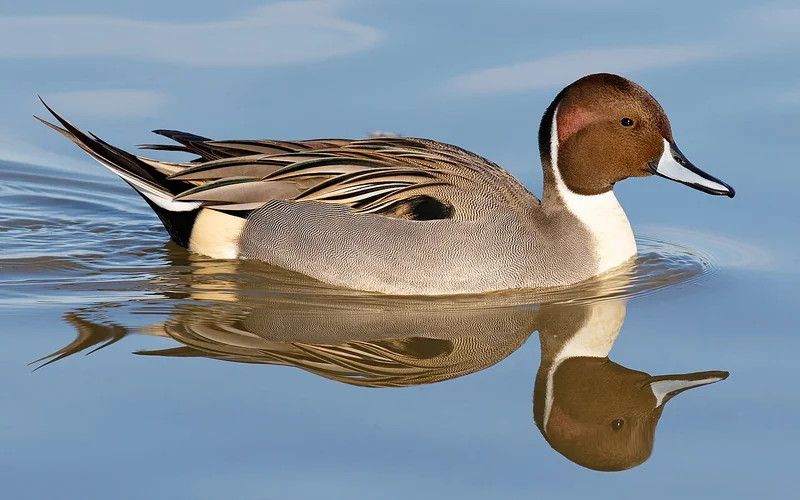 Featured photonorthern-pintail.jpg
Anas acuta, the northern pintail, is a medium-large dabbling duck of the family Anatidae, distributed across the Northern Hemisphere. Adults are 51 to 76 cm long (males including the long pointed tail) with a wingspan of 80 to 95 cm and weigh 0.5 to 1.1 kg. Adult males show a chocolate-brown head, white breast and neck, and grey body with sharply pin-pointed central tail feathers. The IUCN lists the species as Least Concern. Northern pintails undertake one of the longest waterfowl migrations in the Holarctic.
Quick facts
- Habitat
- Open shallow wetlands, prairie ponds, river deltas, and coastal marshes. The species favours open water without dense emergent vegetation and is often the first dabbling duck to arrive in spring as wetlands thaw.
- Range
- Breeds across the Holarctic — most of Canada, Alaska, the western United States, northern Europe, and across temperate Asia. Winters across the southern United States, Mexico, southern Europe, North Africa, the Middle East, and southern Asia.
- Size
- 51–76 cm body · 80–95 cm wingspan · 0.5–1.1 kg
- Plumage
- Adult males in breeding plumage show a rich chocolate-brown head and neck, a clean white breast and underparts with a thin white stripe extending up the side of the neck, a fine grey-vermiculated body, and the diagnostic two long pointed central tail feathers (the 'pin' of the species' English name). Adult females are uniformly mottled brown — the most subtly patterned female plumage among temperate dabbling ducks.
- Song
- Females give a typical hoarse 'quack-quack' similar to female mallards but slightly higher-pitched. Males give a soft whistled 'kuk' or 'pruup' — quieter than most dabbling ducks. The species is generally less vocal than mallards or wood ducks.
- Migration
- Long-distance migrant. Northern populations move south to the southern US, Mexico, southern Europe, North Africa, and southern Asia for winter. Annual round-trip migrations of up to 6,000 km are documented; the species' migration is among the longer Holarctic waterfowl movements.
- Conservation
- Least Concern (LC)
Overview
Anas acuta is one of the most widely distributed Anas dabbling ducks in the world. The Latin epithet 'acuta' means 'pointed' or 'sharp', a reference to the male's distinctive long pointed central tail feathers (the 'pin' of the English name). The species is one of the earliest spring migrants in temperate North America — pintails arrive on prairie wetlands as soon as ice begins to thaw, sometimes before any other duck species.
Distribution
The breeding range covers most of the Holarctic. Some North American populations have declined sharply over the late twentieth century — the prairie-pothole breeding population fell by approximately 75 per cent between 1955 and 2000, driven by wetland drainage for agriculture and prairie-pothole nest predation. Recovery has been partial; current populations remain below historical levels. Eurasian populations are more stable.
Long-distance migration
Northern pintails undertake one of the longest waterfowl migrations in the Northern Hemisphere. Banding studies have documented individual birds moving from Alaska to South America (a 6,000+ km one-way migration) and from Russia to South Asia. Some individuals make trans-Pacific or trans-Atlantic crossings during exceptional migration events. The species' broad range and long migration make it one of the most important waterfowl species in international flyway management.
Sources & further reading (2)
- iucn-red-list — accessed 2026-04-30
- encyclopedia — accessed 2026-04-30
Frequently asked questions
Why are male pintails called 'pintails'?
The English name comes from the male's diagnostic long pointed central tail feathers. The two central feathers extend 5-10 cm beyond the rest of the tail, forming a sharp 'pin' shape that distinguishes the species from any other dabbling duck. The Latin name 'Anas acuta' uses the same imagery — 'acuta' means 'pointed' or 'sharp'. Both common and scientific names directly reference this distinctive plumage feature.
Why have pintail populations declined so much?
North American pintail populations fell by approximately 75 per cent between 1955 and 2000. The drivers were wetland drainage for agriculture (the prairie-pothole region — the species' primary North American breeding habitat — lost over half of its historical wetland area), nest predation by skunks and raccoons in the remaining habitat, and possibly broader climate-driven changes to spring snowmelt timing. Recovery has been partial; current populations remain well below historical levels.
How far do pintails migrate?
Banding studies have documented individual northern pintails moving from Alaska to South America (a 6,000+ km one-way migration) and from Russia to South Asia. Some individuals make trans-Pacific or trans-Atlantic crossings during exceptional migration events. The species' migration is one of the longest documented among Holarctic waterfowl and is a major component of international flyway management programmes.