Mimus polyglottos
Northern Mockingbird (Mimus polyglottos)
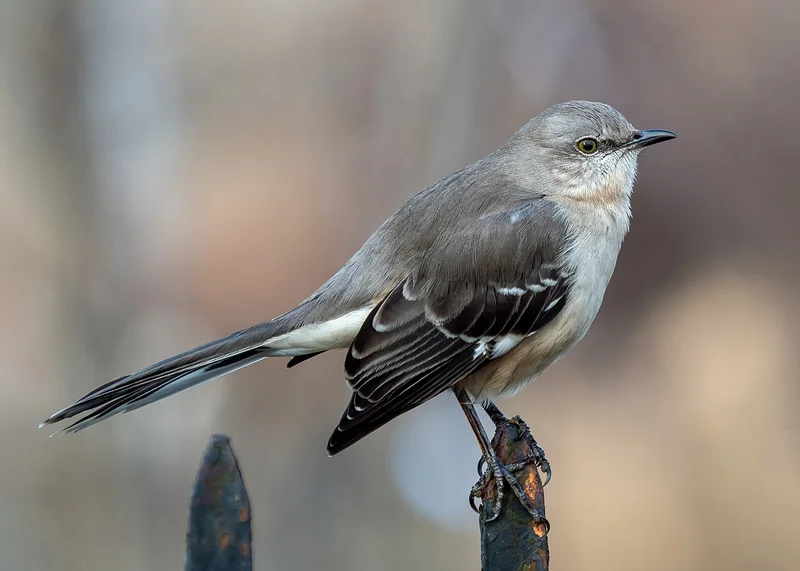 Featured photonorthern-mockingbird.jpg
Mimus polyglottos, the northern mockingbird, is a medium-sized songbird of the family Mimidae, distributed across most of the United States, Mexico, and the Caribbean basin. Adults are 22 to 28 cm long with a wingspan of 31 to 38 cm and weigh 40 to 58 g. The plumage is uniformly soft grey above and pale below with bold white wing-patches visible in flight. The IUCN lists the species as Least Concern. Northern mockingbirds are accomplished vocal mimics — the species' Latin epithet 'polyglottos' means 'many-tongued' and reflects the bird's wide imitation repertoire.
Quick facts
- Habitat
- Open and partly wooded country, suburbs, parks, and gardens. The species adapted readily to human-modified habitats and is among the most familiar songbirds across the southeastern United States.
- Range
- Most of the United States from southern New England west to California and south through Mexico, the Caribbean, and into northern South America. Northern populations expanded substantially north over the twentieth century, possibly tracking suburban habitat and warmer winters.
- Size
- 22–28 cm body · 31–38 cm wingspan · 40–58 g
- Plumage
- Adults show uniform soft pale grey upperparts, pale grey-white underparts, conspicuous bold white wing-patches that flash in flight, white outer tail feathers also visible in flight, and a long thin black bill. Both sexes look alike. The white wing-flashes are distinctive in flight and are also displayed during territorial encounters and predator-mobbing.
- Song
- A long, complex, varied series of phrases that mimic other birds, mechanical sounds, and ambient noise. Each phrase is typically repeated three to five times before the bird moves to the next — the textbook mockingbird pattern. Documented mimicry includes over 200 species' calls plus mechanical sounds (alarm clocks, machinery, mobile phones).
- Migration
- Largely resident year-round. Northern populations make some short-distance autumn movements, but no long-distance migration. The species is one of the most-resident large songbirds across most of its range.
- Conservation
- Least Concern (LC)
Overview
Mimus polyglottos is one of about a dozen Mimus mockingbird species across the New World. The species is the only northern Mimus, with most relatives in Central and South America. The Latin epithet 'polyglottos' means 'many-tongued' and reflects the species' wide vocal mimicry repertoire. The species is the state bird of Arkansas, Florida, Mississippi, Tennessee, and Texas — more than any other species except the northern cardinal.
Mimicry
Northern mockingbirds are accomplished vocal mimics. Documented imitations include over 200 different species' calls plus various mechanical sounds — alarm clocks, machinery, mobile phone ringtones, car alarms, dogs barking. Each phrase is typically repeated three to five times before the bird moves to the next, distinguishing the mockingbird's song from the related brown thrasher's (which uses paired repetitions). Female mockingbirds prefer males with larger mimicry repertoires, making the trait sexually selected.
Range expansion
Northern mockingbirds have expanded their breeding range substantially north over the twentieth century. The species was historically restricted to the southern United States south of about Pennsylvania; modern range now reaches southern Maine and southern Ontario. The expansion likely tracks suburban habitat development (which provides ideal mockingbird foraging and nesting cover) and warmer winters under continued climate change. The species is now one of the most familiar large songbirds across the entire eastern United States.
Sources & further reading (2)
- iucn-red-list — accessed 2026-04-30
- encyclopedia — accessed 2026-04-30
Frequently asked questions
How many sounds can a northern mockingbird mimic?
Documented imitations include over 200 different species' calls plus various mechanical sounds — alarm clocks, machinery, mobile phone ringtones, car alarms, dogs barking. Each individual male's repertoire is smaller than the species' total but typically reaches dozens of mimicked phrases. Female mockingbirds prefer males with larger mimicry repertoires, making the trait sexually selected.
How do you tell mockingbird from brown thrasher song?
The mockingbird repeats each phrase three to five times before moving to the next. The brown thrasher repeats each phrase typically twice. Both species incorporate mimicked phrases from other birds, but the mockingbird's three-to-five-fold repetition is the most reliable cue. Mockingbirds also tend to sing at a higher overall pitch than thrashers and have a more rapid pace through the repertoire.
Why do mockingbirds attack hawks and crows?
Northern mockingbirds are aggressively territorial and actively mob predators that approach the nest — including hawks, crows, snakes, cats, and humans. The mobbing involves diving at the predator from above, calling loudly, and sometimes pecking. The behaviour is one of the most conspicuous predator-defence displays among small songbirds and is often described in popular folklore. Pairs cooperate in the mobbing; the male and female take turns attacking while the other guards the nest.