Circus hudsonius
Northern Harrier (Circus hudsonius)
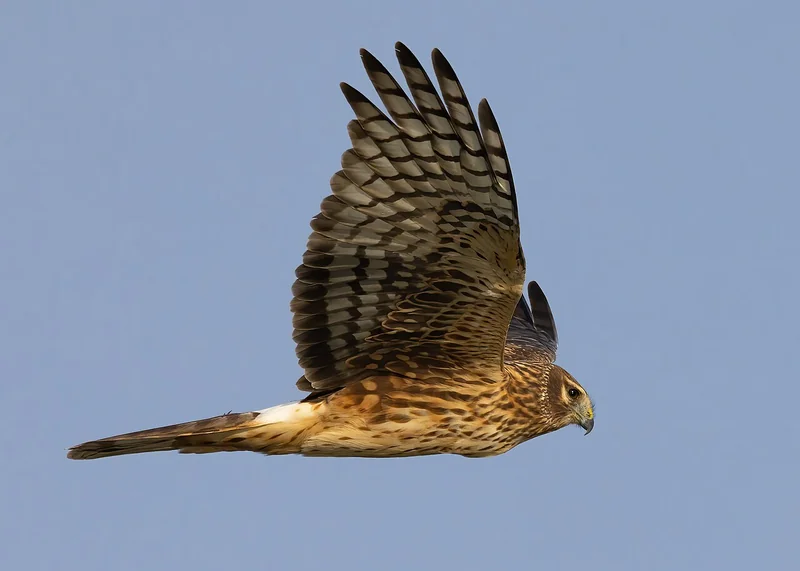 Featured photonorthern-harrier.jpg
Circus hudsonius, the northern harrier, is a medium-sized hawk of the family Accipitridae, distributed across most of North America. Adults are 41 to 52 cm long with a wingspan of 97 to 122 cm and weigh 290 to 750 g. The plumage shows a distinctive sex-pattern difference — adult males are pale grey with black wingtips, adult females are streaked brown — and both sexes carry a striking white rump and an owl-like facial disc. The IUCN lists the species as Least Concern.
Quick facts
- Habitat
- Open grasslands, marshes, agricultural fields, and prairie habitats. The species hunts by flying low over open ground in slow coursing flight and depends on intact open-country habitat with abundant small-mammal prey.
- Range
- Most of North America from Alaska and Canada south through the United States and into northern Mexico. Winters from the southern United States south through Mexico and parts of Central America.
- Size
- 41–52 cm body · 97–122 cm wingspan · 290–750 g
- Plumage
- Adult males show pale grey upperparts and head, white underparts, sharp black wingtips, and a clean white rump visible in flight. Adult females are uniformly streaked brown with the same white rump and a buff facial disc. Both sexes show an owl-like flat facial disc — unusual among diurnal raptors and shared with most other Circus harriers. Juveniles resemble adult females but with rich rufous underparts and bolder dark streaking.
- Song
- Adults give various wheezing, screaming, and chattering calls during territorial display. The species is mostly silent while hunting; vocalizations are concentrated near the nest and during the male's elaborate courtship sky-dancing display.
- Migration
- Long-distance migrant. Most populations move south for winter to the southern United States, Mexico, and parts of Central America. The species is one of the most-tracked North American raptors at hawk-migration count sites.
- Conservation
- Least Concern (LC)
Overview
Circus hudsonius is one of about a dozen Circus harriers worldwide. The species was historically lumped with the European hen harrier (C. cyaneus) under the name 'northern harrier' or 'marsh hawk'; the two were split as separate species in 2016 on molecular and morphological grounds. The species' English name 'harrier' references the slow coursing low-flight hunting style, which 'harries' (harasses) prey through repeated low passes over open ground.
Owl-like facial disc
Northern harriers have a flat owl-like facial disc — unusual among diurnal raptors. The facial disc functions as a parabolic sound reflector that focuses prey-noise onto the asymmetrically positioned ear openings, similar to the acoustic-hunting adaptation of owls. The harrier hunts partly by sound: small mammals moving in tall grass produce sounds the bird can localize and strike. The trait is shared with most other Circus harriers and is one of the textbook examples of convergent evolution between distantly related hunting bird groups.
Sexual dimorphism
Adult male and female northern harriers look so different that early observers described them as separate species. Adult males are pale grey with black wingtips and white underparts. Adult females are uniformly streaked brown. Both sexes share the white rump and owl-like facial disc, but the colour difference is one of the most striking sexual plumage dimorphisms in any North American raptor. The 'grey ghost' name for adult males is widely used by birders.
Sources & further reading (2)
- iucn-red-list — accessed 2026-04-30
- encyclopedia — accessed 2026-04-30
Frequently asked questions
Why does a hawk have an owl-like facial disc?
Northern harriers (and most other Circus harriers) have a flat owl-like facial disc — unusual among diurnal raptors. The facial disc functions as a parabolic sound reflector that focuses prey-noise onto the asymmetrically positioned ear openings. The harrier hunts partly by sound: small mammals moving in tall grass produce sounds the bird can localize and strike. The trait is one of the textbook examples of convergent evolution between distantly related hunting bird groups (owls and harriers).
Why are male and female harriers so different?
Adult male northern harriers are pale grey with black wingtips and white underparts (the 'grey ghost' of birding folklore). Adult females are uniformly streaked brown. The sexual plumage dimorphism is one of the most striking in any North American raptor — the two were historically described as separate species before observers noted them at the same nests. Both sexes share the white rump and owl-like facial disc that identify the species.
Are northern and hen harriers the same species?
No, not since 2016. The North American northern harrier (Circus hudsonius) was historically lumped with the European hen harrier (C. cyaneus) under the same English and scientific names. Molecular evidence and morphological differences supported the 2016 split. The two are now treated as full sister species, with no current contact zone between them — northern harrier is restricted to the Americas, hen harrier to Eurasia.