Morus bassanus
Northern Gannet (Morus bassanus)
 Featured photonorthern-gannet.jpg
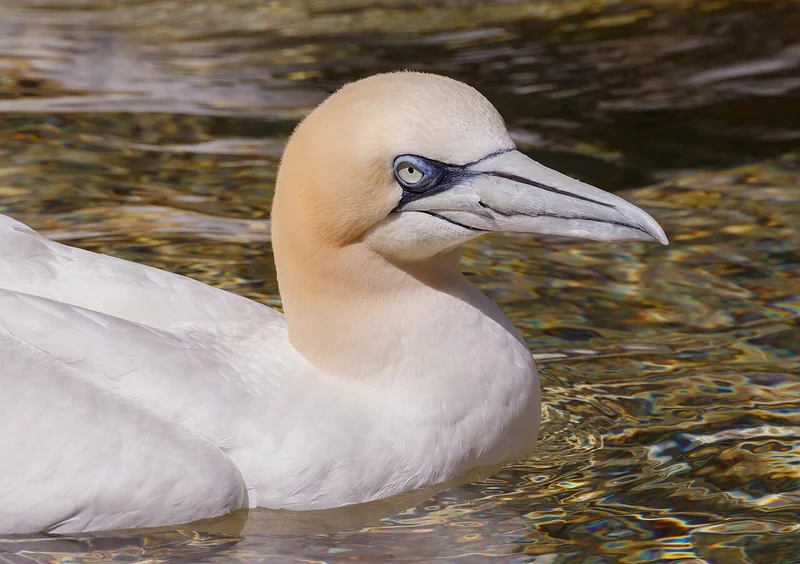
Morus bassanus, the northern gannet, is the largest seabird of the family Sulidae. Adults are 87 to 100 cm long with a wingspan of 1.65 to 1.8 m and weigh 2.4 to 3.6 kg. The plumage is mostly pure white with sharp black wingtips and a yellow-flushed head. The IUCN lists the species as Least Concern. Northern gannets perform some of the most spectacular plunge-dives of any bird — diving from heights of up to 30 m at speeds over 100 km/h to catch fish near the surface. The species is the only Suliformes representative in the corpus and breeds at major North Atlantic colonies.
Quick facts
- Habitat
- Open North Atlantic Ocean and adjacent coastal seas. Breeds in dense colonies on coastal cliffs, rocky islets, and sea-stacks; spends the non-breeding season at sea.
- Range
- North Atlantic — coastal Britain, Iceland, Norway, the Faroe Islands, eastern Canada (Newfoundland, Quebec), and a few additional sites. The total breeding population is estimated at over 500,000 pairs.
- Size
- 87–100 cm body · 165–180 cm wingspan · 2.4–3.6 kg
- Plumage
- Adults are uniformly pure white throughout the body with sharp black wingtips visible in flight, a bright yellow-flushed head and nape, pale blue facial skin, and pale grey legs and feet. Both sexes look alike. Juveniles are uniformly dark mottled brown for the first year and progressively whiten over four to five years through staged moults. The cigar-shaped silhouette in flight (long pointed wings, pointed tail, pointed head and bill) is one of the most distinctive seabird outlines in the North Atlantic.
- Song
- A loud harsh 'arrah-arrah' call delivered constantly at colonies. The species is highly vocal at breeding sites and gives various harsher chattering calls during territorial display.
- Migration
- Partial migrant. Northern populations move south for winter to lower-latitude North Atlantic and Mediterranean waters; southern populations are largely resident. Some long-distance trans-Atlantic crossings have been documented.
- Conservation
- Least Concern (LC)
Overview
Morus bassanus is one of three Morus gannet species worldwide (with the Cape gannet M. capensis of southern Africa and the Australasian gannet M. serrator). The Sulidae family also includes the boobies of tropical seas. The species' Latin epithet 'bassanus' references Bass Rock — a famous sea-stack off the Scottish east coast that hosts the world's largest northern gannet colony. The bird is the only Suliformes representative in this corpus.
Plunge-diving
Northern gannets perform some of the most spectacular plunge-dives of any bird. The species circles 10-30 m above the water, spots a school of fish, folds the wings tightly back, and dives bill-first at high speed. Verified dive speeds reach 100 km/h or more. The bird's anatomy includes specialized adaptations: subcutaneous air sacs along the underside of the body absorb the impact, the closing nictating membrane protects the eyes, the nostrils have closing valves, and the skull is specifically reinforced for high-speed water entry. The technique is shared with several Sulidae relatives but reaches the largest scale in this species.
Bass Rock and other colonies
Bass Rock — a sea-stack off the Scottish east coast — hosts the world's largest northern gannet colony, with over 75,000 pairs. The species' Latin epithet 'bassanus' directly references this colony. Other major colonies include St. Kilda (Scotland), Iceland, Newfoundland, and several Norwegian sites. Total global population is estimated at over 500,000 breeding pairs and has grown substantially over the twentieth century after recovery from earlier human persecution.
Sources & further reading (2)
- iucn-red-list — accessed 2026-04-30
- encyclopedia — accessed 2026-04-30
Frequently asked questions
How fast does a northern gannet dive?
Verified dive speeds reach 100 km/h or more. The species circles 10-30 m above the water, spots a school of fish, folds the wings tightly back, and dives bill-first at high speed. The impact would be lethal without specialized adaptations: subcutaneous air sacs along the underside of the body absorb the impact, the closing nictating membrane protects the eyes, the nostrils have closing valves, and the skull is specifically reinforced for high-speed water entry. The species is one of the most extreme aerial-pursuit predators among seabirds.
Why is the species named 'bassanus'?
The Latin epithet 'bassanus' references Bass Rock — a famous sea-stack off the Scottish east coast that hosts the world's largest northern gannet colony. The colony has over 75,000 breeding pairs and has supported breeding gannets continuously for many centuries. The Scottish observers who first formally described the species in the eighteenth century used Bass Rock specimens for the type description, and the place name was incorporated into the binomial.
How does a gannet survive a 100 km/h dive?
Gannet anatomy includes several specialized adaptations for high-speed plunge-diving: subcutaneous air sacs along the underside of the body absorb the impact (similar to airbags); the closing nictating membrane protects the eyes; the nostrils have flap valves that close during the dive; the skull is specifically reinforced for high-speed water entry; and the body is streamlined into a rigid cigar shape during the descent. Without these adaptations, the impact at this speed would cause fatal trauma.