Colaptes auratus
Northern Flicker (Colaptes auratus)
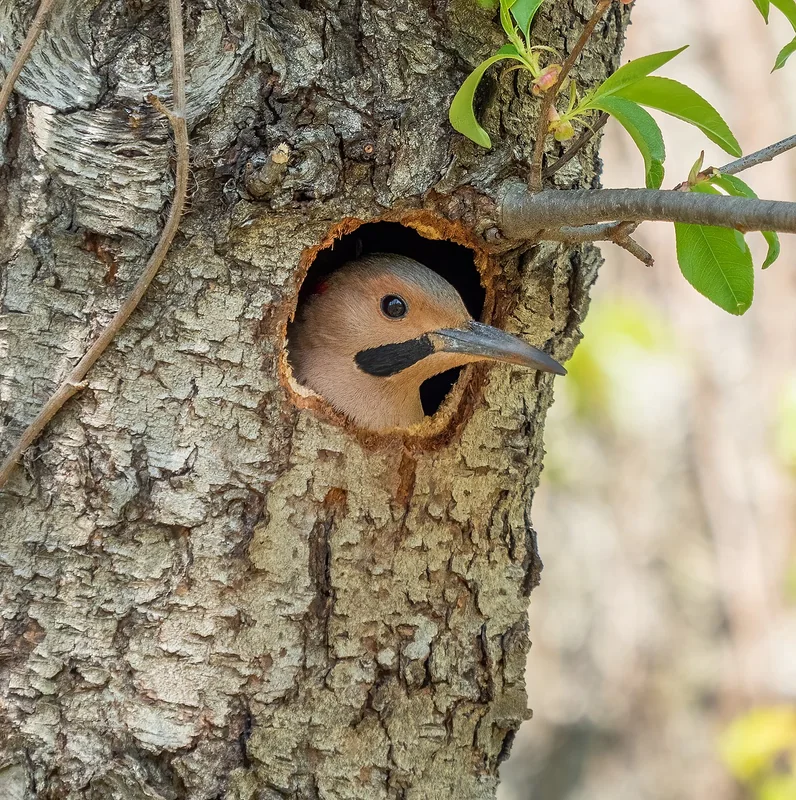 Featured photonorthern-flicker.jpg
Colaptes auratus, the northern flicker, is a medium-large woodpecker of the family Picidae, distributed across most of North America. Adults are 28 to 36 cm long with a wingspan of 42 to 54 cm and weigh 86 to 167 g. The plumage is mostly brown with bold black-spotted underparts, a black crescent across the upper breast, white rump visible in flight, and a flash of either yellow or red on the underwings depending on the regional form. The IUCN lists the species as Least Concern. Northern flickers are unusual among woodpeckers in foraging primarily on the ground for ants.
Quick facts
- Habitat
- Open and partly wooded country, woodland edges, parks, suburbs, and farmland. The species prefers areas with both trees (for nest cavities and roosts) and open ground (for ant foraging).
- Range
- Most of North America from southern Alaska and Canada south through the United States to Mexico and Central America. Two distinct regional plumage groups occur: 'yellow-shafted' flickers across most of eastern North America and 'red-shafted' flickers in the western mountains.
- Size
- 28–36 cm body · 42–54 cm wingspan · 86–167 g
- Plumage
- Adults show a brown back finely barred with black, a pale brown breast and belly heavily marked with bold black spots, a black crescent across the upper breast, and a white rump that flashes conspicuously in undulating flight. Eastern 'yellow-shafted' flickers have a grey crown, red nape patch, and golden-yellow underwing and tail-feather shafts. Western 'red-shafted' flickers have a brown crown, no red nape patch, and salmon-red underwing shafts. The two forms hybridize freely in the central Great Plains.
- Song
- A loud, repeated 'wick-wick-wick-wick' or 'kee-yew' delivered both in flight and from a perch. The drumming is slower and more deliberate than smaller woodpeckers'.
- Migration
- Partial migrant. Northern populations move south for winter; central and southern populations are largely resident. Some southward autumn movements occur even within the resident range.
- Conservation
- Least Concern (LC)
Overview
Colaptes auratus is one of the most ground-foraging woodpeckers in North America. The species' specialization on ants — taken from the ground using the long sticky tongue — sets it apart from typical bark-and-trunk-foraging woodpeckers. The 'yellow-shafted' (eastern) and 'red-shafted' (western) forms were treated as separate species through much of the twentieth century but were lumped in 1973 after extensive evidence of free interbreeding in a broad central-US hybrid zone.
Yellow-shafted vs. red-shafted
The two regional plumage groups differ in several characters: shaft colour (yellow vs. salmon-red), crown colour (grey vs. brown), nape patch (present in yellow-shafted, absent in red-shafted), and male moustache colour (black vs. red). The two interbreed freely across a hybrid zone running from Alaska to Texas, producing intermediate plumages. Despite the lumped taxonomic treatment, the two forms remain phenotypically distinct outside the hybrid zone.
Behaviour
Northern flickers spend more time foraging on the ground than any other North American woodpecker. The species' tongue can extend up to twelve centimetres beyond the bill tip — exceptional even among woodpeckers — and is used to extract ants from underground colonies. Flickers also drum on metal surfaces (chimneys, gutters, road signs) for territorial signalling, which can produce dramatic acoustic effects and occasional cosmetic damage to suburban metalwork.
Sources & further reading (2)
- iucn-red-list — accessed 2026-04-29
- encyclopedia — accessed 2026-04-29
Frequently asked questions
Why do flickers eat so many ants?
Northern flickers are the most ant-eating bird in North America — ants make up over half the diet through most of the year. The species' long sticky tongue (extending up to twelve centimetres beyond the bill) is specialized for extracting ants from underground colonies, and flicker stomach contents from ant-rich habitats sometimes contain over five thousand ants from a single foraging session. The specialization explains why flickers forage so much on the ground rather than on tree trunks.
Are yellow-shafted and red-shafted flickers the same species?
Currently treated as one species (Colaptes auratus) since 1973. The two regional groups — yellow-shafted (eastern) and red-shafted (western) — were ranked as separate species through the early twentieth century. Lumping followed extensive evidence of free interbreeding across a broad hybrid zone in the central United States. Some authorities still consider the two groups distinct enough to merit re-splitting, but the lumped treatment is currently dominant.
Why do flickers drum on metal?
Flickers and several other woodpeckers drum on resonant surfaces for territorial signalling. Metal chimneys, gutters, road signs, and similar surfaces produce a much louder and more distinctive drum than wood, and territorial flickers in suburban areas readily exploit the loud surfaces. The drumming usually takes place in early spring during territory establishment, and the bird is signalling other flickers — not feeding. Some cosmetic damage to suburban metal fittings does occur.