Cardinalis cardinalis
Northern Cardinal (Cardinalis cardinalis)
 Featured photonorthern-cardinal.jpg
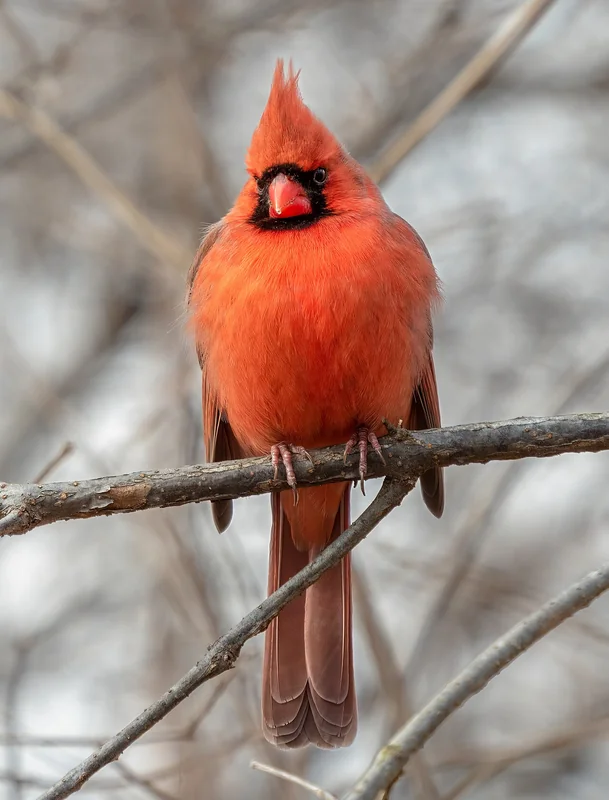
Cardinalis cardinalis, the northern cardinal, is a mid-sized songbird of the family Cardinalidae, distributed across the eastern half of the United States, southeastern Canada, and through Mexico to northern Guatemala and Belize. Adults are 21 to 23.5 cm long with a wingspan of 25 to 31 cm and weigh 33 to 65 g. The male is brilliant red with a black face mask; the female is buff-brown with red highlights. The IUCN Red List assesses the species as Least Concern, with a population estimated by Partners in Flight at well over one hundred million.
Quick facts
- Habitat
- Woodland edges, dense thickets, suburban gardens, and brushy fence lines. The species favours dense low cover for nesting and is among the most familiar garden birds across the eastern United States.
- Range
- Eastern and central United States from southern Maine and Ontario west to South Dakota and the Texas Panhandle, south through Mexico to northern Guatemala and Belize. The range has expanded steadily north and west since the late nineteenth century, aided by suburban bird feeders.
- Size
- 21–23.5 cm body · 25–31 cm wingspan · 33–65 g
- Plumage
- Adult males are brilliant crimson over the entire body, with a tall pointed crest, a black face mask surrounding a heavy red bill, and dusky red wings. Females show a similar shape and crest but a buff-brown body with red wings, tail, and crest, and the same heavy reddish-orange bill. Juveniles resemble the female but with a dark bill until the first autumn moult.
- Song
- A loud, clear, whistled phrase commonly transcribed as 'birdy-birdy-birdy' or 'cheer-cheer-cheer'. Both sexes sing — unusual among temperate songbirds — and pairs sometimes counter-sing matching phrases.
- Migration
- Resident year-round throughout the range. The species does not undertake true migration; pairs hold territories continuously.
- Conservation
- Least Concern (LC)
Overview
Cardinalis cardinalis is the type species of the family Cardinalidae and the source of the English name 'cardinal'. Both common name and scientific binomial reference the scarlet robes of Roman Catholic cardinals. The bird is the state bird of seven United States — Illinois, Indiana, Kentucky, North Carolina, Ohio, Virginia, and West Virginia — more than any other species.
Distribution
The breeding range covers the eastern half of the United States, southeastern Canada (a recent twentieth-century arrival), and through eastern Mexico to northern Guatemala and Belize. The range has expanded steadily north and west over the last century and a half, with bird feeders providing reliable winter food in formerly marginal habitat.
Behaviour
Pairs hold territories year-round and remain together through the non-breeding season — 'cardinal pair-bonds' are notably stable. Females sing as readily as males, often from the nest while incubating, which is rare among temperate songbirds and may serve to communicate with the mate or coordinate brooding.
Nesting
The female builds a cup nest of twigs, bark strips, and grasses in dense low cover — saplings, vine tangles, and shrubs — typically one to three metres above the ground. Clutch size is typically three eggs, pale greenish-white spotted with brown and grey. Two or three broods per season are typical across the southern part of the range.
Sources & further reading (3)
- iucn-red-list — accessed 2026-04-29
- encyclopedia — accessed 2026-04-29
- ornithology-reference — accessed 2026-04-29
Frequently asked questions
Why are male cardinals red and females brown?
The male's crimson plumage is produced by carotenoid pigments derived from diet — the brighter the red, the more carotenoid-rich the food intake during moult. Bright males advertise foraging skill and condition to potential mates. Females are buff-brown with red accents, a more cryptic plumage that reduces predation risk during the long incubation periods cardinals undertake.
Why is the species named 'cardinal'?
Both the English name and the scientific epithet 'cardinalis' reference the scarlet robes worn by senior clergy of the Roman Catholic Church. Sixteenth-century European observers in the Americas noted the resemblance, and the comparison has carried into the bird's vernacular and binomial names. The bird itself gave its name to the family Cardinalidae.
Do female cardinals sing?
Yes — and unusually for temperate songbirds. Female northern cardinals sing complex phrases comparable to those of males, sometimes from the nest while incubating. The behaviour appears to function in pair coordination and possibly territory defence; it is part of a small but growing recognition that female song is more widespread among songbirds than the older literature suggested.