Passer domesticus
House Sparrow (Passer domesticus)
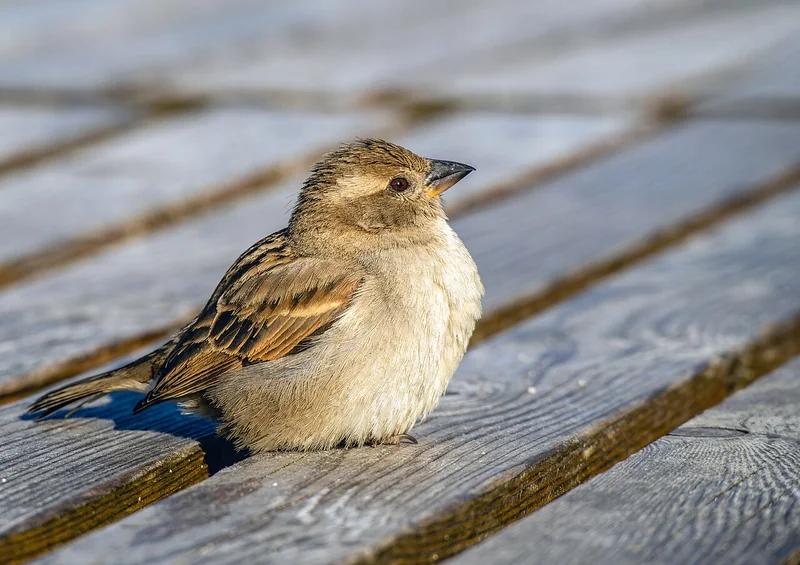 Featured photohouse-sparrow.jpg
Passer domesticus, the house sparrow, is a small Old World sparrow native to most of Europe, the Mediterranean basin, and much of Asia. Adults are 14 to 18 cm long with a wingspan of 19 to 25 cm and weigh 24 to 39 g. The species is one of the most successful avian commensals of human settlements and has been intentionally introduced to the Americas, southern Africa, Australia, and many oceanic islands. The IUCN Red List assesses the species as Least Concern globally, although several northwestern European populations have declined sharply since the 1980s.
Quick facts
- Habitat
- Almost exclusively associated with human habitation: cities, towns, farms, and grain-storage facilities. Pure natural habitats away from buildings are rarely occupied; the species' fortunes track human agricultural and urban activity closely.
- Range
- Native to most of Europe, the Mediterranean basin, the Middle East, and southern and central Asia. Established by introduction across the Americas, sub-Saharan Africa, Australia, New Zealand, and many oceanic islands; the global range is now among the most extensive of any wild bird.
- Size
- 14–18 cm body · 19–25 cm wingspan · 24–39 g
- Plumage
- Adult males in breeding plumage show a grey crown, chestnut nape, white cheeks, a black bib, and a streaky brown back; females and juveniles are uniformly buff-brown above with a pale supercilium and an unmarked grey-buff underside. The plumage is distinctly sexually dimorphic — uncommon among small brown passerines and a useful field mark.
- Song
- A persistent, monotonous series of chirps and cheeps without distinct phrase structure. Males advertise from a perch at a nesting cavity with a repeated 'chirrup' call.
- Migration
- Sedentary across nearly all of the range. Some northern populations make short local movements in winter; long-distance migration is absent.
- Conservation
- Least Concern (LC)
Overview
Passer domesticus belongs to the family Passeridae, the Old World sparrows — distinct from the New World sparrows (family Passerellidae) despite the shared English name. The species is one of the classic commensal birds: through the spread of agriculture and permanent settlement, the house sparrow followed humans out of its presumed origin in the Middle East and now occupies a global range almost coextensive with human population centres.
Distribution
The native range covers Europe, the Mediterranean basin, the Middle East, and most of central and southern Asia. Deliberate nineteenth-century introductions established the species across the Americas (notably the 1851 Brooklyn release), southern Africa, Australia, and New Zealand. Subsequent passive spread followed shipping routes to islands across the Atlantic and Pacific.
Population trends
Despite the global Least Concern listing, several long-monitored populations in northwestern Europe have declined by half or more since the 1980s. The drivers are debated; loss of nesting cavities in modern building stock, reduced invertebrate availability for nestlings, and predation by sparrowhawks have all been proposed. The Asian and North American populations remain large and broadly stable.
Cultural history
The species has accompanied human settlement long enough to appear in classical and biblical writings; references to the genus in Old Testament Hebrew and ancient Greek literature are usually interpreted as the house sparrow. The 1851 release of approximately one hundred birds in Brooklyn, New York — intended as biological control of inchworms — founded the entire North American population that subsequently spread coast to coast within fifty years.
Sources & further reading (3)
- iucn-red-list — accessed 2026-04-29
- encyclopedia — accessed 2026-04-29
- ornithology-reference — accessed 2026-04-29
Frequently asked questions
Is the house sparrow native to North America?
No. The species was introduced to Brooklyn, New York in 1851 and to several other North American cities through the 1850s and 1860s. The introductions were intentional, motivated in part by a belief that the birds would control inchworm outbreaks. From those founding releases the population expanded across the continent within a few decades.
Are house sparrows true sparrows?
House sparrows belong to the Old World sparrow family Passeridae. The unrelated New World 'sparrows' — for example the song sparrow and white-throated sparrow — belong to the family Passerellidae. The two groups share an English name through superficial similarity in size and brown plumage, not common ancestry within the songbird radiation.
Why are house sparrows declining in some European cities?
Long-term monitoring across northwestern Europe shows declines of fifty per cent or more in many urban populations since the 1980s. Proposed drivers include loss of cavity nest sites in modern sealed-eaves construction, reduced summer insect availability for nestlings, and increased predation by recovering sparrowhawks. No single cause has been confirmed and the picture varies between cities.