Poecile atricapillus
Black-capped Chickadee (Poecile atricapillus)
 Featured photoblack-capped-chickadee.jpg
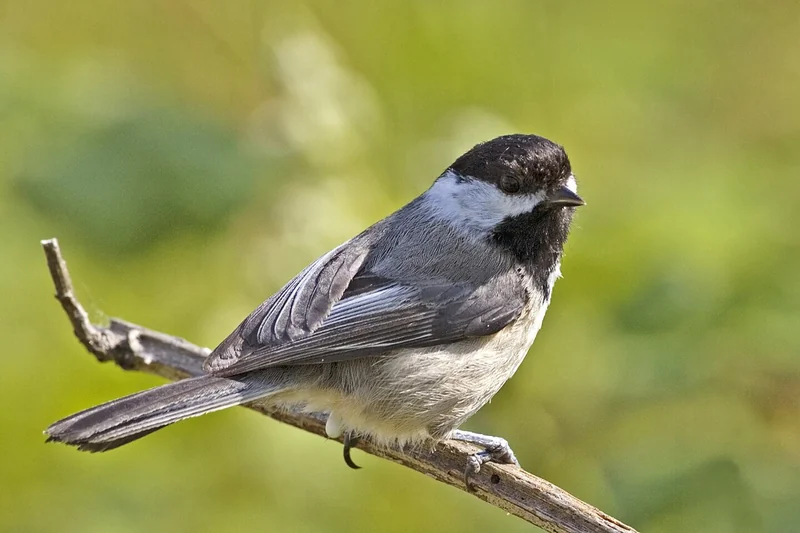
Poecile atricapillus, the black-capped chickadee, is a small songbird in the tit family Paridae, distributed across the boreal and temperate forests of Canada and the northern United States. Adults are 11.5 to 14 cm long with a wingspan of 16 to 21 cm and weigh 9 to 14 g. The plumage shows a sharply defined black cap and bib above white cheeks and a buffy underside. The species is assessed as Least Concern by the IUCN Red List and is the state or provincial bird of Maine, Massachusetts, and New Brunswick.
Quick facts
- Habitat
- Mixed and deciduous forest, forest edges, and well-treed suburban yards across the boreal and northern temperate zone. The species is non-migratory and remains in the same area year-round, including across cold winters at northern latitudes.
- Range
- Across most of Canada south of the boreal forest's northern edge, Alaska, and the northern half of the contiguous United States south to roughly forty degrees north latitude. The southern range edge meets — and locally overlaps with — the closely related Carolina chickadee (Poecile carolinensis).
- Size
- 11.5–14 cm body · 16–21 cm wingspan · 9–14 g
- Plumage
- Both sexes show a glossy black crown extending to just below the eye, a black bib on the throat, white cheeks, a grey back and wings with white feather edging, and pale buff flanks against a whitish belly. The plumage is identical between sexes — most reliable separation in the field is by behaviour, not appearance.
- Song
- Two main vocalizations: a clear two- or three-note whistled 'fee-bee' or 'fee-bee-ee' song, and the namesake 'chick-a-dee-dee-dee' call. Studies have shown the number of 'dee' notes scales with perceived predator threat — a small dangerous predator triggers more 'dees' than a larger less manoeuvrable one.
- Migration
- Resident year-round throughout the range. Local irruptive movements occur in some winters when boreal seed crops fail, but the species does not undertake regular migration.
- Conservation
- Least Concern (LC)
Overview
Poecile atricapillus is one of seven Poecile chickadees in North America. The black-capped chickadee occupies the largest range and is the species most often referred to simply as 'the chickadee' across most of Canada and the northern United States. The genus name Poecile is from Greek poikilos, 'multi-coloured'; the species epithet atricapillus combines Latin atra (black) and capillus (hair of the head).
Distribution
The range covers most of forested Canada south of the boreal tree line, Alaska, and the northern half of the contiguous United States. The southern boundary contacts the range of the Carolina chickadee (Poecile carolinensis) along a narrow zone from Kansas through New Jersey, where the two species hybridize. The hybrid zone has been moving north over recent decades, possibly tracking climate.
Cognition and food caching
Black-capped chickadees scatter-cache thousands of food items — single seeds and invertebrates — across hundreds of locations in autumn and recover them weeks to months later using spatial memory. The hippocampus of the species enlarges in autumn and shrinks in spring, tracking the seasonal demand on memory. The behaviour is one of the textbook examples of memory-driven hippocampal plasticity in vertebrates.
Vocalizations
The 'chick-a-dee-dee-dee' call from which the species takes its name is one of the most studied bird calls in the world. Field experiments have shown the number of 'dee' notes appended to the call increases with the perceived danger of a stationary predator: small, agile predators that pose more threat to a small bird elicit more 'dees' than larger, less manoeuvrable ones. The call is also used to recruit flock members to mob a predator.
Sources & further reading (3)
- iucn-red-list — accessed 2026-04-29
- encyclopedia — accessed 2026-04-29
- ornithology-reference — accessed 2026-04-29
Frequently asked questions
Are black-capped and Carolina chickadees the same species?
No. They are sister species that meet along a narrow contact zone running from Kansas through New Jersey, where the two interbreed and produce hybrids. Outside the hybrid zone the species are reproductively distinct, differ subtly in voice and proportions, and occupy separate ranges. Field identification within the contact zone is notoriously difficult.
Why does the chickadee's call have a variable number of 'dee' notes?
Field experiments show the number of 'dee' notes scales with the perceived threat level of a stationary predator. Smaller, more agile predators — which pose more risk to a small bird — elicit more 'dee' notes than larger, less manoeuvrable predators. The call also functions as a mob recruitment signal: flockmates respond to the rate and length of the call when joining a mobbing event.
How do chickadees survive northern winters?
Several adaptations work together. Black-capped chickadees scatter-cache thousands of food items in autumn and recover them weeks later using spatial memory. They roost overnight in cavities and enter regulated nocturnal hypothermia, lowering body temperature by about ten degrees Celsius to conserve energy through long sub-freezing nights. Both behaviours allow the species to remain non-migratory at boreal latitudes.