Cyanocitta cristata
Blue Jay (Cyanocitta cristata)
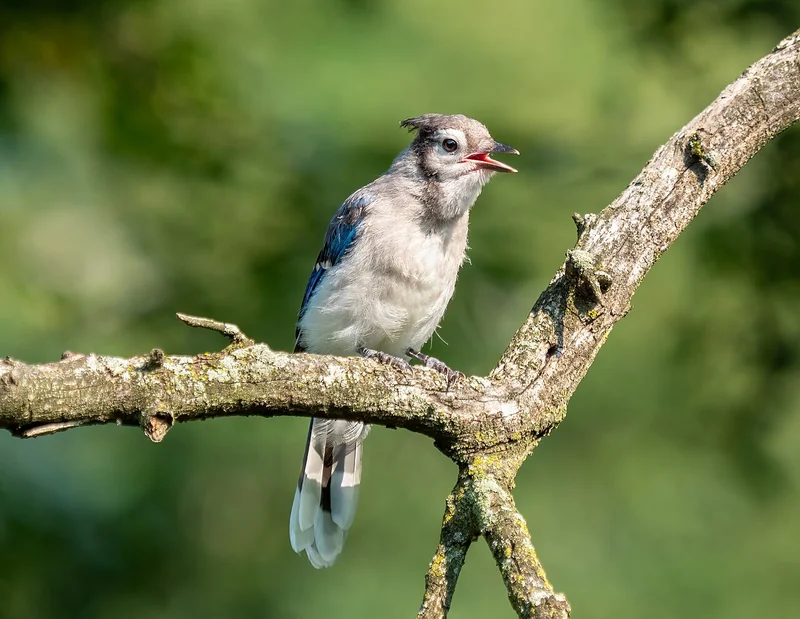 Featured photoblue-jay.jpg
Cyanocitta cristata, the blue jay, is a mid-sized songbird in the corvid family, distributed across eastern and central North America from southern Canada to the Gulf Coast of the United States. Adults are 22 to 30 cm long with a wingspan of 34 to 43 cm and weigh 70 to 100 g. The plumage is bright blue above with a white face and underparts, a black necklace, and bold black-and-white wing barring. The species is assessed as Least Concern by the IUCN Red List.
Quick facts
- Habitat
- Mixed and deciduous forest, especially oak-dominated woodland, as well as suburban parks, gardens, and city tree plantings. Acorn-bearing oak forest is the species' core habitat; the jay's autumn caching of acorns has been credited with helping oak forests recolonize formerly glaciated landscapes.
- Range
- Eastern and central North America from Newfoundland and southern Canada south to the Gulf Coast and west to the Great Plains. The western range edge advances slowly as suburban tree planting extends suitable habitat into formerly grassland-dominated regions.
- Size
- 22–30 cm body · 34–43 cm wingspan · 70–100 g
- Plumage
- Both sexes show bright lavender-blue upperparts with bold black-and-white barring on the wings and tail, a pale grey to white face and underparts, and a narrow black necklace. The blue colour is structural — produced by light scattering in feather microstructure rather than by a blue pigment — so a damaged or wet feather can appear dull grey-brown.
- Song
- A repertoire of loud, harsh calls dominated by a piercing 'jay! jay!' contact note. Blue jays are accomplished mimics and reproduce the calls of red-shouldered and red-tailed hawks with sufficient accuracy to alarm other birds at feeders.
- Migration
- Partial migrant. Some northern individuals move south in autumn; many remain on territory year-round, and the same individual may migrate one year and not the next.
- Conservation
- Least Concern (LC)
Overview
Cyanocitta cristata belongs to the family Corvidae — the crows, ravens, jays, and magpies — and shows the cognitive sophistication characteristic of the group. Laboratory studies have documented blue jays using sticks as tools to rake otherwise inaccessible food toward themselves, and wild birds cache hundreds to thousands of acorns each autumn, recovering many through the winter. The species is one of two North American Cyanocitta jays; the other is the western Steller's jay.
Distribution
The breeding range covers eastern and central North America from Newfoundland and southern Canada south to Florida and west to Texas and the eastern Great Plains. The range has expanded slowly westward over the last century, tracking the spread of suburban tree planting; blue jays now occur regularly as far west as the Rocky Mountain foothills, where the species was formerly accidental.
Acorn caching
Blue jays cache large numbers of acorns each autumn, carrying them in the throat and oesophagus to widely scattered ground sites and burying them under leaf litter. Studies in eastern North America have estimated single jays cache thousands of acorns per autumn. Uncached acorns germinate, and the species has been credited with rapid post-glacial northward expansion of oak species — jays disperse acorns farther and faster than wind or gravity ever could.
Vocal mimicry
Blue jays mimic the high screaming whistles of red-shouldered and red-tailed hawks with enough accuracy that other songbirds at feeders flee for cover. The function of the mimicry is debated — possibilities include alarming competitors away from food, alerting flock members to a real hawk, or simple acoustic play — and may differ between contexts. The behaviour is widespread across the species' range.
Sources & further reading (3)
- iucn-red-list — accessed 2026-04-29
- encyclopedia — accessed 2026-04-29
- ornithology-reference — accessed 2026-04-29
Frequently asked questions
Why does the blue jay's blue colour disappear from a damaged feather?
The blue is structural, not a pigment. Blue jay feathers contain melanin (which appears black) overlaid with a microstructured keratin layer that scatters short-wavelength light back to the eye while absorbing longer wavelengths. Damaging the keratin microstructure — by crushing, wetting, or backlighting the feather — eliminates the scattering and the feather looks grey-brown.
Why do blue jays imitate hawks?
Blue jays are skilled mimics of red-shouldered and red-tailed hawks. The function is debated. Possibilities include scaring competitors away from a food source, warning flock members of a genuine hawk in the area, and acoustic play in a cognitively complex species. The behaviour appears across the range and in different contexts, suggesting more than one function may apply.
How many acorns does a blue jay cache in a year?
Field studies in eastern oak forest have estimated that a single blue jay caches thousands of acorns in autumn, carried one or a few at a time in the throat and oesophagus to widely scattered ground sites. Many cached acorns are recovered; the rest germinate, and the species has been credited with the rapid post-glacial northward spread of oaks across eastern North America.