Zenaida macroura
Mourning Dove (Zenaida macroura)
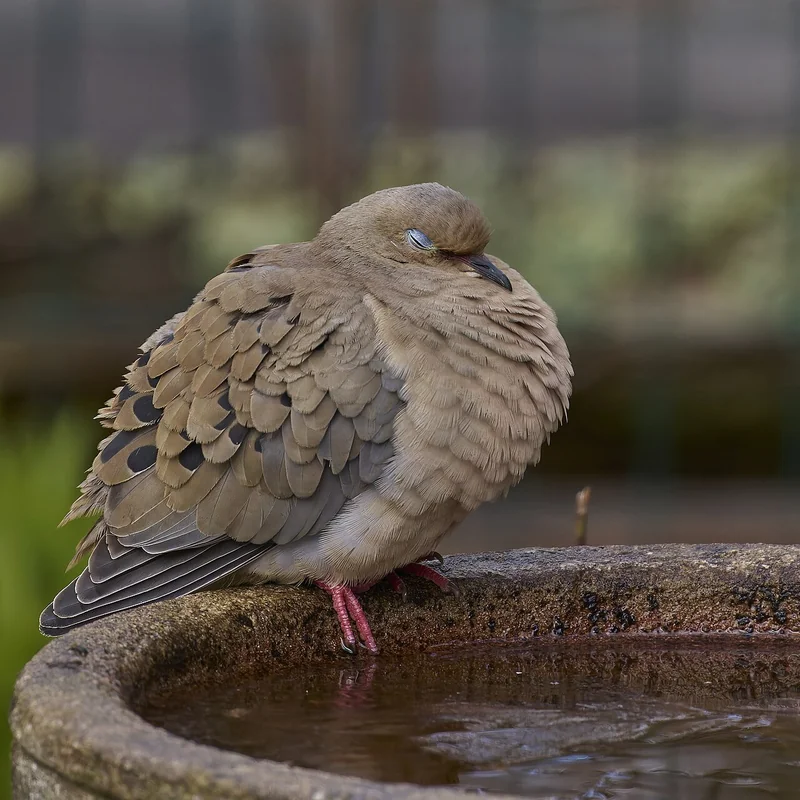 Featured photomourning-dove.jpg
Zenaida macroura, the mourning dove, is a medium-sized dove of the family Columbidae, distributed across most of North America and into Central America. Adults are 23 to 34 cm long with a wingspan of 37 to 45 cm and weigh 96 to 170 g. The plumage is soft pale buff-brown with a long pointed tail, small dark spots on the wings, and a rosy wash on the breast in adults. The IUCN lists the species as Least Concern. The species is among the most numerous birds in North America and one of the most heavily hunted gamebirds in the United States.
Quick facts
- Habitat
- Open and semi-open country — farmland, suburbs, parks, gardens, desert washes, and woodland edges. Pure dense forest is largely avoided.
- Range
- Most of North America from southern Canada south through the United States, Mexico, and Central America. Some Caribbean island populations are isolated and subspecifically distinct. The species has expanded both range and numbers over the last century, partly tracking the spread of agricultural grain and bird feeders.
- Size
- 23–34 cm body · 37–45 cm wingspan · 96–170 g
- Plumage
- Both sexes are soft pale buff-brown above, paler grey-buff below, with a rosy wash on the breast in adults. The tail is long and pointed, with bright white feather tips visible in flight. Black spots on the wings and a small black spot below the eye are field marks. Males are slightly more strongly washed pink on the breast.
- Song
- A soft, mournful 'coo-OOO-coo, coo, coo' delivered from a perch — the cooing carries far in the still air of summer dawns and is the source of the species' English name.
- Migration
- Partial migrant. Northern populations move south for winter; populations across most of the United States are resident year-round. Migration is partly altitudinal in mountainous regions.
- Conservation
- Least Concern (LC)
Overview
Zenaida macroura is the most widespread of the seven Zenaida doves of the Americas. The species is among the most numerous breeding birds in North America, with a continental population estimated by Partners in Flight at over three hundred million. Mourning doves are also the most heavily hunted gamebird in the United States — annual harvest exceeds twenty million individuals — yet population trends remain broadly stable, partly because of the species' high reproductive rate (up to six broods per year in southern populations).
Distribution
The breeding range covers most of North America from southern Canada south to Mexico and Central America. The species has expanded both range and abundance over the last century, partly through tracking the spread of agriculture and grain availability. Caribbean island populations are isolated and have been treated as separate subspecies; the West Indian populations are sometimes recognized as subspecies macroura proper.
Reproduction
Mourning doves can produce up to six broods per year in the southern part of the range, more than nearly any other North American bird. Each brood is two eggs, incubated for fourteen days, and the young (squabs) fledge at about fourteen days. Both parents produce 'crop milk' — a protein- and lipid-rich secretion from the crop lining — and feed it to the squabs for the first several days, a behaviour shared across the family Columbidae and unrelated to mammalian lactation.
Sources & further reading (2)
- iucn-red-list — accessed 2026-04-29
- encyclopedia — accessed 2026-04-29
Frequently asked questions
Why is it called a 'mourning' dove?
The species' soft three-note cooing call — typically transcribed 'coo-OOO-coo, coo, coo' — sounds melancholy enough to early English-speaking observers that the species was named for the mournful quality of the song. Many other Zenaida doves and other Columbidae have similar low cooing calls, but the mourning dove's combination of slow tempo and descending pitch contour is particularly evocative of human grieving.
What is 'crop milk'?
Crop milk is a thick protein- and lipid-rich secretion produced by the crop lining of both parent doves and pigeons. It is fed to nestlings for the first several days and is unrelated to mammalian milk despite the convergent name. Both male and female doves produce it. Flamingos and male emperor penguins independently evolved similar crop secretions for chick feeding — convergent functional analogues.
How can mourning doves have so many broods per year?
Mourning doves can produce up to six broods per year in the southern part of the range. Two factors enable this: short brood cycles (eggs hatch in 14 days, young fledge in another 14), and crop-milk feeding (which decouples breeding from insect availability). Pairs often start a new clutch before the previous brood has fully fledged, with the male tending the older young while the female incubates the next clutch.