Poecile gambeli
Mountain Chickadee (Poecile gambeli)
 Featured photomountain-chickadee.jpg
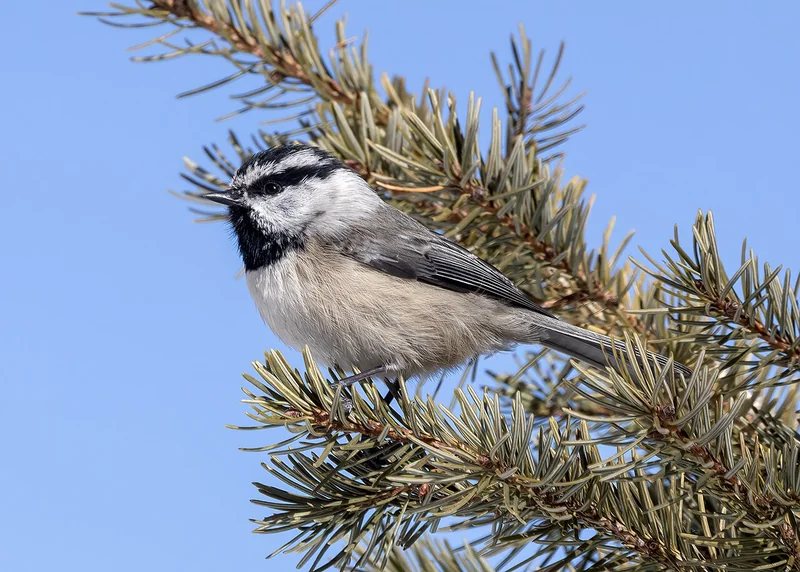
Poecile gambeli, the mountain chickadee, is a small Paridae of coniferous forests across the western United States and southern Canada. Adults are 12 to 14 cm long with a wingspan of 19 to 22 cm and weigh 9 to 12 g. The plumage shows a black cap and bib, a clear white eyebrow stripe, and pale grey flanks. The IUCN lists the species as Least Concern. Mountain chickadees are obligate conifer specialists and rarely overlap in habitat with the closely related black-capped chickadee.
Quick facts
- Habitat
- Coniferous montane forest — pine, fir, spruce — across the western mountains of North America. The species rarely uses deciduous forest and occupies higher elevations than the black-capped chickadee where the two ranges meet.
- Range
- Western mountain ranges of North America from southern Alaska and the Yukon south through the Rocky Mountains, Sierra Nevada, and Cascades to northern Mexico. The species is broadly resident across the breeding range.
- Size
- 12–14 cm body · 19–22 cm wingspan · 9–12 g
- Plumage
- Both sexes show a glossy black crown extending below the eye, a black bib on the throat, white cheeks, a clear white supercilium running back from the bill, soft grey upperparts, and pale grey-buff underparts. The white eyebrow is the most reliable field mark separating mountain chickadee from the black-capped chickadee where ranges overlap.
- Song
- A clear three- or four-note whistled 'fee-bee-bay' or 'fee-bee', plus the namesake 'chick-a-dee-dee-dee' contact call shared with all Poecile chickadees. The whistled song is slightly hoarser than the black-capped's.
- Migration
- Largely resident year-round. Some local altitudinal movements between summer breeding territories and lower-elevation winter sites occur, but no long-distance migration.
- Conservation
- Least Concern (LC)
Overview
Poecile gambeli is one of seven Poecile chickadees in North America. The species was named for the American naturalist William Gambel, who collected the type specimen in California in the 1840s. The mountain chickadee is the typical chickadee of high-elevation conifer forests across the western US and is one of the most-studied songbirds in research on spatial-memory hippocampal plasticity, alongside the closely related black-capped chickadee.
Distribution
The breeding range covers the western mountain ranges of North America. Elevation preferences are high: in regions where mountain and black-capped chickadees overlap (parts of the Rocky Mountains and the Cascades), mountain chickadees occupy the higher conifer elevations and black-capped chickadees the lower mixed-forest belt. The two species hybridize occasionally in the narrow contact zone but generally remain ecologically distinct.
Caching and memory
Mountain chickadees scatter-cache thousands of food items each autumn and recover them weeks to months later using spatial memory. The hippocampus enlarges in autumn and shrinks in spring, tracking the seasonal demand on memory. Studies comparing high-elevation and low-elevation populations show that birds from harsher habitats have larger hippocampi and better cache-recovery performance — a textbook example of within-species selection on cognitive ability.
Sources & further reading (2)
- iucn-red-list — accessed 2026-04-30
- encyclopedia — accessed 2026-04-30
Frequently asked questions
How do I tell mountain chickadee from black-capped chickadee?
The mountain chickadee has a clear white supercilium running back from the bill above the dark eye-line — black-capped chickadees lack this stripe. The mountain's flanks are paler grey rather than buff, and the song is slightly hoarser. Where the ranges overlap, mountain chickadees occupy higher-elevation conifer belts and black-capped chickadees occupy lower mixed-forest belts.
Why is the species name 'gambeli'?
The species was named after the American naturalist William Gambel (1823-1849), who collected many of the type specimens of western North American birds during his travels in the 1840s. Gambel's quail, Gambel's white-crowned sparrow, and Gambel's mountain chickadee all bear his name. He died young at 26 from typhoid contracted on a return expedition through the Sierra Nevada.
Do mountain chickadees really have bigger brains in harsher habitats?
Field studies comparing high-elevation and low-elevation mountain chickadee populations have shown that birds from harsher (colder, longer-winter) habitats have measurably larger hippocampi (the brain region storing spatial memory) and better food-cache-recovery performance than lower-elevation populations. The pattern is one of the textbook examples of within-species selection on cognitive ability driven by environmental demand.