Sialia currucoides
Mountain Bluebird (Sialia currucoides)
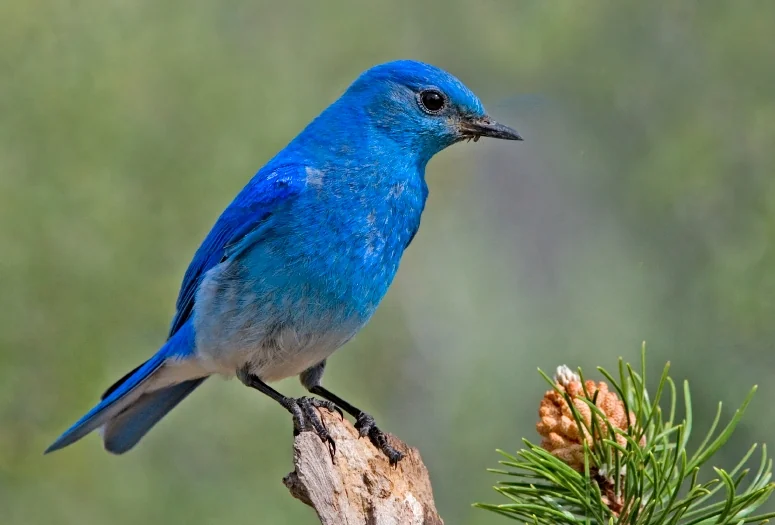 Featured photomountain-bluebird.jpg
Sialia currucoides, the mountain bluebird, is a small thrush of the family Turdidae, distributed across the western mountain ranges of North America. Adults are 16 to 20 cm long with a wingspan of 28 to 36 cm and weigh 24 to 37 g. Adult males are brilliant sky-blue throughout the body, head, and tail; females are pale buff-grey with bluer wings and tail. The IUCN lists the species as Least Concern. The mountain bluebird is the all-blue counterpart of the eastern and western bluebirds and is the state bird of Nevada and Idaho.
Quick facts
- Habitat
- Open and semi-open country at montane elevations — mountain meadows, sagebrush steppe, alpine grasslands, and aspen-edge habitats. The species favours high-elevation open habitat with scattered cavity-bearing trees for nesting.
- Range
- Western North America from Alaska south through the Rocky Mountains, Sierra Nevada, and Cascades to northern Mexico. Northern populations migrate; central and southern populations are largely resident year-round.
- Size
- 16–20 cm body · 28–36 cm wingspan · 24–37 g
- Plumage
- Adult males show brilliant sky-blue throughout the body, head, wings, and tail — the bluest plumage of any North American thrush. Adult females are softer pale buff-grey on the head and breast with bluer-tinged wings and tail. Juveniles are heavily spotted brown — the spotted pattern is the ancestral thrush condition that adults outgrow. The blue colour is structural, produced by feather microstructure scattering light.
- Song
- A soft, mellow, warbling phrase delivered from an exposed perch — gentler and more peaceful than most thrush songs. The species' song is sometimes described as the most melodious of the three North American Sialia bluebirds.
- Migration
- Partial migrant. Northern populations move south for winter; central and southern populations are largely resident. Some altitudinal movements occur as birds move down from high-elevation summer habitat to lower-elevation winter sites.
- Conservation
- Least Concern (LC)
Overview
Sialia currucoides is one of three Sialia bluebirds in North America (with the eastern bluebird S. sialis and the western bluebird S. mexicana). The species is the only Sialia with all-blue male plumage — eastern and western bluebirds carry chestnut breasts. The mountain bluebird is the state bird of both Nevada and Idaho. The species was named for its high-elevation habitat preference, which separates it ecologically from the lower-elevation eastern and western bluebirds.
Distribution
The breeding range covers the western mountain ranges of North America from Alaska to northern Mexico. The species favours high-elevation open habitat — mountain meadows, sagebrush steppe, alpine grasslands — with scattered cavity-bearing trees for nesting. The breeding range overlaps with the western bluebird at lower elevations, where the two species partition habitat by elevation and openness.
Hover foraging
Mountain bluebirds forage by hover-and-pounce — the bird hovers briefly above open ground, scanning for movement, then drops to seize the prey item. The technique is unusual among thrushes (the related eastern and western bluebirds typically forage by drop-and-pounce from a perch) and gives the species a distinctive feeding behaviour visible from a distance. Insects taken include grasshoppers, beetles, and caterpillars on open mountain meadows.
Sources & further reading (2)
- iucn-red-list — accessed 2026-04-30
- encyclopedia — accessed 2026-04-30
Frequently asked questions
How is mountain bluebird different from western bluebird?
The mountain bluebird's male plumage is brilliant sky-blue throughout — body, head, breast, belly. The western bluebird male has a similar sky-blue head and back but a chestnut breast and white belly. Mountain bluebirds also occupy higher-elevation habitat (mountain meadows, sagebrush steppe) than the western bluebird (lower-elevation oak woodland). Where ranges overlap, the elevation and habitat differences keep the two species ecologically separated.
Why does the mountain bluebird's blue look different in different light?
The blue colour is structural, not pigmentary — produced by light scattering in feather microstructure rather than by pigment. The wavelengths reflected to the eye depend on the angle of incoming light and the angle of viewing, so the same male appears slightly different shades of blue from different angles. The same physics applies to most blue-coloured birds (jays, indigo bunting, peacock).
Why is the species called the 'mountain' bluebird?
The species occupies high-elevation open habitat across the western mountain ranges of North America — mountain meadows, sagebrush steppe, alpine grasslands. The 'mountain' name distinguishes it from the lower-elevation eastern and western bluebirds, both of which prefer oak-pine woodland habitats. The high-elevation niche is ecologically distinct enough that the three species rarely compete directly.