Puffinus puffinus
Manx Shearwater (Puffinus puffinus)
 Featured photomanx-shearwater.jpg
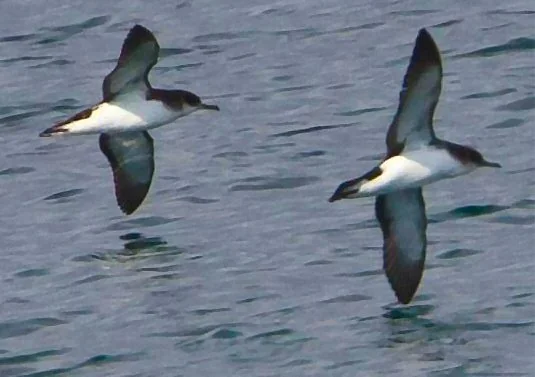
Puffinus puffinus, the Manx shearwater, is a medium-sized tubenose seabird of the family Procellariidae, distributed across the North Atlantic. Adults are 30 to 38 cm long with a wingspan of 76 to 89 cm and weigh 350 to 575 g. The plumage is sharply pied — glossy black above and pure white below — with the diagnostic shearwater wingtip-skimming flight low over the waves. The IUCN lists the species as Least Concern. Manx shearwaters have one of the longest documented lifespans of any wild bird, with multiple ringed individuals exceeding fifty years.
Quick facts
- Habitat
- Open North Atlantic during the non-breeding season; breeds in dense colonies on grassy offshore islands, with adults nesting in burrows excavated into the soil.
- Range
- Breeds on offshore islands of the British Isles, Iceland, the Faroe Islands, and parts of the Mediterranean and the eastern Atlantic. Skomer and Skokholm Islands off the Welsh coast hold the largest world populations. Wintering range covers the South Atlantic from southern Brazil to Argentina.
- Size
- 30–38 cm body · 76–89 cm wingspan · 350–575 g
- Plumage
- Adults show glossy black upperparts including the head, wings, and tail; pure white underparts from chin to undertail coverts; and a thin black bill. The flight pattern — alternating glides and short bursts of stiff wingbeats with the wingtips angled almost vertical, often skimming the wave surface — is the textbook shearwater flight and the source of the family's English name. Both sexes look alike.
- Song
- Mostly silent at sea. At breeding colonies, adults give a strange chorus of cackling, mewing, and crooning calls from inside burrows after dark — among the most unusual seabird-colony sound landscapes. Daytime visits to the colony are rare; the species is strictly nocturnal at the burrow.
- Migration
- Long-distance Trans-equatorial migrant. Breeds in the North Atlantic in summer; winters in the South Atlantic off the coast of Argentina and southern Brazil. The annual round-trip migration covers approximately 16,000 km.
- Conservation
- Least Concern (LC)
Overview
Puffinus puffinus is the type species of the genus Puffinus and the model species for many shearwater behavioural and physiological studies. The species' Latin name reflects an old confusion — early observers called the species 'puffin' before the name was permanently attached to the unrelated Atlantic puffin (Fratercula arctica). The 'Manx' part of the English name refers to the Isle of Man, where the species was historically abundant before introduced rats extirpated the population in the eighteenth century.
Long lifespan
Manx shearwaters have one of the longest documented lifespans of any wild bird. Skomer Island ringing records since the 1950s have produced multiple individuals exceeding fifty years of age — one famous individual ringed in 1957 was still breeding in 2008, an age of at least fifty-one. The species' slow reproductive rate (one chick every two years) and low adult mortality combine to produce the long lifespan. The shearwater's life-history pattern is broadly typical of long-lived seabirds.
Migration
Manx shearwaters undertake one of the most studied long-distance bird migrations. After breeding in the North Atlantic, adults migrate south to wintering grounds in the South Atlantic off Argentina and southern Brazil, an annual round-trip of approximately 16,000 km. Geolocator tracking has documented the route in detail since the 2000s. Juvenile birds make their first independent migration entirely without parental guidance — the chicks fledge in the breeding burrow weeks after their parents have already departed and find their way to the wintering grounds independently using innate cues.
Sources & further reading (2)
- iucn-red-list — accessed 2026-04-30
- encyclopedia — accessed 2026-04-30
Frequently asked questions
How long does a Manx shearwater live?
One of the longest documented lifespans of any wild bird. Multiple individually-ringed Manx shearwaters from the long-running Skomer Island study have exceeded fifty years of age, with one famous bird (ringed in 1957, still breeding in 2008) reaching at least fifty-one years. The species' slow reproductive rate (one chick every two years) and low adult mortality combine to support the unusually long life expectancy.
Why are Manx shearwaters silent during the day at colonies?
The species is strictly nocturnal at the breeding burrow — adults visit only at night to avoid predators. Daytime visits are extremely rare. After dark, the colony erupts in a chorus of cackling, mewing, and crooning calls from inside the burrows; the call exchange allows mates and chicks to find each other in the dense underground colony. The pattern is shared with several other Procellariidae species.
How do juvenile Manx shearwaters navigate to South America?
Juveniles make their first independent migration entirely without parental guidance. Adult shearwaters depart the breeding colony weeks before the chicks fledge; the young birds eventually leave the burrow on their own, fly to the open ocean, and navigate to the South Atlantic wintering grounds using innate cues. The behaviour is one of the best-documented examples of innate long-distance navigation in seabirds and has been studied in detail through geolocator tracking.