Aix galericulata
Mandarin Duck (Aix galericulata)
 Featured photomandarin-duck.jpg
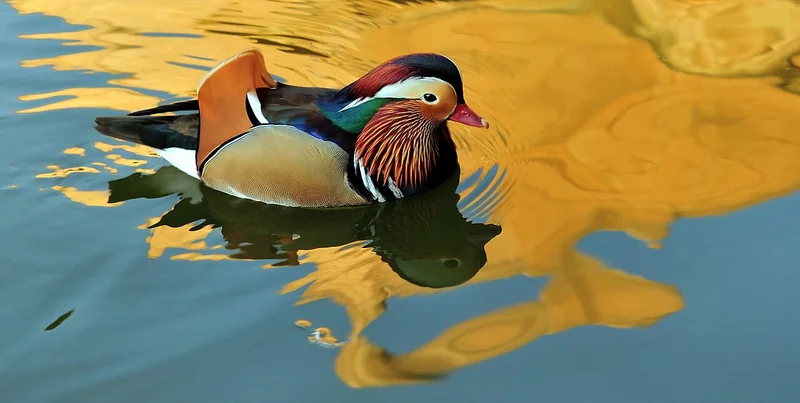
Aix galericulata, the mandarin duck, is a medium-sized perching duck native to East Asia. Adults are 41 to 49 cm long with a wingspan of 65 to 75 cm and weigh 444 to 550 g. Adult males in breeding plumage show an extraordinary mix of orange 'sail' feathers raised on the back, purple breast, white-and-orange head, and intricate body patterning. Females are far subtler — soft grey-brown with a white eye-ring. The IUCN lists the species as Least Concern, and feral populations are established in Britain and parts of central Europe.
Quick facts
- Habitat
- Wooded ponds, slow rivers, and shaded forest pools. Strongly tied to forested wetlands, the species rarely occurs in open water away from tree cover.
- Range
- Native to eastern Russia, Korea, eastern China, and Japan. Introduced and naturalized in Britain (where the population numbers in the thousands) and parts of central Europe (Netherlands, Germany). The native East Asian population is much larger than any introduced population.
- Size
- 41–49 cm body · 65–75 cm wingspan · 444–550 g
- Plumage
- Adult males in breeding plumage show a complex pattern: orange 'sail' feathers (modified tertials) raised vertically along the back; purple breast bordered by white-and-black bars; chestnut whisker-like cheek feathers; multicolored crested head with white-and-orange stripes; and warm cream flanks. Females are uniformly soft grey-brown with white spots on the breast and flanks and a fine white eye-ring extending back as a thin line.
- Song
- Males give a soft whistle, females a sharp 'aack' alarm call. The species is generally quiet compared with most dabbling ducks; vocalizations rarely carry far.
- Migration
- Partial migrant. Northern East Asian populations move south for winter; southern populations and the British/European introduced populations are largely resident.
- Conservation
- Least Concern (LC)
Overview
Aix galericulata is the East Asian member of the small Aix perching-duck genus (with the American wood duck A. sponsa as sister). The two species are remarkably similar in ecology — both are tree-cavity nesters in wooded wetlands — but the male plumages are dramatically different, with the mandarin's orange 'sail' feathers being unique among ducks. The species figures heavily in Chinese, Korean, and Japanese folk culture as a symbol of marital fidelity.
Distribution
The native range covers eastern Russia, Korea, eastern China, and Japan. The species declined sharply across the native range through the twentieth century — habitat loss from logging and wetland drainage, plus localized hunting — and remains uncommon in much of the historical range. Introduced populations in Britain (descended from ornamental escapes since the 1930s) now number in the thousands and are larger than several native populations within China.
Cultural symbolism
Mandarin ducks have figured in East Asian art and folklore for over two thousand years. Pairs are typically depicted side by side as a symbol of marital fidelity and conjugal happiness — the species pairs in autumn, displays vividly during winter, and the plumage of the two sexes is famously contrasting. The ornithological reality is more complex (mandarin pair-bonds are typically seasonal, not lifelong), but the cultural symbolism has persisted unchanged across multiple millennia.
Sources & further reading (2)
- iucn-red-list — accessed 2026-04-29
- encyclopedia — accessed 2026-04-29
Frequently asked questions
What are the orange 'sail' feathers on the male's back?
The two orange flag-like feathers raised vertically on the male mandarin's back are heavily modified tertial feathers, unique among ducks. The 'sails' are raised in courtship display and lowered against the body when the male is at rest. The trait is sexually selected — females consistently prefer males with brighter, more symmetrical sails — and has no flight or thermoregulatory function.
Why is the mandarin duck a symbol of marital fidelity?
East Asian art and folklore depict mandarin pairs as the textbook image of marital harmony, often shown side by side in paintings, embroidery, and porcelain. The cultural association traces to over two thousand years of Chinese and later Korean and Japanese tradition. The biological reality is somewhat different — mandarin pair-bonds are typically seasonal, not lifelong — but the symbolic association has persisted unchanged across multiple cultures and millennia.
Are mandarin ducks really wild in Britain?
Yes. Britain hosts a feral population descended from ornamental escapes since the 1930s. The current British population numbers several thousand individuals — larger than several native populations in China — and is self-sustaining without continued releases. Smaller introduced populations exist in the Netherlands, Germany, and a few other parts of central Europe. The British population is now considered an established naturalized species.